
Entrepreneur Universe Bright Group Develops Hong Kong Fintech Amid China Regulatory and Customer Risks
EUBG progresses fintech operations after acquiring a Hong Kong lender while managing revenue concentration and cross-border regulatory challenges with strong cash reserves.
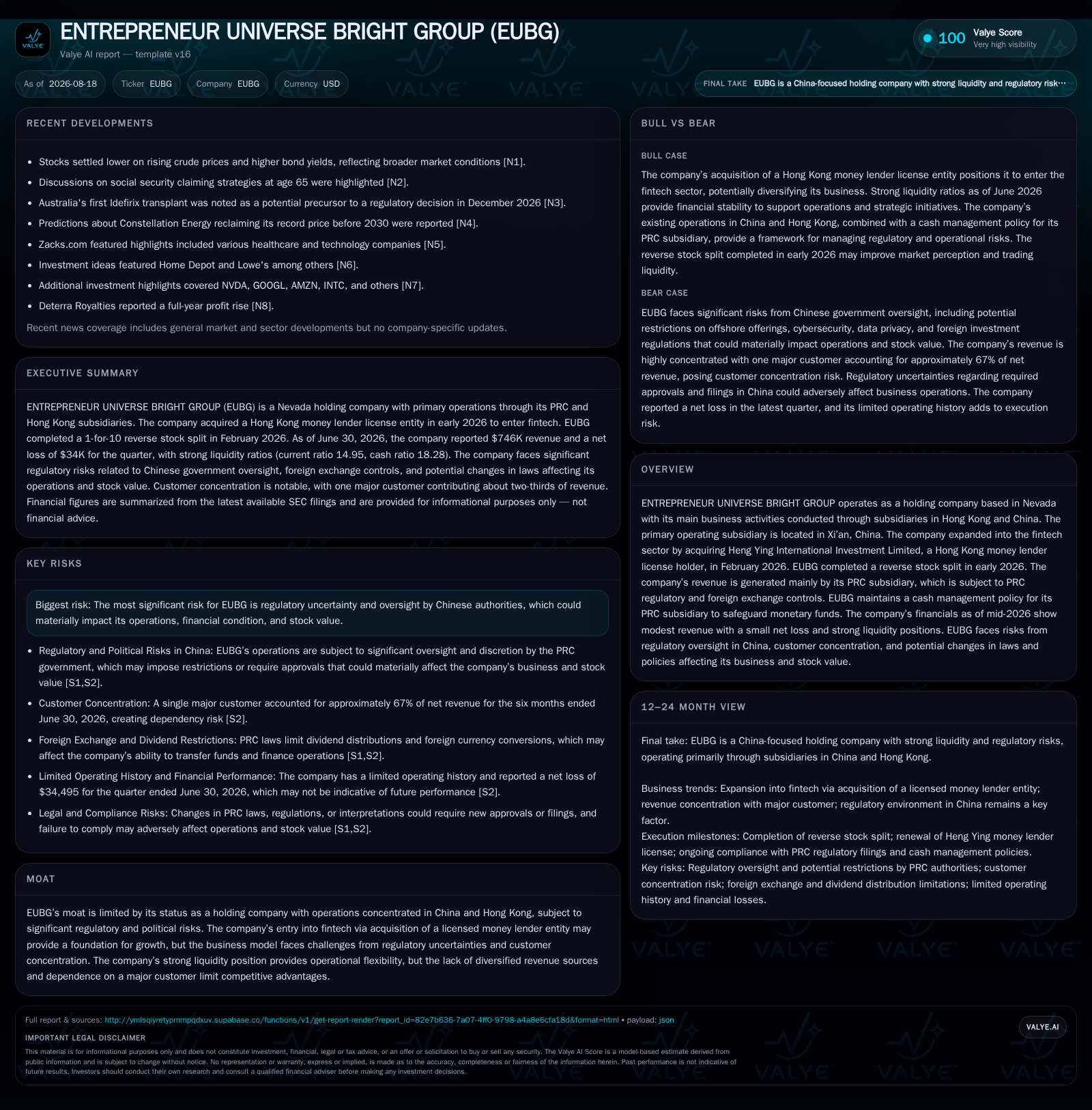
Entrepreneur Universe Bright Group, a Nevada holding company with primary operations in China and Hong Kong, reported continued development of its fintech subsidiary after acquiring a licensed money lender in Hong Kong in early 2026. The company’s revenue remains concentrated in its PRC digital marketing consulting subsidiary, which serves predominantly private companies via an e-commerce platform. Regulatory oversight from Chinese authorities and foreign exchange controls present ongoing operational constraints. While liquidity remains strong with a near $10.7 million cash balance as of mid-2026, EUBG’s growth is constrained by customer concentration risks and the uncertain regulatory landscape surrounding overseas-listed Chinese firms. The reverse stock split earlier this year seeks to improve capital market perception, but long-term viability hinges on successful diversification and regulatory compliance.
Recent Operating Update
ENTREPRENEUR UNIVERSE BRIGHT GROUP (EUBG) filed its latest Form 10-Q on August 13, 2026, providing an updated snapshot of its financial condition and operational progress through mid-2026 [S2]. The most material near-term change has been the acquisition on February 10, 2026, of Heng Ying International Investment Limited, a Hong Kong entity holding a money lender license essential for the company’s planned entry into fintech lending [S1][S5]. Following the routine renewal of this license in June 2026, EUBG began activating this business line gradually [S21]. This move diversifies EUBG’s traditional digital marketing consulting activities largely performed by its PRC subsidiary based in Xi’an.
Operational performance during H1 2026 showed a net income of only $43,384 compared with $606,337 for the same period last year—reflecting startup costs for the fintech segment alongside modest scale [S18]. Cash balances remain robust at approximately $10.7 million as of June 30, reflecting prudent cash management and limited liabilities [F1][S20]. Importantly, EUBG maintains a comprehensive Monetary and Cash Fund Management System to navigate stringent PRC currency controls and cross-border restrictions [S6][S11]. These policies are critical given that the company’s operating subsidiaries hold most cash within China and Hong Kong jurisdictions where government oversight can delay or limit capital movement.
In December 2025, EUBG enacted a reverse stock split at a ratio of 1-for-10 shares to consolidate equity units without altering par value or authorized share count [S5]. This was aimed at improving market metrics such as share price stability rather than capital structure.
Business Model Details
EUBG operates principally as a holding company incorporated in Nevada but without substantive operations outside its subsidiaries in Hong Kong and China [S9]. Its main revenue generator is Xi’an Yunchuang Space Information Technology Co., Ltd., a wholly-owned PRC subsidiary specializing in digital marketing consulting services tailored primarily toward startups and small-to-medium enterprises (SMEs) seeking to optimize e-commerce strategies [S1][S4][S9]. This consulting arm relies heavily on an e-commerce platform ‘‘Chuangyetianxia’’ developed by an affiliated company Xi’an CNT that connects sellers with buyers including wholesale suppliers and end customers [S1][S19].
Revenue from these consulting engagements is largely fee-based for marketing planning, customer acquisition strategy implementation, and facilitating brand-building efforts through online channels [S21]. The monetization revolves around service fees tied to client engagements. At the same time, Heng Ying operates under a licensed money lender model permitting secured and unsecured lending across personal and business loans within Hong Kong’s financial regulatory framework. This provides additional interest income streams once fully operational
EUBG’s layered holding structure—with the PRC subsidiary wholly owned by the HK entity which is itself wholly owned by EUBG—introduces complexity around intercompany cash flows that must comply with both country-specific foreign exchange regulations and anti-money laundering standards [S14][S25]. Dividend payments up the chain require meeting stringent compliance steps to avoid government restrictions or penalties
Industry Structure & Competitive Position
EUBG straddles the intersection of financial services holding companies active in fintech lending and digital marketing consulting geared toward ecommerce SMEs—a niche blending regulated finance products with technology-enabled marketing advisory services. The core geographic footprint covers Mainland China’s domestic market through Xi’an operations combined with Hong Kong-based licensed lending activity.
Within fintech lending in Hong Kong/China, EUBG faces competition from established licensed money lenders such as China Rapid Finance (though primarily consumer-focused) as well as diversified fintech platforms like Lufax integrating loan products with e-commerce ecosystems. Digital marketing consulting rivals include both large traditional firms like Accenture Interactive targeting SME tech adoption as well as local boutique agencies offering bespoke e-commerce solutions.
Competitive advantages hinge on regulatory compliance finesse within complex jurisdictions (China/Hong Kong), ability to cross-leverage licensing assets like money lender licenses for new fintech products paired with client acquisition expertise anchored by e-commerce channel integration. However, customer concentration risk is acute; over 60% of EUBG's revenue stems from one major client Zhongchuang Boli Technology Holdings Co., Ltd., exposing it to downside if that relationship weakens or terminates [S13][S19]. Given limited operating history amid rapid sector regulation changes since Covid-era reforms tightening Chinese oversight on overseas-listed firms, resilience depends on regulatory navigation agility.
Growth Drivers
Key drivers include expansion of Heng Ying’s lending portfolio following its license renewal realized in H1 2026. As management develops business plans incorporating secured/unsecured personal/business loans tailored for SMEs engaged on marketplaces connected via their digital marketing consulting platform, incremental revenue streams are expected to build from interest margins generated by credit products [S21]. Effective capitalization supported by strong liquidity (over $10 million cash) enables measured scaling without immediate capital constraints [F1].
Another vector is leveraging Xi’an Yunchuang’s existing client base among startups requiring deeper digital marketing penetration amid rising adoption of ecommerce sales channels accelerated during post-pandemic recovery [S1][S13]. Rising demand among SMEs for integrated consulting plus technical platform solutions offers potential volume growth if retention strengthens beyond current major-customer dependence
Renewed strategic focus on cross-border ecommerce also aligns with increasing regional trade flows needing professionalized marketing partnerships between sellers/buyers using digital tools—a natural extension for EUBG’s consultancy services supporting product branding and sales generation.
Risks & Growth Constraints
The dominant risk arises from regulatory uncertainty governing foreign listings by Chinese companies coupled with tightened capital control enforcement by PRC authorities potentially limiting dividend repatriation or inter-subsidiary fund transfers [S2][S11][S15]. Increased cybersecurity review requirements impose monitoring overheads that could divert resources and delay business execution.
Customer concentration poses revenue volatility risk; losing the principal client contributing over half revenue would materially damage top-line stability absent replacement clients or diversified service offerings [S13][S19]. New fintech operations remain nascent with no material revenues yet disclosed specifically attributable to Heng Ying beyond planned launches post-license renewal; delays here could impair projected growth trajectories [S21].
Operationally managing cross-jurisdiction compliance spanning China mainland digital services regulations along with HK money lender licensing requirements entails execution complexity further compounded by evolving international tensions affecting investor sentiment toward China-based tech-financial hybrids.
Financial constraints include modest overall profitability drop witnessed during Q2 H1 FY26 reflecting costs incurred developing fintech infrastructure coupled with uncertain scalability timeline for fresh lending ventures that may require ongoing capital infusion until breakeven points are reached [S18]
What to Watch Next
Critical upcoming demand markers include visible ramp-up in revenue streams attributable to Heng Ying’s lending operations following its June license renewal clearance—the speed at which loan origination volume adheres to planned projections will be informative.
Management’s ability to diversify revenue beyond key existing large customers will be evident through client win announcements or disclosed expanding engagement breadth which would mitigate concentration risk.
Further regulatory filings or statements clarifying compliance progress under Mainland China cybersecurity review frameworks or CSRC offshore listing trial measures will provide insight into potential restrictions impacting future access to U.S./international capital markets [S2][S4]
Share price reaction post-reverse stock split will indicate investor appetite; however sustained improvement depends heavily on stable earnings results coupled with clarity around growth execution plans especially from new fintech activities.
Financial Profile Discussion
As of June 30, 2026, EUBG reported cash and equivalents totaling approximately $10.7 million against current liabilities under $760 thousand yielding an impressive current ratio near 15x—a strong liquidity buffer that supports short-term operational needs comfortably [F1]. Total debt data is dated end-2020 at approximately $3 million but net debt is negative approximating minus $7.6 million indicating ample net cash resources available should capital needs arise.
Despite healthy liquidity positioning boosted by sound monetary fund safeguarding policies at the subsidiary level (PRC subsidiary formally adopted written cash management system since September 2021), profitability pressures surfaced during H1 FY26 where net income dwindled below $50 thousand driven mainly by expenses related to fintech expansion investment alongside flat revenues compared with prior periods [F1][S18]
The absence of dividend declarations since September 2024 special one-time payment signals retained earnings being funneled into growth initiatives rather than shareholder returns currently [S17]
This analysis synthesizes publicly available SEC filings up to August 13, 2026. It does not constitute investment advice but aims to provide detailed contextual understanding based on verified disclosures combined with sector knowledge relevant for stakeholders assessing ENTREPRENEUR UNIVERSE BRIGHT GROUP's strategic positioning amidst complex regulatory landscapes and emerging fintech integration challenges.
Disclaimer: This is research-only, informational analysis and not investment advice. It may include AI-generated interpretation and general industry context. Always verify important details using primary sources.

Comments