
Legence Corp. Expands Backlog Amid Sector Cyclicality and Fixed-Price Contract Risks
Legence’s integrated MEP services grow backlog with focus on data centers and life sciences, while managing margin pressure and impairment impacts.
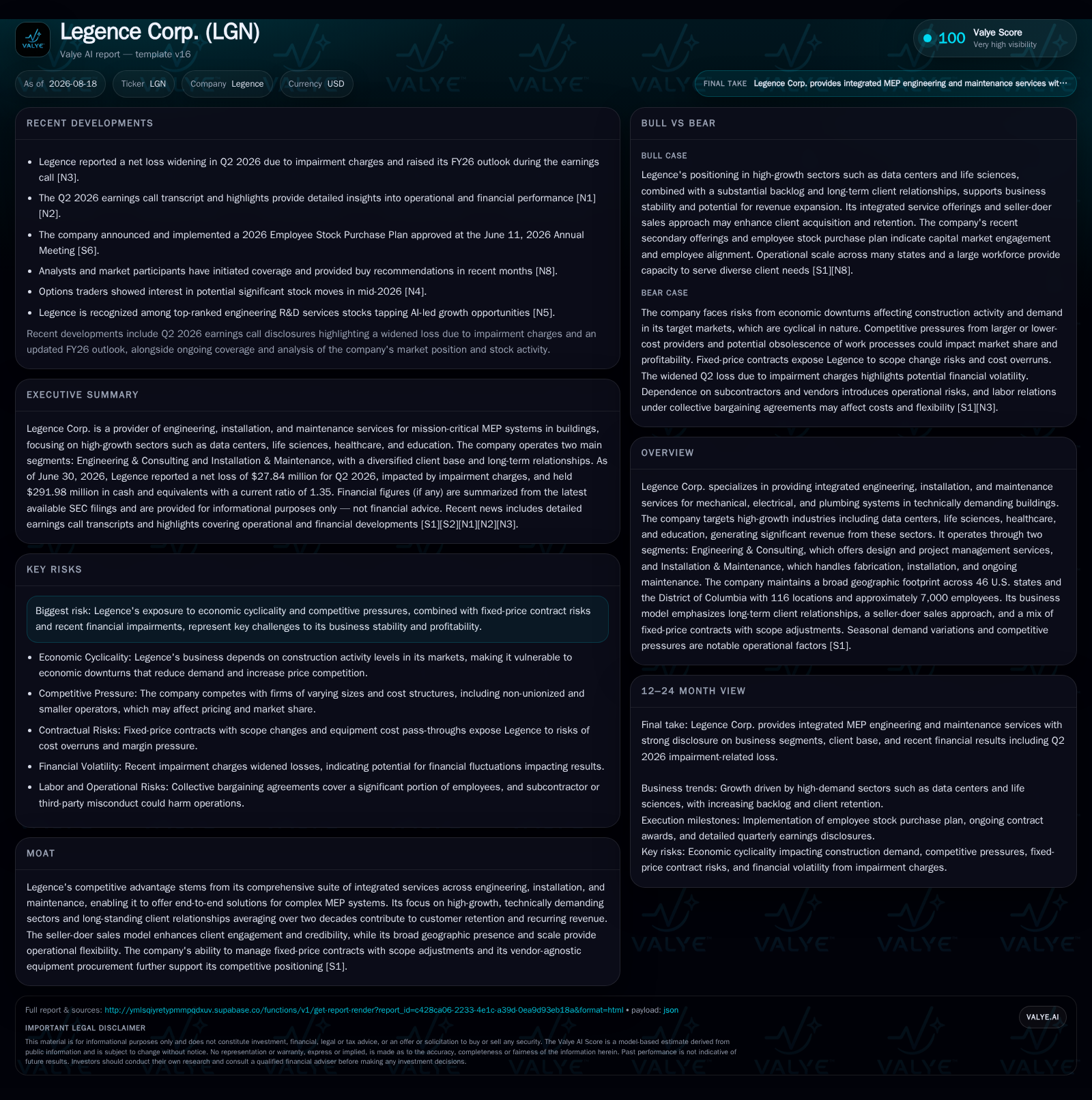
In its latest quarter ending June 2026, Legence Corp. reported continued growth in backlog, driven by robust demand from data centers and life sciences sectors, confirming the durability of its focus on high-growth, technically demanding building markets. The company’s business model integrates engineering, installation, and maintenance of complex mechanical, electrical, and plumbing systems (MEP) through fixed-price contracts and recurring maintenance agreements, leveraging a seller-doer sales approach to deepen customer relationships. Despite revenue expansion, profitability faced headwinds due to impairment charges reflecting execution risks inherent in fixed-price contracting amid cyclical market pressures. Legence’s extensive U.S. geographic footprint and long-term client relationships support operational flexibility but also expose it to economic cyclicality and competitive intensity.
Recent Operating Update
The operational tempo remains supported by a diverse client base spanning approximately 20,000 customers since 2019, with projects largely completed within nine-month cycles excluding multi-year maintenance agreements [S1]. The August 2026 earnings call highlighted that while top-line demand remains robust across key verticals, margin compression is a near-term concern driven by rising input costs and execution challenges linked to their fixed-price contractual models [N1][N2].
Business Model: Integrated Engineering-to-Maintenance Value Chain
Legence generates revenue through two primary segments: Engineering & Consulting offers design, energy consulting, and project management services; Installation & Maintenance encompasses fabrication, HVAC/plumbing system installation, and ongoing maintenance contracts [S1]. This end-to-end integration differentiates Legence by enabling streamlined project delivery for technically demanding buildings — notably those requiring complex HVAC systems, process piping networks, advanced lighting controls, and plumbing infrastructure.
Revenue mechanics rely heavily on fixed-price contracts supplemented with negotiated scope adjustments to address on-site changes. About 60% of revenue comes from retrofits or upgrades targeting existing buildings versus approximately 40% from new construction projects [S1], emphasizing the importance of recurring service lines for revenue stability. Maintenance contracts extend duration beyond typical build phases, contributing to visibility on future cash flows.
The seller-doer sales model empowers field engineers involved in technical delivery to cultivate client relationships directly. This practice tends to improve project win rates due to enhanced credibility with owners or general contractors when bidding on complex MEP scopes. Procurement is vendor-agnostic, allowing equipment sourcing flexibility tuned to project economics.
Industry Structure and Competitive Position
Legence operates within the broader building mechanical, electrical, and plumbing (MEP) services industry characterized by national firms providing large-scale engineering consulting (e.g., Stantec Inc., WSP Global) alongside regional/local contractors specializing in installation or maintenance (e.g., Comfort Systems USA). Competition hinges on technical competence for critical infrastructures including data centers—which require ultra-reliable HVAC/process piping—as well as precision labs in life sciences facilities.
Its scale — roughly 7,000 employees across 116 U.S. locations — provides operational leverage over smaller players who may lack geographic reach or integrated service capability. The broad footprint enables responsiveness to multi-site clients while spreading regulatory compliance risks across jurisdictions.
Despite these advantages, Legence faces competition risks from companies with lower cost structures or non-unionized workforces capable of aggressive pricing strategies. Additionally, internal pressures surface around maintaining sufficient technician utilization rates during market slowdowns.
Growth Drivers
Legence’s growth trajectory is anchored in several structural demand drivers: expanding data center infrastructure fueled by cloud computing needs; escalating investments in life sciences R&D facilities; rising energy efficiency mandates promoting HVAC system upgrades; retrofit activity amid aging commercial building stock; complexity growth in building automation solutions; public sector educational facility spending; and renewal/expansion of long-term maintenance agreements.
Backlog growth serves as an early indicator aligning with these sectoral dynamics. Sustained contractor win rates supported by the seller-doer approach underpin expansion into new geographies.
Risks and Growth Constraints
The fundamental risk facing Legence is macroeconomic cyclicality affecting construction capital spending patterns — pronounced given the predominance of fixed-price contracts which can amplify exposure to cost overruns or scope creep if project inputs rise unexpectedly. Such mismatches led to realized impairments reported recently which pressured operating margins [N4][S2].
Competitive intensity includes not only national firms but nimble smaller contractors undercutting prices via leaner cost bases or non-union labor pools. This scenario may force price concessions harmful to profitability.
Other constraints encompass supply chain volatility disrupting timely equipment availability; labor shortages inflating technician wages; credit risk from subcontractors leading to potential collection issues; regulatory variance increasing compliance costs; and technological changes obligating faster service innovation.
What To Watch Next
Critical near-term milestones include updates on backlog replenishment reflecting sustained health from data center builds or healthcare expansions; shifts in project cycle times signaling operational efficiency improvements; margin trajectory post-impairment reflecting contract management success; utilization rates among engineers/technicians indicating workforce productivity; progress on negotiated scope adjustments balancing fixed pricing realities; renewal rates on multi-year maintenance contracts illustrating recurring revenue stability; competitive positioning metrics such as project win rates; plus any guidance refinement emanating from upcoming quarterly disclosures [S2][N1][N2]
Monitoring these factors will clarify whether recent impairments are isolated phenomena or symptomatic of deeper margin pressure requiring strategic recalibration.
Financial Profile Discussion
As of June 30, 2026, Legence held $292 million in cash & equivalents against current liabilities of approximately $1.22 billion resulting in a current ratio of about 1.35 — indicative of adequate short-term liquidity [F1]. The company carried estimated total debt near $825 million as of December 31, 2025, with net debt around $533 million after accounting for cash balances [F1].
Prudent capital management will be essential given the sizeable leverage profile combined with cyclical revenue flows inherent in construction-related contracting businesses. Sustained cash flow generation supported by backlog conversion will be pivotal in maintaining balance sheet health during market fluctuations.
Disclaimer: This analysis is based solely on publicly available information including SEC filings dated through August 13, 2026 ([S1], [S2], [S3]) supplemented by recent news releases ([N1], [N2], [N4]). It does not constitute investment advice or an endorsement of Legence Corp.’s securities. Readers should conduct independent due diligence before making financial decisions.
Disclaimer: This is research-only, informational analysis and not investment advice. It may include AI-generated interpretation and general industry context. Always verify important details using primary sources.

Comments