
Cal Redwood Acquisition’s Strategic Pursuit of TMT Targets Validates Its SPAC Positioning
Cal Redwood Acquisition Corp. maintains strong liquidity and leverages its management’s TMT expertise as it advances its de-SPAC transaction with Carvix, Inc.
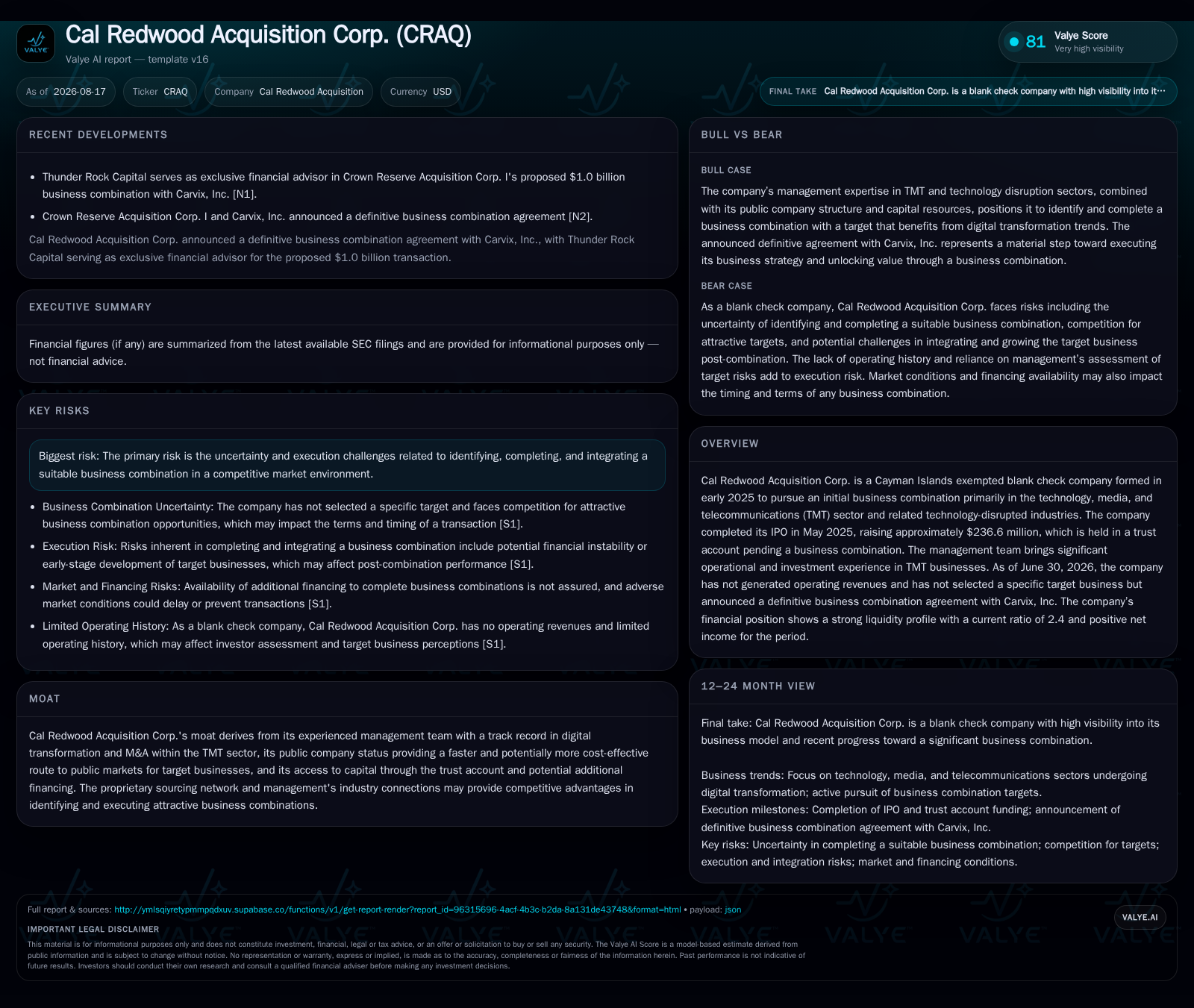
Cal Redwood Acquisition Corp. is a Cayman Islands-based blank check company focused on acquiring technology, media, and telecommunications (TMT) businesses. Following its May 2025 IPO that raised $236.6 million held in trust, the SPAC announced a definitive merger agreement with Carvix, Inc. as of mid-2026. The company’s August 2026 quarterly filing highlights a stable financial position characterized by a current ratio of 2.4, no material litigation, and income derived mainly from trust account earnings. Success hinges on completing its business combination amid typical SPAC execution risks including shareholder redemption dynamics and market conditions affecting deal economics.
Latest Quarterly Filing: Securing Position Ahead of Business Combination
Cal Redwood Acquisition Corp.’s August 2026 10-Q confirms its status firmly within the pre-business combination phase typical for Special Purpose Acquisition Companies (SPACs). The filing reveals no material change in risk factors compared to prior reports ([S5]). Notably, the company's liquidity remains healthy with cash and equivalents at $821 thousand as of June 30, 2026, supported by total current assets of approximately $956 thousand against current liabilities near $398 thousand, producing a current ratio of about 2.4 ([F1]). This liquidity profile ensures operational runway for due diligence and negotiation activities while maintaining compliance cost coverage.
No operating revenues were recorded during this period owing to the SPAC’s blank check status. Net income is primarily derived from interest generated on the sizeable trust account where IPO proceeds are held—a standard SPAC mechanism minimizing risk exposure to capital until deal closure ([S1],[F1]). The company also reports no material litigation proceedings ([S5]), underscoring a clean legal footing desirable before large-scale deal announcements.
Blank Check Model Anchored in Experienced Management Team Focused on TMT Sector
Incorporated in Cayman Islands on January 7, 2025, Cal Redwood Acquisition Corp was formed specifically as an exempted blank check entity to execute a business combination primarily involving technology, media, and telecommunications (TMT) companies or other sectors undergoing technology disruption ([S1]). This sector focus aligns with the management team's background—executives experienced in identifying and scaling high-growth digital ventures through transformational strategies. Such specialization is critical given TMT's complex ecosystem and rapid innovation cycles where technical insight facilitates superior target identification and value creation post-merger.
From its IPO on May 27, 2025—which raised approximately $236.6 million after including private placements—the funds were placed under trustee management in money-market or short-duration U.S. government securities ([S1]). The SPAC’s unit structure comprises Class A ordinary shares bundled with rights exercisable upon business combination completion to dilute equity accordingly. This setup effectively locks up investor capital pending de-SPAC while providing limited operational expenditure scope beyond compliance and transaction pursuit costs.
Sector Dynamics: Capital Efficiency, Redemption Rights, and Market Conditions for SPACs Targeting Technology Disruption
The broader SPAC environment deeply influences Cal Redwood’s path forward. The gross IPO proceeds were subject to over $14 million in underwriting fees and other offering expenses ([S1]), consistent with industry norms yet diminishing net proceeds destined for acquisition funding.
As Cal Redwood targets technology disruptors within TMT spaces—areas favored by investors seeking alternative routes to public markets—it competes alongside numerous Nasdaq-listed peers who also leverage experienced sponsors familiar with sector nuances. Typical redemption ranges vary widely; thus managing shareholder sentiment through transparent disclosures and strategic communications will influence ultimate capital retention.
PIPE (private investment in public equity) financing remains an established fallback to augment transaction funding if shareholder redemptions dilute original capital pools significantly. While Cal Redwood has not publicly confirmed PIPE involvement for this transaction at this stage, such financing mechanisms are industry-standard tools supporting successful deal closes amid volatile market conditions.
Growth Catalyst: Business Combination Prospects with Carvix, Inc.
A notable milestone arrived with Cal Redwood entering into a definitive merger agreement with Carvix, Inc., signifying concrete progress toward completing its initial business combination ([S2]). Although specific target operational details or valuation metrics are absent—a cautious approach respecting regulatory boundaries—the choice of Carvix aligns with the declared strategy focusing on TMT or adjacent sectors experiencing technology-driven transformation.
Successfully executing this de-SPAC transaction would transition Cal Redwood from a shell entity into an operating public company poised to generate revenue streams through Carvix’s business operations. It would unlock value creation potential predicated on management’s ability to integrate acquired assets effectively and capitalize on growth vectors intrinsic to disruptive technology enterprises.
Watchpoints: Deal Execution Risks and Shareholder Redemption Impact on Capital Structure
Despite firm progress, Cal Redwood faces customary risks that challenge every SPAC endeavor ([S1],[S5]). Chief among these is adherence to stipulated timelines for closing an initial business combination—typically two years from IPO—with failure resulting in mandatory liquidation or extension votes requiring shareholder approval.
Redemption risk looms large because significant shareholder exercising of redemption rights reduces funds in trust available for synergy realization post-merger or necessitates additional financing rounds potentially dilutive to existing holders. Regulatory scrutiny surrounding disclosures and conflict-of-interest matters also demands meticulous compliance vigilance.
Integration risks add complexity following deal consummation; successfully merging distinctive corporate cultures and operational models will test management execution capabilities under public market pressures familiar to seasoned industry competitors.
What to Monitor Next: Deal Milestones, Redemption Rates, and Regulatory Environment Updates
Key upcoming indicators include finalizing shareholder voting outcomes on the proposed merger agreement with Carvix and observing actual redemption patterns relative to anticipated thresholds influencing cash availability ([S2],[S5]). Market reception reflected through share price movements pre- and post-approval vote can materially affect the broader funding environment.
Regulatory developments impacting SPAC governance or disclosure requirements should remain under close review given evolving SEC stances post recent boom-and-correction cycles in the SPAC space. Announcements regarding PIPE investor commitments—if pursued—will afford deeper clarity into transaction funding robustness.
Financial Position Commentary: Trust Account Strength Underpins Execution Confidence
As revealed by the latest quarter-end data ([F1]), Cal Redwood's financial foundation continues to exemplify typical SPAC balance sheet characteristics prior to de-SPAC completion: cash & equivalents totaling around $821k outside the trust account support ongoing operational needs without stress; meanwhile total debt remains minimal.
The $236.6 million initially raised languishes predominantly in trust investments secured via short-maturity U.S. Treasury instruments providing minimal risk exposure and reliable interest income streams contributing positively to net income figures despite absence of operating revenues so far ([S1],[F1]). Transaction costs tied to underwriting fees are recognized upfront but do not impair core liquidity crucial for execution capacity.
This financial positioning affords Cal Redwood flexibility absent near-term refinancing pressures commonly observed in leveraged corporate contexts—an advantageous platform ensuring management can navigate remaining transactional stages while mitigating solvency concerns intrinsic to blank check vehicles.
Cal Redwood Acquisition Corp.'s progression exemplifies disciplined capital stewardship combined with sector-specialized strategic vision characteristic of contemporary TMT-focused SPACs. Its credible management bench amplifies sourcing effectiveness within technology-disrupted industries where identify-to-acquire cycles demand operational expertise beyond pure capital allocation prowess.
Investors monitoring Cal Redwood should prioritize developments around redemption outcomes post-vote execution, PIPE financing announcements if any emerge, updated regulatory guidelines applicable broadly across SPAC frameworks, and progress milestones related to integrating Carvix post-business combination closure.
This analysis is based solely on disclosed SEC filings as of August 17, 2026, without speculation beyond verified statements.
Disclaimer: This is research-only, informational analysis and not investment advice. It may include AI-generated interpretation and general industry context. Always verify important details using primary sources.

Comments