
Green Circle Decarbonize Technology Advances PCM Thermal Storage Amid Capital Restructuring
Recent quarter highlights strategic share restructuring and ongoing focus on proprietary PCM-based HVAC decarbonization solutions.
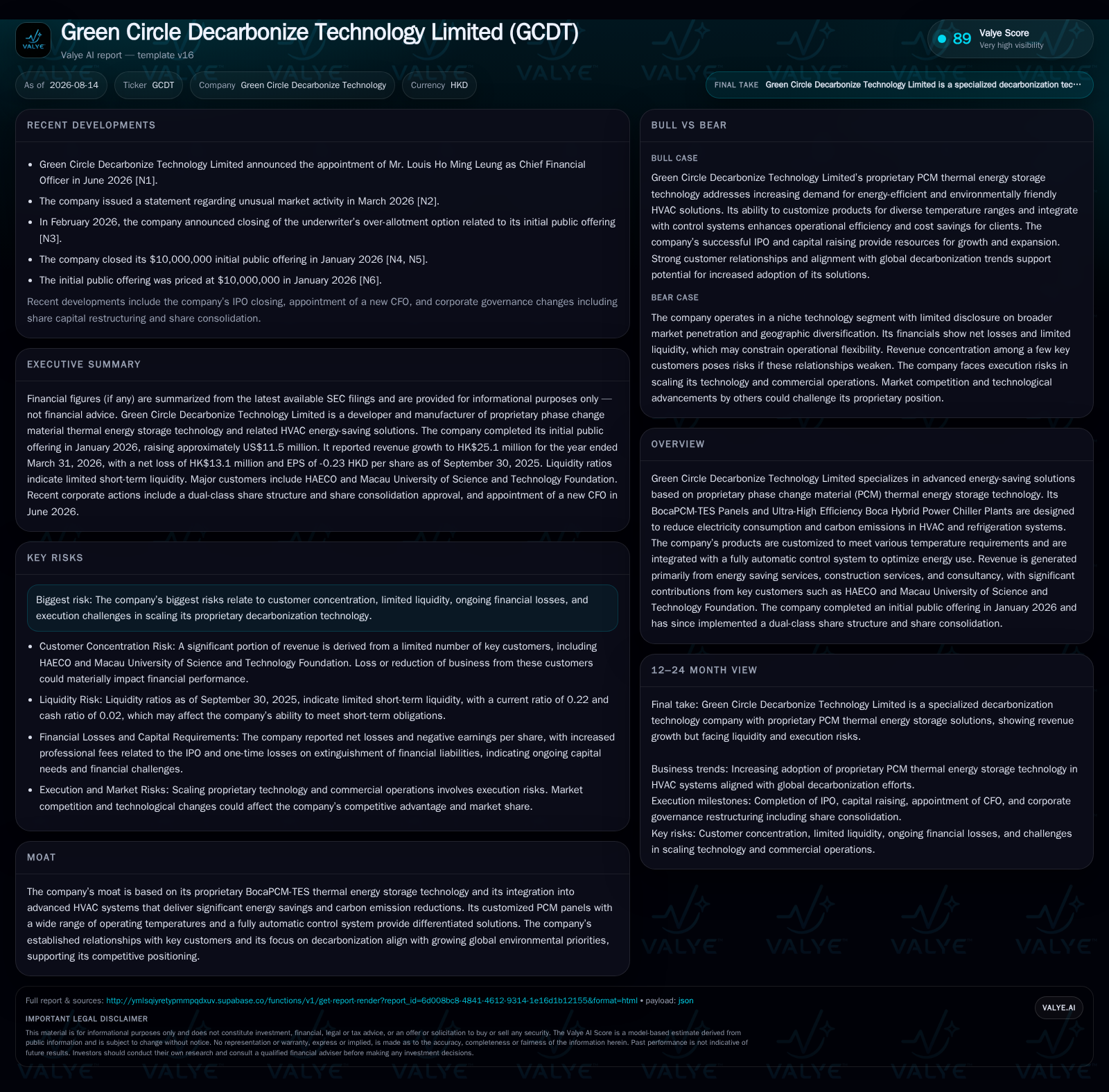
Green Circle Decarbonize Technology Limited (GCDT) is solidifying its position in the clean energy thermal storage industry through its proprietary BocaPCM-TES technology integrated into advanced HVAC systems. The company’s August 2026 quarterly filings reveal a significant capital structure overhaul with the creation of dual-class shares aimed at governance optimization following its January 2026 IPO. While revenue growth is evident, GCDT continues to face financial challenges including customer concentration and liquidity constraints typical of emerging tech providers. Its differentiated phase change material panels and automated control systems underpin noteworthy energy savings for key clients like HAECO and Macau University. Scaling the customized thermal storage solutions and managing capital intensity will be critical to long-term viability.
Recent Operating Update
Green Circle Decarbonize Technology Limited held an extraordinary general meeting in August 2026 where shareholders overwhelmingly approved a substantial increase in authorized share capital—from US$50,000 to US$5 million—and the establishment of a dual-class share structure comprising Class A ordinary shares with one vote per share and Class B ordinary shares with fifty votes per share [S2]. This governance restructuring followed the company's January 2026 initial public offering (IPO) which raised approximately US$11.5 million gross proceeds [S6][S8]. The reclassification, share buybacks, and issuance of Class B shares are strategic moves aimed at consolidating control among key insiders while broadening capital-raising flexibility.
Meanwhile, operational updates affirm ongoing commercialization of their proprietary phase change material (PCM) based thermal energy storage (TES) technology optimized for HVAC decarbonization. The flagship product line includes customized BocaPCM-TES Panels encapsulating more than twenty PCM variants with unique phase change temperatures spanning -86°C to +600°C [S1]. These panels are assembled into integrated Ultra-High Efficiency Boca Hybrid Power Chiller Plants that utilize fully automatic control systems enabling real-time electricity demand peak management by shifting loads from peak to off-peak periods—a critical method for reducing energy costs under variable tariff regimes [S1][S6].
Business Model Specifics
GCDT's revenue model is multifaceted, deriving income from energy-saving service contracts, product sales including PCM panel manufacturing and installation, construction services related to mechanical ventilation and air conditioning (MVAC), as well as consultancy engagements focused on energy efficiency improvements [S13]. Major customers entail sophisticated end-users such as Hong Kong Aircraft Engineering Company Limited (HAECO) and Macau University of Science and Technology Foundation—primarily generating revenue through long-term projects involving deployment of their chiller plants and BocaPCM-TES Systems on large commercial sites like airports and university hospitals [S13][S16].
The monetization mechanics hinge on customized thermal panel fabrication tailored to client temperature specifications alongside integrated system architecture featuring proprietary automation software. Economically, this allows clients to capitalize on latent heat storage benefits—storing excess cooling capacity during off-peak hours and deploying it on-demand—thus lowering overall electricity consumption by approximately 40% during operations compared to conventional HVAC systems, supported by empirical data from installed sites such as HAECO’s headquarters [S1][S6]. These efficiency gains translate into roughly 50%-70% reductions in running costs depending on localized tariff structures.
Margins are influenced heavily by project mix between high-margin design/consulting services versus relatively more capital-intensive product sales requiring scale production capabilities. The company also emphasizes reducing carbon emissions directly through lowered electricity usage, aligning its value proposition with global ESG mandates which bolster buyer willingness for upfront investments despite integration complexity.
Industry Structure and Competitive Position
Operating within clean energy thermal storage and HVAC decarbonization, GCDT inhabits a niche combining advanced material science innovation with system-level integration. The broader market has players such as CALMAC and Ice Energy focusing predominantly on PCM material technologies or ice-based thermal storage products; Trane and Carrier dominate large-scale HVAC manufacturing but without similarly integrated bespoke PCM innovations; while Siemens and Johnson Controls lead in building automation but typically complement rather than develop core TES materials.
Green Circle differentiates itself by owning proprietary BocapCMS-TES material formulations coupled tightly with a fully automated control system that enables dynamic peak load shifting—not merely passive storage. This dual advantage positions them strategically but also subjects them to challenges related to scaling custom manufacturing processes.
Notable peers tend to either emphasize volume manufacturing of standard components or software-driven energy management solutions rather than vertically integrated PCM-TES production combined with tailor-made plant deployments found at GCDT.
Growth Drivers
Tailwinds for GCDT stem from intensifying regulatory pressures requiring carbon emissions reductions alongside rapidly rising electricity costs that incentivize investments in energy efficiency technologies. Corporate sustainability agendas heighten demand for retrofit or new-build installations of advanced HVAC systems featuring latent heat TES solutions.
Advancements in phase change materials offer expanding operational temperature ranges enabling applicability across diverse industrial sectors beyond traditional commercial buildings—including pharmaceutical logistics (ultra-low temperature transport boxes) confirmed in recent development agreements highlighted by the company [S14]. Further growth derives from scaling their automatic control capabilities leveraging machine learning potentials noted by management aiming at self-learning optimization models over time [S14]. Government subsidies targeting clean-tech adoption also remain meaningful demand enablers.
Risks and Watchpoints
Despite promising technology, Green Circle faces several headwinds common among emerging cleantech providers. Customer concentration stands out starkly: HAECO alone contributed nearly 48% of revenues with Macau University accounting for about 47% in fiscal 2026—heightening risk case if either relationship weakens or project timelines delay [S16]. Diversification beyond these flagship customers remains an imperative yet challenging task given bespoke engineering requirements.
Technology execution remains complex: manufacturing high-performance PCMs at scale requires rigorous quality control; integrating these panels into reliable hybrid chiller plants involves precise engineering; the automation controls must adeptly balance multiple environmental variables—all dependencies that could impair rollout speed or inflate costs if unsettled.
Market adoption risk factors include upfront project costs deterring price-sensitive prospects plus competition from incumbents offering less capital-intensive but lower benefit alternatives. Despite top-line expansion, the company recorded a net loss rising to HK$13.1 million attributable largely to one-time equity-settled debt extinguishments coupled with increased professional fees—pointing toward substantial non-recurring expenses during transition year post-IPO [S15][S5]
New financing arrangements executed July 2026 involving $10 million promissory notes paired with warrants aim at reinforcing liquidity but simultaneously introduce dilution considerations linked to warrant exercises [S9]
Disclaimer: This is research-only, informational analysis and not investment advice. It may include AI-generated interpretation and general industry context. Always verify important details using primary sources.

Comments