
Calidi Biotherapeutics Faces Going Concern Pressure Amid Progress in Oncolytic Virotherapy Pipeline
Clinical-stage Calidi advances proprietary cancer immunotherapy assets while managing cash constraints and regulatory milestones.
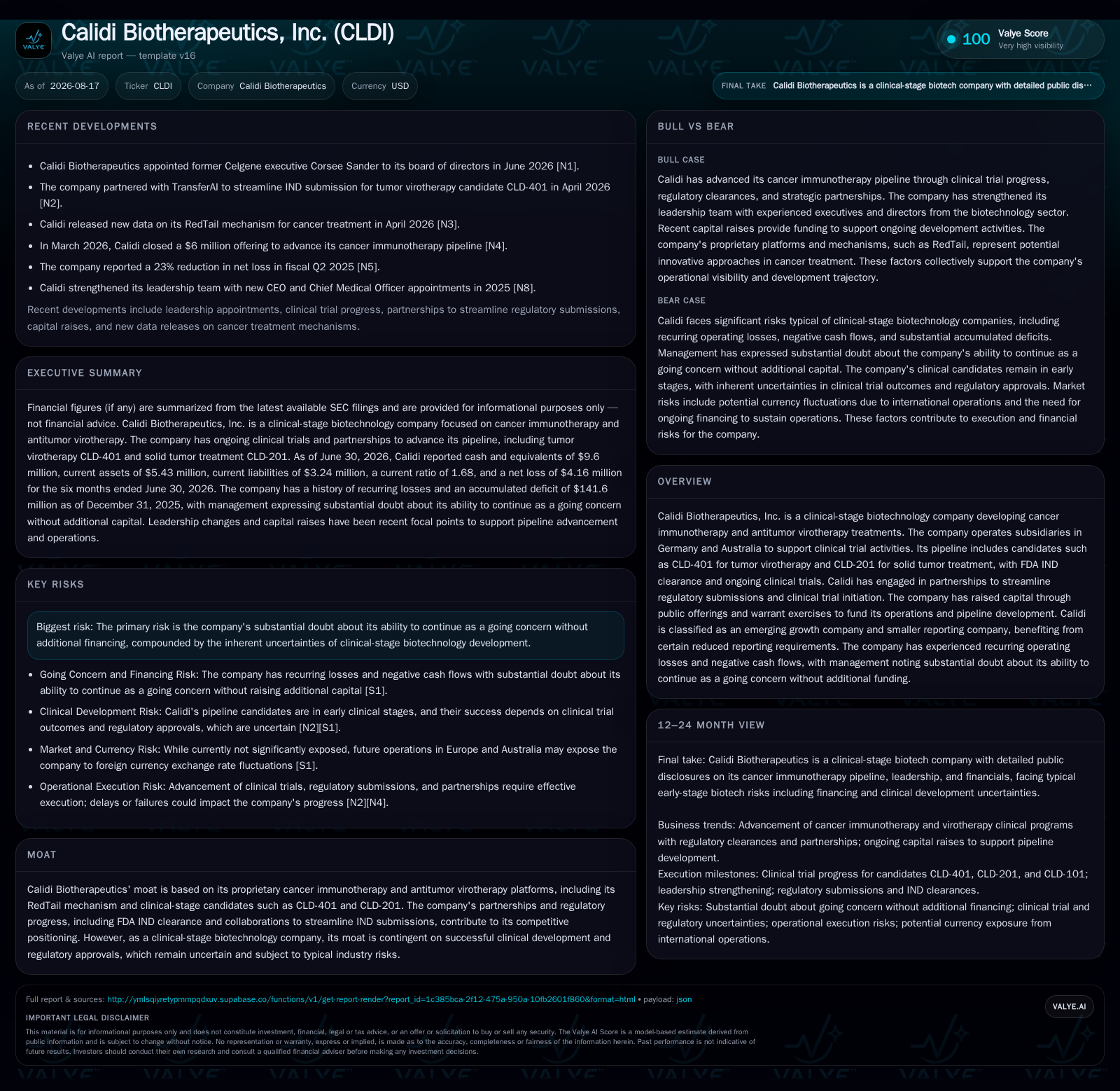
Calidi Biotherapeutics, a clinical-stage biotech focused on oncolytic virus therapies for metastatic cancers, reported sustained operating losses and ongoing capital raises in its latest quarterly filing. The company has advanced key pipeline candidates including CLD-401 and CLD-201 with FDA IND clearances and international clinical operations supporting trials. Despite promising proprietary RedTail platform technology geared toward systemic delivery of virotherapy, substantial doubt remains about Calidi’s ability to continue as a going concern without raising additional capital. Growth depends on execution of clinical milestones, partnering efforts, and regulatory clearances in a competitive immuno-oncology landscape.
Recent Operating Update
In its latest quarterly Form 10-Q filed August 13, 2026, Calidi Biotherapeutics reported no material changes in risk factors but reaffirmed recurring operating losses typical of clinical-stage biotechs [S2]. The company simultaneously issued an 8-K detailing second quarter financial results ended June 30, 2026 alongside corporate developments such as capital transactions [S3]. While specifics of the quarter’s financials were not elaborated in detail in the excerpts provided, combined disclosures indicate persistent cash burn driven by R&D activities supporting its oncology pipeline.
Calidi continues to operate subsidiaries StemVac GmbH in Germany and Calidi Biotherapeutics Australia Pty Ltd to facilitate clinical trial conduct across multiple regulatory jurisdictions [S1]. Maintaining these international presences is critical given the challenges of enrolling patients into advanced cancer immunotherapy and virotherapy trials where geographic diversity can accelerate recruitment and regulatory feedback loops.
Business Model Analysis
Calidi Biotherapeutics derives from a merger resulting in a Delaware-incorporated entity focused on developing targeted therapies employing genetic medicine delivered via an engineered oncolytic virus platform called RedTail [S1]. This enveloped virus technology intends to evade the patient’s immune system upon systemic administration—addressing one of the most significant challenges faced by virotherapy—to efficiently target metastatic tumors and deliver cytotoxic or immunostimulatory payloads.
The company’s value proposition centers on this proprietary platform's capability to treat metastatic solid tumors systemically rather than locally. The pipeline features candidates like CLD-401 aimed at tumor virotherapy and CLD-201 targeting solid tumors more broadly; both have received FDA IND clearance allowing initiation or continuation of clinical trials [S1].
Revenue generation strategies remain in line with industry norms for clinical-stage biotech companies lacking commercial products. These include upfront license fees upon collaboration or partnering agreements, milestone payments linked to specific development or regulatory achievements, funding under research agreements with third parties or government bodies, eventual product sales if approved, and royalty income thereafter [S1]. To date, no commercial revenues have been realized given that candidate therapies are still navigating early-mid stage development hurdles.
Given the capital-intensive nature of biotechnology R&D—especially for complex modalities like oncolytic viruses—Calidi has engaged actively in equity offerings including at-the-market offerings and registered direct placements to bolster capital resources [S14]. Such efforts supplement cash reserves needed for trial expenditures but simultaneously introduce dilution risks common to biotechs pre-revenue.
Industry Structure and Competitive Position
Calidi operates within the broader oncology-focused segment of the biotechnology industry emphasizing immunotherapy and virotherapy innovations. This niche is characterized by intense competition from both established pharmaceutical companies developing approved checkpoint inhibitors or cell therapies like CAR-Ts — e.g., Bristol Myers Squibb’s Opdivo — as well as emerging biotechs specializing in novel platforms such as BioNTech’s mRNA approaches or Oncorus’ oncolytic viruses.
The distinguishing feature of Calidi lies in its RedTail platform—an enveloped oncolytic virus engineered for systemic delivery—which seeks to overcome typical immune neutralization faced by similar viral therapies administered intravenously. This technological differentiation potentially provides a competitive moat but remains unproven until successful late-stage clinical outcomes demonstrate efficacy and safety superior or additive to other immunotherapies.
Strategic international subsidiaries enable operational footprint expansion crucial for multi-center clinical trial activities—a necessity given the increasingly globalized nature of pivotal studies required for oncology drug approval [S1]. However, these also expose Calidi to foreign currency volatility and geopolitical risks inherent in cross-border operations [S1].
Peers encompass early-stage biotech firms developing novel cancer immune modulators with comparable cash burn profiles but variable pipeline richness. Capital efficiency relative to peers will depend heavily on speed of IND-to-clinic transitions for CLD series candidates and ability to secure partnership/licensing arrangements that provide non-dilutive funding buffers.
Growth Drivers
Clinical development progress stands as the foremost growth catalyst. Successful advancement of CLD-401 and CLD-201 through phased trials directly influences valuation inflection points via achievement of data readouts sufficient to trigger milestone payments or licensing discussions. Patient enrollment rates across trial sites leveraged through subsidiaries will materially affect timelines.
Regulatory submissions beyond initial IND clearances—including Investigational New Drug amendments or eventual New Drug Application (NDA)/Biologics License Application (BLA) filings—will signal maturation along commercialization pathways.
Capital raising activities underpin operational longevity enabling uninterrupted R&D expenditure; completing planned public offerings or warrant inducements extends runway mitigating near-term going concern risks [S3].
Partnerships both reduce technical risk via shared expertise/access to complementary assets and alleviate financial burden through milestone-triggered revenues [S1]. Calidi’s established collaborative efforts highlight an attempt to leverage such strategic alliances proactively
Additionally, advances within the RedTail platform enhancing systemic delivery efficiency or payload versatility could incrementally widen therapeutic applicability across cancer types.
Risks and Constraints
A dominant risk factor is explicit management acknowledgment of ‘‘substantial doubt’’ regarding their ability to continue as a going concern absent additional capital infusion within twelve months [S5]. High cash burn rates intrinsic to biotech R&D impose stringent financing discipline; failure or delay of capital raises could force operational cutbacks or restructuring.
Clinical trial failures or delays represent typical but existential risks; single failed pivotal studies can abolish product viability irreversibly.
Regulatory hurdles encompassing slow approval cycles or requests for supplementary data inflate development timelines and costs.
Intellectual property challenges remain a constant threat — competitors filing overlapping patents could erode freedom-to-operate around RedTail-derived assets.
Manufacturing scale-up complexities for enveloped oncolytic viruses may constrain supply chain responsiveness affecting timely study completion or future commercialization.
Dilution risk arises from frequent equity offerings necessary to sustain development expenditures prior to revenue realization.
International subsidiaries broaden operational scope yet add layers of foreign exchange risk and exposure to regulatory differences among jurisdictions.
Finally, competition from alternative immunotherapies may limit market penetration prospects notwithstanding successful approval outcomes.
What To Watch Next
Key upcoming catalysts include clinical data releases from ongoing trials of lead candidates CLD-401 and CLD-201; positive signals here will validate platform claims supporting further development investment.
Management guidance or disclosures regarding upcoming regulatory submission milestones (e.g., IND amendments or phase transitions) will clarify progress pacing.
Announcements about new licensing agreements or expanded collaboration frameworks will illustrate de-risking success through partnership leverage.
Monitoring subsequent capital raise announcements will provide insight into funding runway stability vis-à-vis near-term operational needs.
Operational KPIs such as patient enrollment rates via Germany/Australia subsidiaries will indicate trial feasibility under pandemic/post-pandemic environment uncertainties.
Any adjustment in going concern disclaimers reflecting improved liquidity conditions would mark pivotal credit profile enhancement.
Financial Profile Discussion
As of June 30, 2026, Calidi reported $5.43 million in current assets against $3.24 million current liabilities for a current ratio of approximately 1.68 — indicative of moderate short-term liquidity cushion [F1]. Total debt stood at $645 thousand with net debt (debt minus cash) implying negative net debt positioning due mainly to prior accumulated cash balances around $9.6 million as last reported December 31, 2024 [F1].
Operating losses persist unabated given no commercial revenues yet were recorded with an operating loss approximately $20.24 million ending December 31, 2025 [F1]. Cash flow statements similarly reflect high R&D-driven cash consumption consistent with peer clinical-stage biotech profiles [S22].
Recent capital raising initiatives documented include public offerings closing gross proceeds near $7.5 million late 2024 through mid-2025 plus various warrant exercises contributing several million dollars more [S14], underscoring reliance on equity markets for working capital support.
This financial picture aligns with typical emerging growth company status retaining exemptions from extended SAAS compliance burdens but flagging the need for continuous external funding access [S1]. Prudence dictates close monitoring of quarterly cash burn against fresh financing inputs.
This analysis synthesizes recent SEC disclosures anchoring the assessment in verifiable business developments without extrapolating speculative forecasts. Given Calidi's early-stage pipeline status compounded by explicit going concern concerns absent refinancing clarity, fundamental uncertainty persists pending clinical proof-points and capital adequacy resolutions which are critical next-period indicators driving longer-term viability prospects.
Disclaimer: This is research-only, informational analysis and not investment advice. It may include AI-generated interpretation and general industry context. Always verify important details using primary sources.

Comments