
MapLight Therapeutics Advances CNS Pipeline Amid Phase 2 Trial Setbacks and Strong Funding
A clinical-stage biotech developing circuit-specific CNS pharmacotherapies reports mixed Phase 2 results and secures $150 million private placement to fuel pipeline progression.
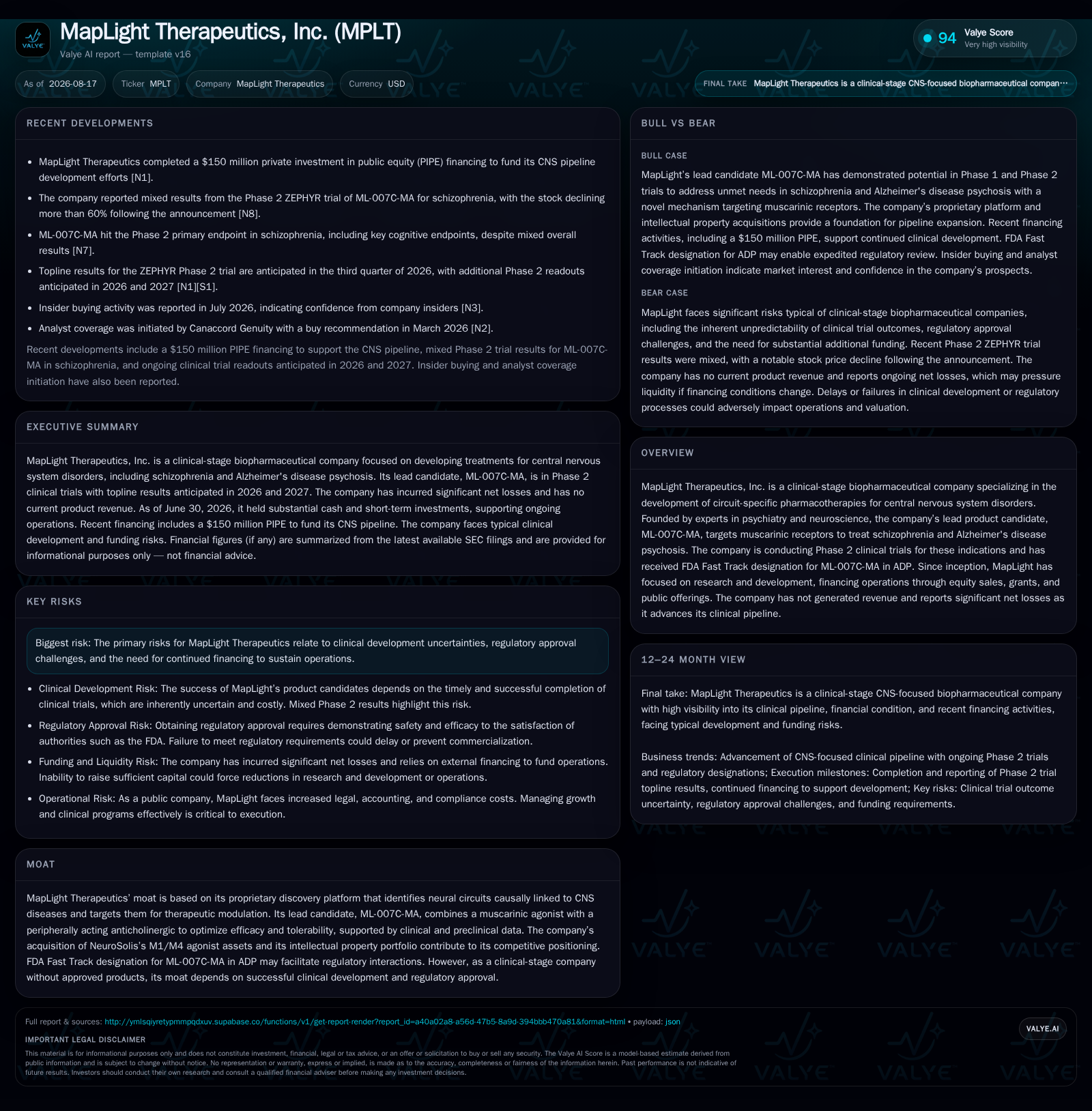
MapLight Therapeutics’ recent Phase 2 trial of ML-007C-MA in schizophrenia yielded mixed outcomes, achieving key cognitive endpoints but missing some primary efficacy targets, triggering a sharp stock decline. The company strengthened its financial position with a $150 million private placement, extending its cash runway into late 2027. Leveraging a proprietary muscarinic receptor-targeting platform, MapLight focuses on neuropsychiatric disorders with unmet needs, including Alzheimer’s disease psychosis where it holds FDA Fast Track designation. Continued capital raising remains essential to fund costly clinical development and regulatory activities.
Recent Operating Update
In its latest quarterly filing dated August 13, 2026, MapLight Therapeutics reported mixed results from its Phase 2 ZEPHYR trial evaluating ML-007C-MA in schizophrenia. The compound achieved key cognitive endpoints—an uncommon success in this challenging therapeutic area—indicating potential efficacy on aspects of cognition often unaddressed by existing antipsychotics. However, the trial did not meet all primary efficacy endpoints comprehensively, which led to a greater than 60% decline in the company's share price shortly after disclosure [N2][N3]. This outcome highlights the complexity of translating cognitive improvements into broad clinical benefit within neuropsychiatric disorders.
Concurrently, MapLight closed a significant $150 million private investment in public equity (PIPE) financing that bolstered its cash reserves during ongoing high-cost clinical development activities [S2][S3][F1]. This financing complements proceeds raised during its October 2025 IPO and earlier funding rounds, extending operational runway into at least late 2027 under current spending plans
ML-007C-MA benefits from an FDA Fast Track designation for Alzheimer’s disease psychosis (ADP), potentially expediting regulatory review processes and enhancing investor confidence through accelerated development pathways [S1][S2].
Business Model Analysis
MapLight Therapeutics operates as a clinical-stage biotechnology firm focused on developing pharmacotherapies that precisely target muscarinic receptor subtypes M1 and M4 within neural circuits implicated in central nervous system (CNS) disorders such as schizophrenia and ADP. Its proprietary platform emphasizes circuit-specific modulation aimed at improving therapeutic efficacy while mitigating peripheral side effects commonly associated with muscarinic receptor targeting [S1].
Currently pre-revenue, MapLight generates value primarily through advancing its pipeline candidates across clinical phases toward regulatory approval [S1]. Monetization prospects depend on successful commercialization or strategic partnerships/licensing arrangements with larger pharmaceutical companies possessing established commercial infrastructure. Intellectual property rights acquired via asset purchases, notably from NeuroSolis, form a protective moat around its lead candidates and underlying technology
Expenses are predominantly research and development focused, including costs for multi-center Phase 2 trials and preclinical program advancement. Given the absence of product revenues, operating losses are expected to continue until successful product launches or licensing deals materialize.
Industry Structure and Competitive Position
Within the biotechnology sector specializing in CNS therapeutics, MapLight competes alongside other clinical-stage biotechs targeting muscarinic receptors or novel neuropsychiatric mechanisms. Its scientific differentiation lies in circuit-specific pharmacology combined with dual-action modulatory effects designed to enhance patient tolerability—a recognized challenge for this receptor class.
The FDA Fast Track designation for ML-007C-MA in ADP provides a competitive advantage by potentially reducing time-to-market risk relative to peers lacking such regulatory support; however, ultimate success depends heavily on forthcoming confirmatory phase 3 data.
The CNS drug development landscape is characterized by high attrition rates and protracted timelines compared to other therapeutic areas. Capital efficiency in progressing candidates through costly trials while managing scientific risk is critical for sustaining competitive positioning.
Growth Drivers
Key growth catalysts include:
- Clinical Trial Milestones: Positive data from ongoing Phase 2/3 studies validating efficacy and safety profiles will materially enhance valuation.
- Regulatory Progress: Leveraging Fast Track status may accelerate approval timelines.
- Pipeline Diversification: Expanding indication coverage beyond schizophrenia into ADP leverages core platform technology.
- Strategic Capital Raises: Recent $150 million PIPE financing supports sustained R&D investment without imminent dilution pressure.
- Intellectual Property Strength: Robust IP portfolio from acquisitions supports future licensing or partnership opportunities.
Measurable KPIs such as enrollment rates, milestone achievements triggering contingent payments under NeuroSolis license agreements, and timing of pivotal data releases will be critical progress markers.
Risks and Constraints
MapLight faces typical biotech risks including potential clinical trial failures or delays that could materially impact valuation. Regulatory uncertainties remain despite expedited pathways like Fast Track designation. The company’s dependence on ongoing capital raises introduces shareholder dilution risks amid significant cash burn driven by expensive CNS trials [S14]. Intellectual property litigation risks exist but have not surfaced recently.
Post-approval market adoption risks stem from competition with established branded therapies and emerging modalities addressing similar neuropsychiatric symptoms. Operational risk includes challenges in patient recruitment for complex CNS trials where comorbidities complicate endpoint interpretation.
Manufacturing scale-up risks currently pose limited concern given early-stage status but will require attention upon approaching commercialization phases.
What to Watch Next
Investors should monitor:
- Comprehensive ZEPHYR trial data presentations clarifying the implications of mixed Phase 2 outcomes on regulatory strategy [N2][N3].
- Updates on ADP-focused clinical programs benefiting from Fast Track status.
- Milestone attainment linked to NeuroSolis asset licenses impacting contingent payments or equity issuance [S1].
- Partnership or licensing announcements leveraging proprietary platform IP enhancing non-dilutive funding avenues.
- Quarterly financial disclosures tracking burn rate trends against extended cash runway post-financing [S2].
Enrollment velocity and interim safety analyses will provide early signals about trial feasibility under current protocols.
Financial Profile Discussion
As of June 30, 2026, MapLight held $71.6 million in cash and equivalents with total current assets approximating $319 million against current liabilities near $19.3 million—yielding a strong current ratio of approximately 16.5x that indicates solid short-term liquidity following recent financing activity [F1]
Operating losses remain substantial consistent with a pre-commercial biotech profile; net loss for the year ended December 31, 2025 was approximately $161 million driven primarily by clinical trial expenditures without offsetting revenues [F1][S1]
The company’s capital strategy relies heavily on equity financings supplemented by grants and licensing deals to fund its extensive R&D pipeline. Proceeds from the October 2025 IPO ($261.6 million net) combined with the August 2026 $150 million PIPE extend the cash runway into late 2027 based on current spending assumptions [S1][S2][S3][F1]
Given the volatile nature of biotech capital markets coupled with high expenditure requirements inherent to CNS drug development programs, maintaining flexible access to funding remains critical. Contingent milestone payments embedded within intellectual property agreements represent potential liabilities that could affect future expense profiles but are currently accounted conservatively pending milestone achievement confirmation.
This analysis integrates information from SEC filings through August 13, 2026 alongside corroborative market news releases as of mid-August 2026. It provides a buy-side perspective grounded strictly in disclosed company data contextualized within biotechnology sector dynamics focused on CNS therapeutic innovation.
Disclaimer: This is research-only, informational analysis and not investment advice. It may include AI-generated interpretation and general industry context. Always verify important details using primary sources.

Comments