
Taylor Devices Backlog Decline Highlights Near-Term Revenue Risk Amid Aerospace Concentration
A notable 37% backlog reduction in the March 2026 quarter signals diminished revenue visibility despite stable aerospace exposure and a strong liquidity position.
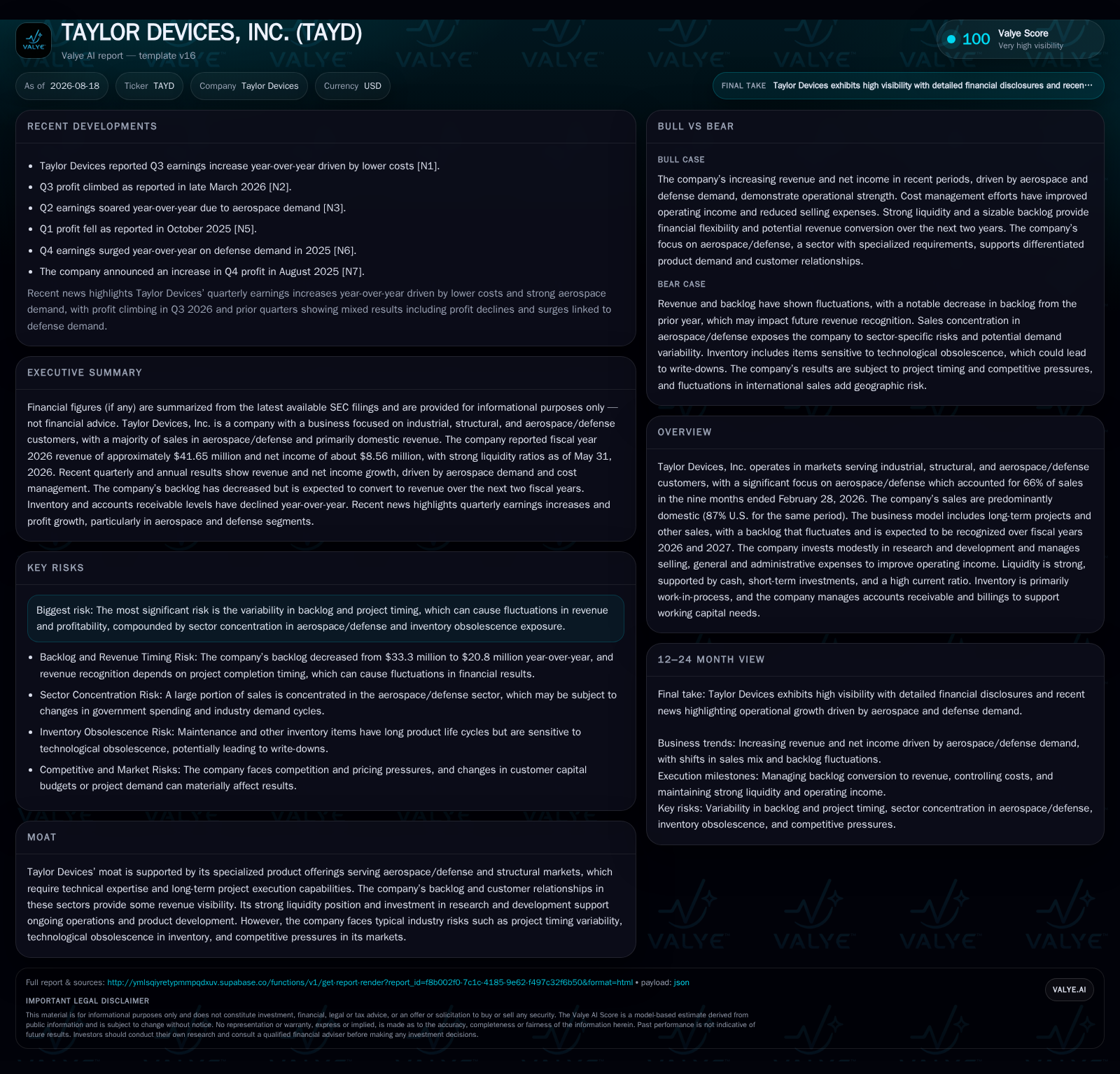
Taylor Devices reported a sharp decrease in its open order backlog, falling from $33.3 million to $20.8 million over the twelve months ending February 28, 2026, indicating reduced near-term revenue visibility across fiscal 2026 and 2027 [S2]. The company’s revenues remain heavily concentrated in aerospace and defense sectors, accounting for 66% of sales for the nine months ended February 28, 2026 [S1]. Operating under long-term contracts recognized via percentage-of-completion accounting, Taylor Devices’ revenue timing is closely linked to project execution and backlog dynamics [S2]. Working capital remains robust with a current ratio near 12.8 supported by solid cash balances and disciplined receivables management despite a moderate increase in days sales outstanding to 39 days [F1][S2]. With backlog normalization reflecting typical cyclicality, investors should monitor order intake trends, margin stability, and working capital efficiency as key indicators of demand durability and execution risk.
Significant Backlog Reduction Undermines Near-Term Revenue Visibility
The decline may reflect either slower new contract wins or accelerated completion of existing projects without immediate replenishment—both scenarios presenting challenges for sustaining recent growth momentum. Backlog size is a critical operating metric within industrial hardware manufacturing since it offers forward-looking visibility into revenue underpinned by enforceable contractual commitments.
While fluctuations in backlog are common due to cyclicality in aerospace/defense spending and capital project timing variability among prime contractors, the scale of this decline introduces caution regarding near-term demand durability.
Aerospace/Defense Market Concentration Drives Revenue Stability but Adds Cyclicality Risk
Approximately two-thirds (66%) of Taylor Devices’ sales for the nine months ended February 28, 2026 came from aerospace and defense customers concentrated in the U.S. market (87% domestic revenue) [S1]. This sector focus benefits from technical barriers to entry—such as precision engineering requirements and regulatory compliance—and longer-duration contracts often supported by government procurement cycles.
However, this concentration also exposes Taylor Devices to risks associated with fluctuating defense budgets and program scheduling shifts that can cause irregularities in order flow and project execution timing. The company's niche positioning aligns it closely with specialty mechanical device producers serving mission-critical aerospace applications.
Contractual Structure Ties Revenue Recognition Closely to Project Execution
Taylor Devices employs long-term fixed-price contracts often containing clauses limiting alternative uses for products sold. Revenues are recognized over time based on percentage-of-completion accounting where costs incurred relative to total estimated contract costs determine recognized income during each reporting period [S2]. Progress billings correspond with milestone payments or agreed schedules but can lag recognized revenues.
At February 28, 2026, the balance sheet showed costs and estimated earnings in excess of billings (CIEB) at approximately $5.68 million—a modest increase of about 6% compared with the prior year—reflecting typical project progression rather than billing acceleration [S2]. This dynamic underscores how working capital management must accommodate timing differences between revenue recognition and cash collections.
Working Capital Profile Reflects Operational Discipline Amid Moderate Receivables Aging
Taylor Devices maintains conservative working capital management as evidenced by a strong current ratio near 12.76 at May 31, 2026 supported by cash holdings just under $0.9 million alongside accounts receivable totaling about $4.86 million net of allowances for credit losses [F1][S2]. Days sales outstanding increased modestly from 32 days at May 31, 2025 to approximately 39 days at February 28, 2026 due primarily to collections against previously overdue structural project balances which have been significantly reduced [S2].
Inventory mainly consists of work-in-process tied directly to multi-period projects characteristic of industrial hardware manufacturing reliant on percentage-of-completion accounting rather than finished goods stockpiling. This inventory profile necessitates vigilance around technological obsolescence risk amid evolving product designs common in aerospace applications [S1].
Growth Drivers Supported by Defense Spending Trends and Incremental Innovation
Taylor Devices’ growth prospects hinge on sustained government defense budgets fueling ongoing procurement of highly engineered mechanical components alongside infrastructure-related structural engineering demand.[S1] While research and development expenditures remain modest relative to larger OEM competitors, they focus on incremental product improvements tailored to evolving aerospace technical standards.[S1]
Aftermarket service opportunities provide additional revenue diversification through maintenance contracts leveraging the installed base typical within this sector.
Risks Centered on Backlog Volatility, Market Concentration, and Execution Challenges
The company’s primary risk stems from volatility in backlog size driven by variable timing of project awards or completions that impact revenue consistency and margin realization.[S6] Aerospace/defense sector concentration amplifies exposure to government budget fluctuations cascading through subcontractor tiers like Taylor Devices.[S1][S6]
Additional risks include potential technological obsolescence affecting work-in-process inventory valuation,[S6] competitive pricing pressures limiting margin expansion,[S6] supply chain disruptions affecting timely project delivery,[S6] as well as occasional customer credit quality concerns evidenced by allowance adjustments against accounts receivable.[S2]
Financial Profile Discussion
Key Metrics To Watch: Order Intake Velocity And Margin Trajectory
Future performance will hinge on new order intake rates relative to shipment volumes as measured through book-to-bill ratios[S2], which will indicate whether backlog attrition represents temporary project wind-downs or sustained softening demand.
Backlog replenishment speed remains critical given historical multi-year revenue recognition patterns while margin trends will reveal cost control effectiveness amid input price inflation.
Receivables aging patterns combined with allowance adjustments will provide insight into customer credit health while R&D investment relative to revenues serves as a barometer for maintaining competitive differentiation.[S1][S2]
Investors should monitor these operating KPIs closely alongside quarterly disclosures to differentiate cyclical fluctuations from fundamental shifts impacting Taylor Devices’ standing within its specialized industrial hardware niche.
This analysis synthesizes public filings up through August 18, 2026 without expressing investment opinions but aims to clarify operational drivers shaping Taylor Devices’ near-term outlook within its industrial aerospace-focused context.
Disclaimer: This is research-only, informational analysis and not investment advice. It may include AI-generated interpretation and general industry context. Always verify important details using primary sources.

Comments