
VanEck Avalanche ETF Launches Staking Distributions Tracking AVAX Volatility
The VanEck Avalanche ETF's inaugural staking rewards distribution marks a new income stream amid ongoing AVAX price volatility and regulatory uncertainty.
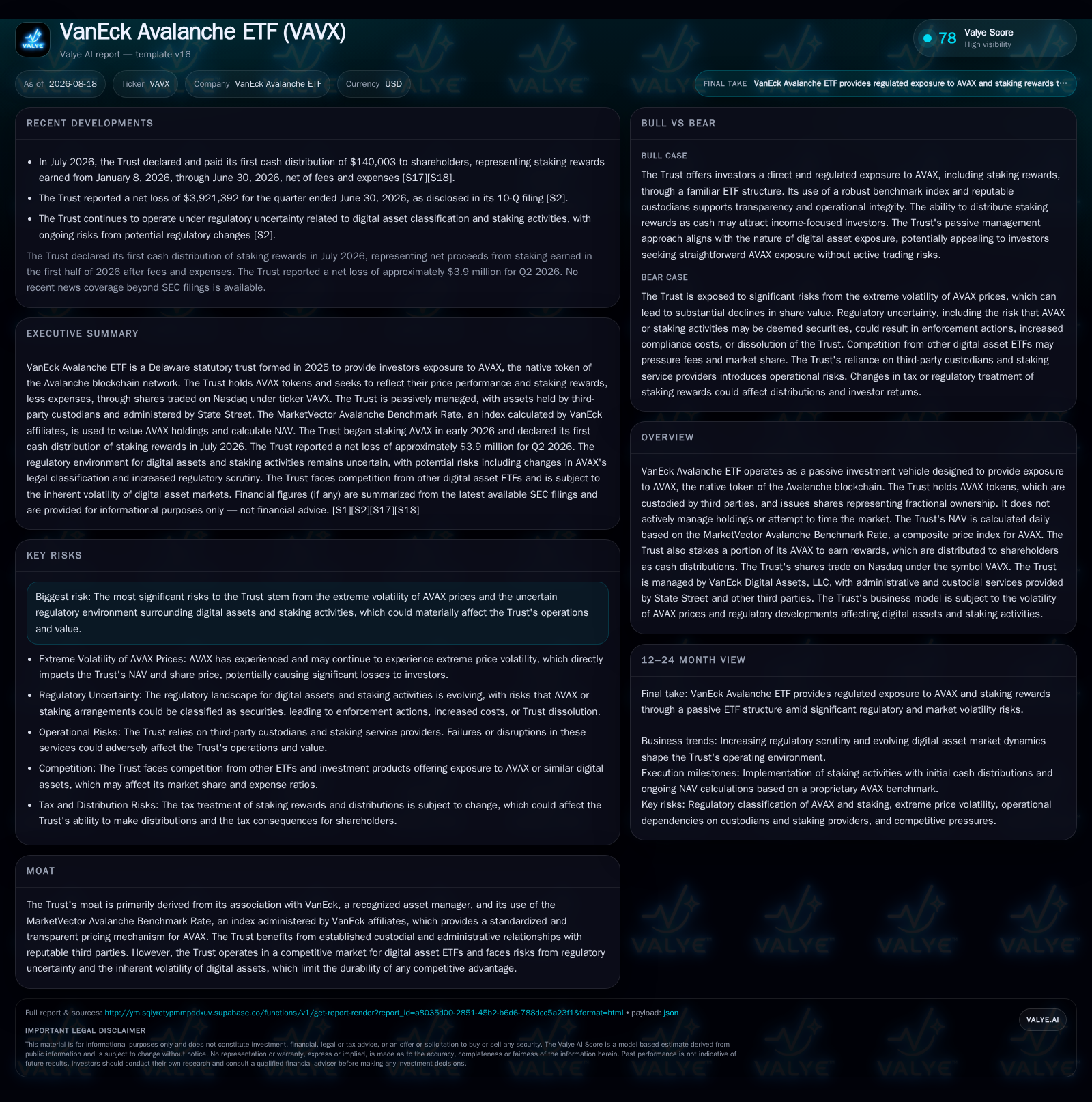
In July 2026, VanEck Avalanche ETF initiated its first cash distribution derived from staking rewards on its AVAX holdings, establishing an additional value layer for shareholders beyond mere price appreciation. This development coincides with persistent wide fluctuations in AVAX prices and an unsettled regulatory landscape around digital assets and staking activities. The Trust’s passive business model centers on holding AVAX tokens custodied by leading third parties, with daily NAV calculated against a proprietary MarketVector Avalanche Benchmark Rate. While staking yields could enhance shareholder returns, regulatory risks—including potential reclassification of AVAX as a security—remain a critical overhang impacting the Trust’s long-term viability.
Staking Rewards Distribution Debut Signals New Income Layer for Shareholders
VanEck Avalanche ETF (VAVX) initiated its first-ever cash distribution on July 8, 2026, totaling approximately $140,000 drawn from staking rewards earned since January 8, 2026, when the Trust began actively staking its AVAX holdings [S3]. This concrete deployment of staking proceeds to shareholders inaugurates a supplementary income stream beyond capital appreciation or depreciation tied solely to AVAX price movements. The Trust plans to declare such staking-related distributions quarterly in order to align with IRS Revenue Procedure 2025-31 safe harbor conditions for grantor trusts that engage in crypto staking activities [S5].
This operational milestone signifies progress in generating periodic yield from staked AVAX tokens held under custody agreements rather than merely holding them passively. However, the distributions are subject to variability governed by underlying blockchain staking economics as well as costs associated with staking providers’ fees and custodial service charges deducted before payout. For investors navigating extreme volatility intrinsic to cryptocurrencies like AVAX, this incremental cash flow mechanism may improve the investment proposition by offering some income stabilization; yet it also introduces new layers of operational complexity and tax considerations [S3][S5]
"Passive Exposure" Model Anchored by AVAX Custodianship and Benchmark Pricing
VAVX functions as a passive exchange-traded fund designed to track the MarketVector Avalanche Benchmark Rate—a proprietary composite price index for AVAX administered by affiliates of VanEck—thus providing transparent daily net asset value calculations [S1]. The Trust itself holds AVAX tokens but does not engage in active trading or market timing strategies. Instead, it relies on specialized custodians—Anchorage Digital Bank N.A. and Coinbase Custody Trust Company—to hold the tokens securely. State Street Bank acts as administrator, transfer agent, and cash custodian supporting operations around share issuance and redemption [S1].
This model illustrates current digitized ETF product structures that distance active portfolio management from direct cryptocurrency market navigation while leveraging established institutional custodian relationships to address security concerns inherent in blockchain asset holding. However, entrusting custody to these centralized custodians inherently concentrates counterparty risk despite their well-recognized status within digital asset infrastructure circles.
"Authorized Participants" and Liquidity Providers: Enabling Efficient Market Operations
Liquidity for VAVX shares—and correspondingly tight tracking of share prices relative to underlying NAV—is facilitated by authorized participants (APs) who create or redeem shares in large blocks known as creation/redemption baskets. These APs include Cumberland New York LLC, Virtu Financial Singapore Pte Ltd., among others consented by the Sponsor [S1]. APs can transact using either cash or in-kind baskets of AVAX tokens depending on market conditions.
Market makers and liquidity providers perform essential roles ensuring secondary market liquidity for VAVX shares on Nasdaq under symbol VAVX. By enabling cost-efficient arbitrage between share prices and intrinsic NAV values calculated from the benchmark index—as well as mitigating trading frictions—the AP ecosystem helps reduce tracking error and maintains orderly markets despite underlying token price swings.
"Digital Asset Volatility" Risks Explicit Amid Recent Industry Turmoil and Regulatory Focus
AVAX trading prices remain highly volatile after notable boom phases peaked in 2021 followed by cascading drawdowns linked to dramatic events including bankruptcy filings of key industry players such as FTX Trading Ltd., Celsius Network, Voyager Digital Ltd., Three Arrows Capital, BlockFi Inc., and Genesis Global Capital LLC during 2022–2023 [S2][S4][S6]. These episodes induced widespread confidence crises throughout crypto markets globally.
The aftershocks have manifested not only in sharp price swings but also diminished liquidity conditions impacting both token trading venues and related derivatives markets. Heightened regulatory scrutiny compounded uncertainties; SEC enforcement actions targeting purported unregistered securities exchanges have led to expanded investigation scopes into digital asset classifications including AVAX itself which remains subject to ongoing debates whether it qualifies as a security or commodity under U.S. law.
Consequently, this regulatory flux combined with pronounced volatility creates persistent risks for investors holding VAVX shares given potential sudden valuation shifts or operational interruptions triggered by legal constraints or market access limitations.
"Competitive Backdrop" Against Other Digital Asset ETFs and Vendor Counterparts
Within the broader digital asset ETF universe where vehicles such as VanEck Bitcoin Trust (a well-established benchmark in crypto ETFs) or Grayscale Ethereum Trust operate at larger scales serving institutional clients alongside retail investors with varying custody arrangements—VAVX differentiates via exclusive exposure to AVAX while relying on VanEck-managed MarketVector indices underpinning transparent pricing methodology.
Unlike futures-based crypto ETFs exemplified by products such as ProShares Bitcoin Strategy ETF which synthetically replicate exposure through derivative contracts rather than holding physical tokens directly—VAVX holds underlying digital assets physically custodied by marquee players like Coinbase Custody unlike competing trusts which may outsource custody elsewhere or vary in fee structures influencing net returns.
Competition extends beyond ETFs towards cryptocurrency index funds and wallets offering unregulated or semi-regulated access raising barriers for regulated products but also pushing customers towards greater innovation around yield generation through mechanisms like staking.
"Growth Pathways" via Staking Innovation, Index Expansion, and Investor Education
Staking rewards distribute incremental yield that can entice investors prioritizing predictable income amidst uncertain crypto price movements. Ongoing innovation around blockchain consensus mechanisms enhancing staking protocols could bolster these returns if efficiently passed through trust structures like VAVX. Furthermore, expansion of digital asset indices by MarketVector Indices broadens product suite opportunities enabling cross-selling or packaging multi-token exposure products anchored in familiar benchmark schemes.
Additionally, rising institutional interest combined with gradual regulatory clarity provides an impetus toward deeper adoption; integration efforts with traditional brokerage platforms facilitate access for retail investors previously daunted by direct wallet ownership complexities.
Educational initiatives highlighting risk-return profiles tailored specifically toward regulated digital token ETFs further augment demand trajectory while improving client retention through clearer communication of benefits vis-à-vis standalone token ownership.
"Regulatory Overhang" Remains a Key Risk Across Disclosure and Enforcement Developments
Despite recent interpretative releases from SEC viewing certain staking activities less stringently with respect to securities laws (notably released March 17, 2026) uncertainty persists about future legal characterizations that may materially affect all stakeholders involved—from sponsors like VanEck Digital Assets LLC to custodians and ultimately shareholders [S7][S10][S17]
Potential reclassification of AVAX as a security would necessitate comprehensive remedial steps such as registration under the Investment Company Act or Investment Advisers Act increasing operational burdens significantly—or prompt trust dissolution if compliance proves impractical—resulting in forced liquidation potentially at unfavorable market conditions undermining shareholder value.
Regulators continue intensifying investigations post-FTX fallout spanning SEC enforcement actions against major exchange operators Binance, Coinbase Global and Kraken emphasizing systemic risk concerns around unregulated intermediaries offering overlapping securities-like services lacking full investor safeguards.
Congressional activity remains uncertain though legislative attention keeps increasing tackling stablecoin issuance rules alongside broader digital asset regulation agendas leaving trust participants attuned closely to policy trajectories given existential stakes attached.
"What to Watch": Subsequent Distribution Frequency, Index Tracking, and Regulatory Signals
Upcoming milestones include monitoring follow-on staking cash distributions' amounts relative to prior payouts indicating trust’s ability to maintain robust yield streams amidst token reward variability [S3][S5]. High tracking accuracy against MarketVector Avalanche Benchmark Rate will confirm operational efficacy managing share price alignment necessary for investor confidence.
Authorized participant activity levels signal secondary market health; any dropoff could presage liquidity constraints adversely affecting trade execution quality. Finally, key regulatory announcements—be they formal SEC statements or legislative enactments clarifying security classifications for digital assets—will serve as trigger points reshaping strategic considerations for VAVX’s sponsor organization regarding continued operation versus exit scenarios.
This analysis synthesizes recent publicly filed disclosures from VanEck Avalanche ETF alongside broader knowledge of regulated digital asset ETFs’ operational architecture industry dynamics without providing investment advice.
Disclaimer: This is research-only, informational analysis and not investment advice. It may include AI-generated interpretation and general industry context. Always verify important details using primary sources.

Comments