
JFB Construction Holdings’ Expansion and Diversification Strains Margins Amid Strategic Merger Plans
Latest quarterly results reveal operational challenges alongside growth ambitions supported by niche sector focus and a pending merger.
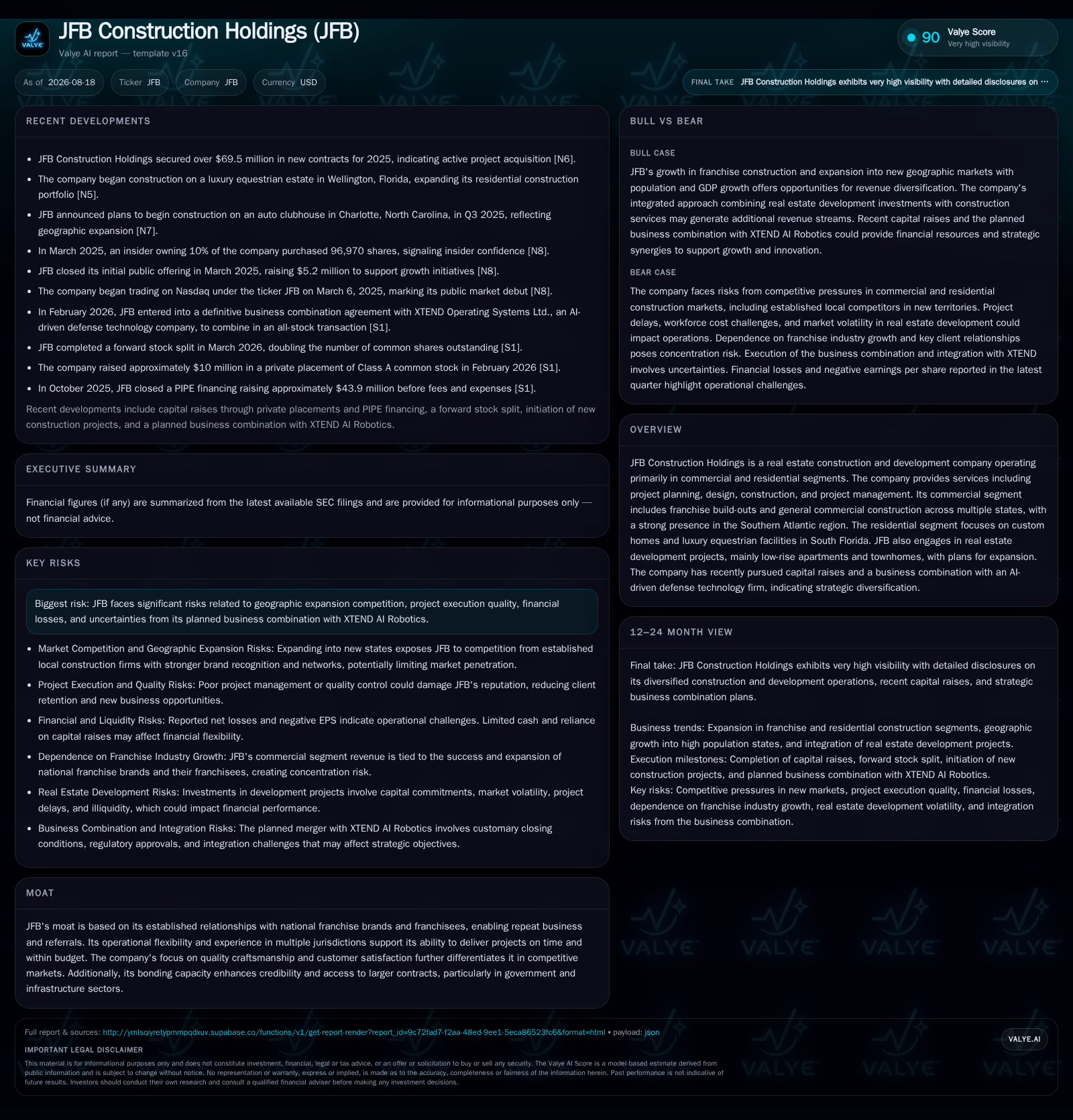
JFB Construction Holdings reported continued investment in workforce expansion and geographic reach as it balances commercial franchise build-outs with residential luxury projects. Despite strong backlog and a current ratio above 3, the company faces operating losses and margin pressures, largely due to the scaling costs and project execution risks inherent in their business mix. JFB’s established franchise relationships anchor repeat business yet geographic diversification increases complexity. The pending all-stock merger with AI-driven defense tech firm Xtend AI Robotics marks a strategic pivot, introducing execution and integration risks as well as potential for broader capital access. Monitoring project margins, backlog quality, and merger milestones will be critical to assessing JFB’s path to sustainable profitability.
Recent Operating Update
JFB Construction Holdings detailed in its Q2 2026 10-Q filing that while it maintains a healthy liquidity cushion with current assets of approximately $20 million against current liabilities near $6.5 million—yielding a current ratio above 3—the company continues to operate at a net loss exceeding $5 million as of end-2025 [F1][S2]. This financial snapshot underscores ongoing operating challenges tied to their expanding portfolio.
The company confirmed an amendment to its previously announced merger agreement with Xtend AI Robotics, narrowing timelines around consideration schedules and adjusting minimum cash conditions ahead of anticipated closing by late 2026 [S3]. This amendment is material because it accelerates transaction logistics while imposing post-close financing restrictions that could affect capital flexibility.
Business Model Overview
JFB functions as an integrated general contractor and real estate developer, focusing on two primary verticals: commercial contracting primarily composed of retail franchise build-outs across multiple states, and high-end residential construction concentrated in South Florida [S1]. Commercial segment clients include national franchise brands and individual franchisees, generating revenue mostly through fixed-price or cost-plus contracts. The repeat nature of franchise-related projects creates recurring business opportunities anchored by established trust relations.
In residential construction, JFB targets custom luxury homes and specialized equestrian facilities where craftsmanship quality supports premium pricing. This segment relies heavily on regional architectural partnerships to cultivate demand [S1]. Real estate development efforts center on low-rise multifamily apartments and townhomes with strategic plans to extend beyond Florida into other southern states via joint ventures. However, these endeavors are capital intensive and dependent on successful market penetration.
Revenue streams arise from contract work billed upon project progress under fixed or cost-plus terms, while margins fluctuate based on project complexity, subcontractor management efficiency, change orders, and supply chain cost fluctuations [S1]. Bonding capacity enhances JFB’s credibility enabling bidding for larger government or infrastructure contracts which require surety backing
Industry Structure and Competitive Position
Operating within the highly fragmented real estate construction industry—sharing space with large diversified peers like Lennar Corporation (residential) and Fluor Corporation (infrastructure)—JFB differentiates itself through its niche combination of commercial franchise build-outs nationwide paired with luxury residential projects locally. This dual focus allows cross-segment learning but also introduces operational complexity around resource allocation.
The industry is capital-intensive with cyclical demand linked closely to regional economic health and consumer confidence. Geographic expansions into Texas and South Carolina help mitigate concentration risk inherent in their core Southern Atlantic footprint but raise risks around brand recognition and regulatory compliance in new jurisdictions [S1]. Competitors in these regions possess entrenched local relationships which could pressure margins during market entry phases.
Operational KPIs such as backlog value reflect contracted but uncompleted work providing revenue visibility; however, JFB has not explicitly quantified backlog growth in recent filings—an important metric to watch given expansion ambitions [S1]. Similarly, project completion rate and subcontractor utilization are critical to managing costs under fixed-price contracts that can be squeezed by labor shortages or material price hikes—factors explicitly noted as risks by management
JFB’s bonding capacity is an explicit moat element enabling access to larger-scale government projects unavailable to lesser-bonded peers. However, expansion into more diverse markets may strain bonding utilization rates if not managed prudently.
Growth Drivers
Regional economic growth drives demand for new retail locations requiring franchise build-outs—a core commercial segment revenue driver—as well as multifamily housing development fueled by population inflows in the South Atlantic region. Rising consumer preference for custom luxury homes supports JFB’s upscale residential segment focused on craftsmanship.
The company emphasizes workforce expansion including hiring additional project managers and sales executives aimed at scaling its simultaneous project capacity thoughtfully without diluting quality [S1]. Positive trends in franchisor partnerships encourage repeat business opportunity flow which could drive top-line growth if execution risks abate.
Strategic partnerships via joint ventures serve as a vehicle for mitigating entry risks into new markets especially for real estate development where local expertise is vital [S1].
Additionally, the pending merger with Xtend AI Robotics represents a potentially transformative diversification into the defense technology sector. While this moves away from pure construction/development activities toward software-driven autonomy systems for unmanned vehicles—potentially widening capital access—it introduces new operational complexities unrelated to core competencies [S3].
Risks and Growth Constraints
Recruiting and retaining skilled personnel amid industry-wide labor shortages remains one of the top operational constraints impacting JFB’s competitive positioning given its limited current headcount (22 full-time employees plus contractors) relative to growth ambitions [S1]. Workforce mismatches can lead to suboptimal subcontractor reliance or delayed project deliveries.
Cost inflation risk is acute given recent global supply chain disruptions impacting steel, aluminum, lumber—all key inputs—with tariffs further pressuring margins [S1][S3]. Fixed-price contract exposure amplifies vulnerability unless well managed through vigilant change order administration.
Geographic expansion elevates regulatory compliance burdens along with marketing challenges that could increase customer acquisition costs or delay award timings adversely affecting workforce deployment efficiency. These have direct profitability implications if certain expected contracts fail or are rescheduled unexpectedly.
The merger transaction creates significant integration risk including potential management distraction from core operations during transition phases alongside uncertain realization of expected synergies or diversification benefits. Delays in merger closing deadlines—now extended through October 31, 2026—or failure to meet minimum cash conditions could materially affect strategic outlook [S3]
Finally, internal control weaknesses related to financial reporting oversight identified previously highlight governance risk areas that must be addressed promptly as public company compliance intensifies post-merger [S1].
What to Watch Next
Key near-term milestones include the closing of the business combination with Xtend AI Robotics within revised timelines which will reshape JFB’s corporate identity and strategy execution framework [S3]. Monitoring updates around regulatory clearances or shareholder approvals is essential.
On the operational front, tracking backlog size disclosures or updates will illuminate revenue trajectory clarity—critical given the scaling phase underway. Project margin trends especially in commercial franchise build-outs will indicate whether operational leverage is improving or challenged by labor/material cost pressures.
Staffing levels relative to awarded projects will reveal if expansion targets are met sustainably without compromising delivery standards. Additionally, changes in bonding capacity utilization rates post-expansion could flag access constraints limiting contract scale.
Finally, any commentary on merger-related integration expenses or synergy realizations during forthcoming quarterly reports will inform on financial health alongside traditional metrics like operating income trends.
Financial Profile Discussion
JFB retains a strong liquidity buffer evidenced by its June 30, 2026 balance sheet showing current assets totaling $20 million against current liabilities of approximately $6.5 million yielding a healthy current ratio of 3.07—a strength that supports ongoing project funding needs amidst rising working capital demands related to expansion investments [F1]
Capital raises undertaken earlier in 2026 totaling over $50 million through private placements signal investor appetite fueling growth plans but also introduce dilution considerations shared among existing stockholders prior to the merger close [S1][S22]
Effective working capital management will remain vital as days sales outstanding (DSO) metrics evolve post-merger when payment cycles may shift due to expanded customer bases including governmental clients via Xtend synergy.
In sum, JFB is currently navigating typical mid-growth phase financial trade-offs characterized by concentrated liquidity deployment upfront against longer-term scale benefits contingent on efficient portfolio execution and successful transaction closure.
Disclaimer: This is research-only, informational analysis and not investment advice. It may include AI-generated interpretation and general industry context. Always verify important details using primary sources.

Comments