
VanEck Ethereum ETF Struggles With Persistent ETH Volatility and Market Turbulence
The latest 10-Q reveals significant net losses linked to pronounced ETH price drops, underscoring operational challenges in passive digital asset ETFs amid regulatory and market uncertainties.
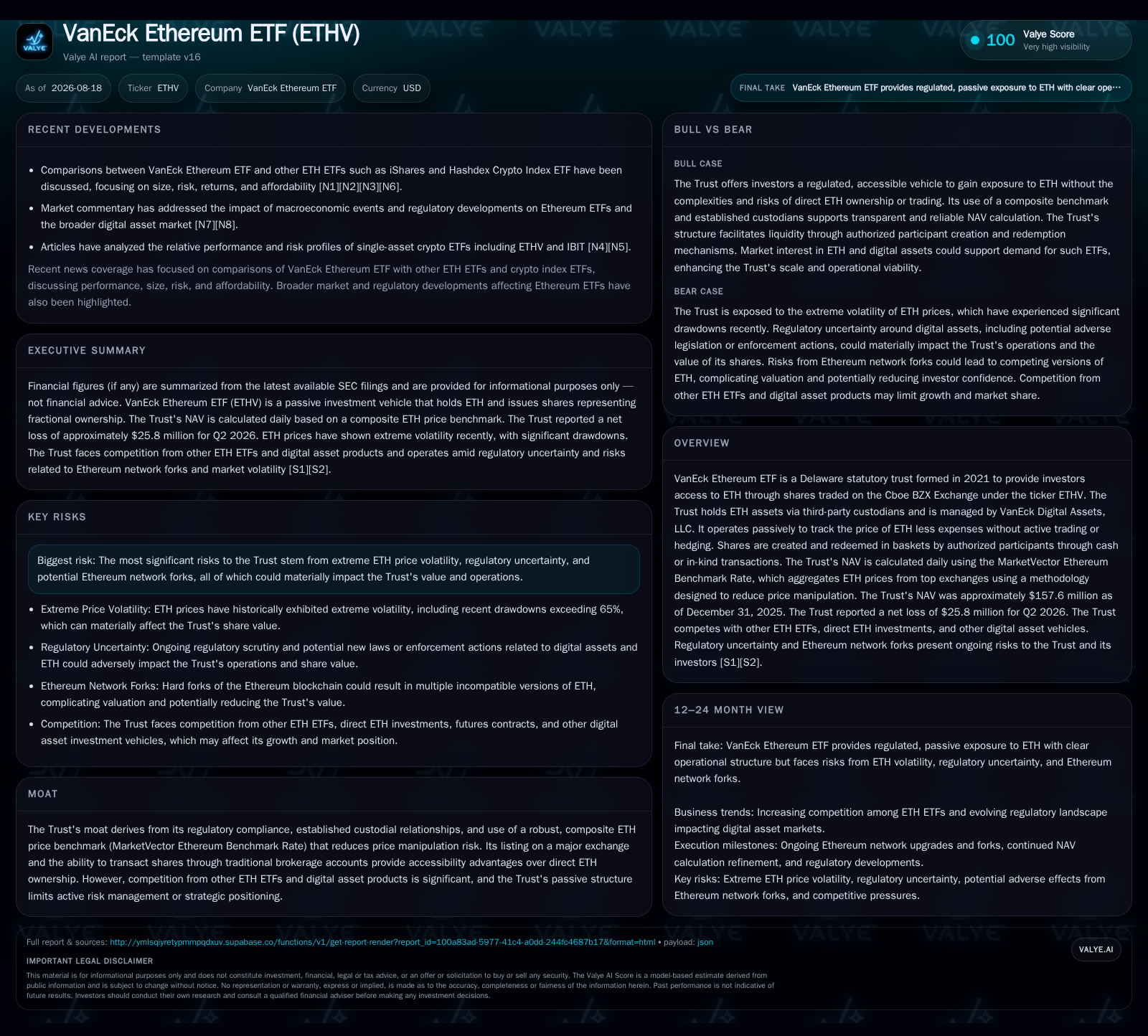
VanEck Ethereum ETF (ETHV) reported a net loss of $25.8 million for Q2 2026 driven primarily by a more than 65% decline in ETH prices since its August 2025 peak, according to the latest 10-Q filing. The Trust passively tracks ETH via custodial holdings and a composite benchmark rate, relying heavily on authorized participants for liquidity through creation and redemption baskets. Despite structural moats established by robust custody partnerships with Gemini Trust and Coinbase Custody, plus disciplined use of the MarketVector Ethereum Benchmark Rate to mitigate manipulation risks, the ETF faces headwinds from extreme digital asset volatility and ongoing regulatory uncertainty. Monitoring creation/redemption activity and tracking error will be critical near-term indicators of resilience and operational stability.
Q2 2026 Quake: ETH Price Volatility Drives Net Loss and Pressures NAV Stability
VanEck Ethereum ETF’s most recent quarterly filing dated August 13, 2026 ([S2]) discloses a painful operational reality: a sharp collapse in ETH prices exerted immense pressure on the Trust’s net asset value (NAV) and financial results. After peaking near $4,830 in August 2025, ETH declined over 65% to below $1,570 by June 2026 due to cascading market turmoil marked notably by the October 2025 Flash Crash. This event involved over $20 billion in collateral liquidations across crypto derivatives markets, combined with marketplace disruptions such as order halts and forced trade unwindings. These tumultuous conditions translated directly into a net loss of $25.8 million for Q2 2026 reported by the Trust ().
The passive structure of ETHV means it neither hedges nor trades actively to offset these volatility shocks; instead, it relies solely on an accurate reflection of ETH prices through its benchmark rate. Given the magnitude of recent price movements, investors face substantial risk of steep NAV fluctuations without internal buffers or downside control mechanisms—a significant operating challenge that tempers near-term return prospects.
Passive Structure Anchored by Custody Security and Benchmark Integrity
The VanEck Ethereum ETF is structured as a Delaware statutory trust formed in 2021 to provide exposure to ETH through shares traded on Cboe BZX Exchange under ticker ETHV ([S1]). It does so via passive management: holding actual ETH assets securely deposited with third-party custodians Gemini Trust Company LLC (ETH Custodian) and Coinbase Custody Trust Company LLC (Additional ETH Custodian) ([S1]). These partnerships align with best-in-class custody standards widely respected within digital asset investment circles.
Pricing accuracy is maintained by using the MarketVector Ethereum Benchmark Rate as the reference index for NAV calculation ([S1]). This composite benchmark aggregates real-time data from top exchanges employing sophisticated methodologies intended to reduce risks of market manipulation—a key moat given digital asset markets’ fragmented nature and opaque trading venues. Tracking error relative to this benchmark remains an essential metric for measuring the Fund’s fidelity in replicating underlying ETH price movements.
Revenue generation is principally from management fees levied on assets under management (AUM), which fluctuate alongside ETH valuations. This underscores direct linkage between volatile crypto markets and fund economics. The absence of active management or trading strategies simplifies operations but leaves the fund fully exposed to downward swings without mitigation levers.
Fragmented Ecosystem: Peer Dynamics and Competitive Positioning Among Digital Asset ETFs
ETHV competes in a rapidly evolving landscape populated by other digital asset ETFs (including Bitcoin-focused products like ProShares BITO), crypto trusts exemplified by Grayscale Ethereum Trust (ETHE), direct cryptocurrency exchanges, wallets, and indexed investment vehicles ().
Unlike less regulated trusts that may employ fee structures reflecting liquidity premiums or discounts relative to NAV, VanEck’s ETF benefits from exchange listing accessibility via traditional brokerage accounts—a crucial advantage that increases retail and institutional investor reach while facilitating transparent price discovery. Regulatory compliance further differentiates it from many over-the-counter crypto products lacking analogous investor protection frameworks.
However, because VanEck operates passively with no active position-taking or leverage features, its pricing power is inherently limited amidst fragmented competition. Investors can replicate exposure more cheaply elsewhere if willing to hold underlying crypto directly or tolerate premium/discount anomalies prevalent in trust structures.
How Liquidity Operations Via Authorized Participants Buffer Price Dislocations
Authorized Participants (APs), registered broker-dealers empowered to create or redeem ETF shares in large baskets—typically blocks of 25,000 Shares—play a central role in maintaining liquidity ([S1]). They transact either in cash or in-kind transfers involving ETH itself to adjust supply dynamically matching investor demand.
This creation/redemption mechanism helps minimize deviations between share prices on exchange and calculated NAV derived from benchmarked ETH prices. Especially during high-volatility episodes like those experienced post-October 2025 crash, AP activity stabilizes share pricing by arbitraging disparities between fund shares and underlying assets.
Operational robustness relies heavily on sufficient AP engagement; any drop-off could exacerbate premium/discount swings resulting from reduced share supply elasticity relative to investor flow volatility. Tracking this activity alongside exchange share volumes offers critical insight into potential liquidity bottlenecks or stress points impacting investors’ ability to transact at fair values.
Macrodrivers: Regulatory Landscape and Market Adoption Shaping Demand Trajectory
Regulatory uncertainty remains a pronounced headwind for VanEck Ethereum ETF’s growth prospects ([S1], [S2]). Although partial clarity has emerged allowing certain crypto ETFs to list on major exchanges under SEC oversight, evolving interpretations concerning money transmitter licensing obligations imposed on authorized participants or liquidity providers introduce potential compliance cost escalations.
Conversely, expanding institutional recognition of cryptocurrencies as asset class adjuncts continues driving gradual inflows into passive digital asset vehicles like ETHV ([N1], [N2]). Growing retail interest facilitated through traditional brokerage channels reinforces demand trends supporting long-term scaling opportunities despite cyclical turbulence.
Innovation in benchmarking indices enhancing price accuracy combined with improvements in custody security infrastructure also bolster market confidence fundamental to sustained capital flows into regulated crypto ETFs.
Short-Term Constraints: Regulatory Risk, Crypto Volatility and Benchmark Limitations
Recent SEC disclosures reiterate that volatile underlying asset prices present continuous valuation challenges affecting both Investor confidence and fund stability ([S1], [S2]). The MarketVector Ethereum Benchmark Rate—while methodologically advanced—has limited operational history making its robustness under all market conditions still subject to assessment. Potential disruptions including blockchain protocol forks or trading platform outages could hinder accurate NAV calculation triggering share price dislocations.
Counterparty risk related to custody providers or authorized participants also emerges as critical vulnerabilities with possible operational halts jeopardizing fund continuity or causing asset losses.
Absent active management capabilities restricts the Trust’s ability to proactively respond to sudden adverse developments seen during prior digital asset market crises such as the FTX bankruptcy cascade referenced broadly across filings ([S2]). This residual risk emphasis delays near-term rerating possibilities until volatility normalizes or structural safeguards improve.
Near-Term Indicators: Monitoring Creation/Redemption Activity and NAV Deviations Ahead
Post-reporting period attention should focus sharply on key operational metrics revealing health signals for VanEck Ethereum ETF’s managing ecosystem ([S1], [S2]). These include:
- Volume trends for share creations/redemptions signaling Authorized Participant appetite,
- Degree of tracking error manifesting divergence between share price valuations versus MarketVector benchmark,
- Movements in AUM reflecting investor sentiment shifts,
- Indicators of custody platform reliability including security incident reports,
- Regulatory announcements impacting compliance regimes applicable to APs or liquidity providers. Monitoring these variables will inform practical expectations about ETF resilience amid ongoing ETH price gyrations while illuminating potential catalysts altering the competitive dynamics within passive digital asset ETFs.
Disclaimer: This is research-only, informational analysis and not investment advice. It may include AI-generated interpretation and general industry context. Always verify important details using primary sources.

Comments