
Healthy Choice Wellness Navigates Liquidity Challenges While Driving Regional Organic Grocery Expansion
HCWC pursues growth through acquisitions and operational enhancements amid persistent liquidity constraints.
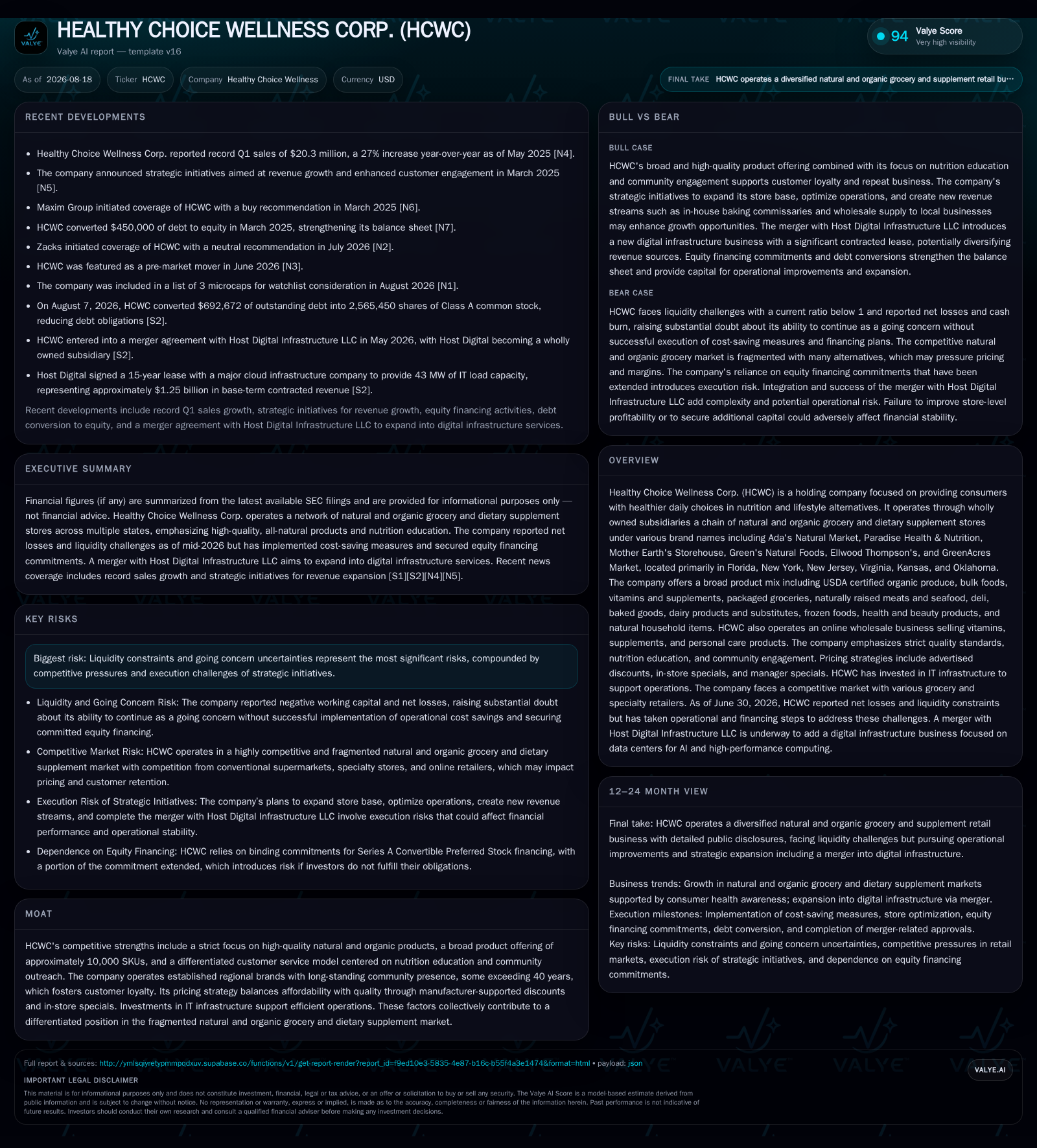
Healthy Choice Wellness Corp. (HCWC) operates a portfolio of regional natural and organic grocery and supplement retail brands, with a focus on delivering high-quality, all-natural products complemented by nutrition education and community outreach. The latest quarterly filing highlights ongoing liquidity pressures evidenced by a working capital deficit and modest cash reserves, balanced against efforts to grow the store base via acquisitions and initiatives aiming to improve operating margins. The company’s broad multi-brand footprint across select U.S. regions positions it competitively within fragmented specialty retail but also exposes it to risks from debt levels, competitive pressures, and execution complexity. Key near-term indicators include progress on new store integrations, sales trends in same-store metrics, and the successful raise of committed equity capital to alleviate financial constraints.
Recent Operating Update
Healthy Choice Wellness Corp.'s latest quarterly filing dated August 14, 2026, underscores ongoing financial pressure amid strategic growth activities. The company's liquidity position remains constrained with cash & equivalents at approximately $0.9 million versus current liabilities of about $13.6 million as of June 30, 2026 – yielding a current ratio near 0.51 which signals tight short-term liquidity coverage [F1][S2]. Total debt stands close to $4.9 million with net debt after cash around $4 million [F1], highlighting the burden of leveraging expansion plans.
Despite these pressures, HCWC's previous fiscal year-end results show improving operational trends: net losses narrowed to $3.9 million from $4.5 million while net cash from operations swung positive to $1.0 million compared to prior years’ negative cash outflow [F1][S1]. This suggests that execution on cost controls and operating improvements is yielding some traction.
Complementing liquidity disclosure is an August 7 event filing detailing Host Digital Infrastructure's 15-year lease agreement accounting for projected base-term contracted revenue exceeding $1 billion over its term post-merger closing—a significant diversification beyond traditional grocery retail formats [S3][S28]. This indicates HCWC’s intent to develop complementary business lines leveraging infrastructure assets.
Business Model and Strategic Position
Healthy Choice Wellness functions as a holding entity overseeing multiple regional brands specializing in natural and organic groceries alongside dietary supplements. Its subsidiary portfolio includes known local chains such as Ada’s Natural Market (Florida), Paradise Health & Nutrition (Florida), Mother Earth's Storehouse (New York Hudson Valley), Green's Natural Foods (New York/New Jersey), Ellwood Thompson's (Virginia), and GreenAcres Market (Kansas/Oklahoma) [S1][S22]. This multi-brand approach provides localized market presence with roughly 20 retail stores collectively offering approximately 10,000 SKUs including USDA certified organic produce, bulk foods, natural household items, health & beauty products, naturally raised meats/seafood, deli items, baked goods produced in new in-house commissaries planned across banners, and frozen foods [S1][S29].
Revenue streams come primarily from brick-and-mortar retail transactions with customers paying upon purchase at physical stores; an ancillary revenue stream exists through Healthy U Wholesale which operates www.TheVitaminStore.com focusing on vitamin/supplement wholesale distribution nationwide [S22]. Monetization mechanics rely on driving volume via multi-category customer conversion supported by community outreach efforts emphasizing nutrition education—an established differentiator fostering customer loyalty in competitive markets where premium grocery products compete against conventional grocers’ organic sections or specialist chains such as Whole Foods or Sprouts Farmers Market.
Pricing strategy balances quality assurance with affordability achieved through manufacturer discounts and targeted in-store promotions enhancing price perception without diluting margin overly [S29]. Product freshness maintenance practices include refrigerated storage for most private-label bulk products like nuts or trail mixes—a less common practice improving product quality consistency relative to competitors who may not invest similarly in cold chain logistics [S19].
Critical operational levers encompass inventory turnover rates managed through active merchandising optimization combined with sales data analytics; store labor levels aligned to traffic peaks; escalating economies of scale from sourcing efficiencies as new locations are added; plus IT investments enhancing ordering accuracy and reducing overhead costs [S25][S29]. These factors contribute materially toward improving gross margin percentages as well as operating margins.
Industry Structure and Competitive Context
Within the U.S. natural and organic grocery retail landscape—which is highly fragmented comprising numerous small- or mid-sized regional players alongside national brands—HCWC situates itself as a consolidator leveraging established community brand equity. This sector sees competition from large supermarket chains increasingly integrating organic grocer sections (e.g., Kroger’s Simple Truth Brand), specialty retailers (Whole Foods Market), regional chains (Sprouts Farmers Market), standalone supplement stores (The Vitamin Shoppe), online wholesalers (Amazon), plus direct-to-consumer local producers.
HCWC’s geographic footprint across seven states represents targeted penetration focused on markets with growing consumer health consciousness yet less saturated than major metropolitan hubs where scale rivals predominate. The range of store formats—from single-location heritage brands like Mother Earth’s Storehouse dating back over four decades to clusters such as Green’s Natural Foods’ eight stores—provides diversity but also adds complexity in harmonizing marketing strategies while preserving local supply preferences.
Customer choice drivers in this segment hinge notably on product assortment breadth including organic certification status; price relative to conventional alternatives; availability of fresh versus packaged goods; private label penetration offering higher margin opportunities; convenient shopping experience including ready-to-go meal options; plus trust enhanced by nutrition education programs delivered by knowledgeable staff enabling customer empowerment.
Growth Drivers
The core supplier network consists predominantly of national distributors like UNFI supplemented by regional vendors ensuring access to organic produce and specialty items aligned with strict selection criteria that exclude artificial additives or hydrogenated oils—supporting HCWC’s brand promise of uncompromising product quality [S19][S29]. Incremental growth plans emphasize:
- Continuing acquisitions to expand store counts beyond existing banners leveraging institutional investor backing dedicated for such purposes into at least April 2027 per preferred stock subscriptions agreements [S5][S9];
- Enhancing same-store sales by increasing average ticket size through cross-category promotions accelerated by transitioning away from deferred loyalty point systems toward immediate VIP program discounts fostering more impulsive purchases while simplifying revenue recognition dynamics [S29];
- Launching new internal commissary baking operations feeding multiple stores expected both to strengthen product differentiation via fresh baked goods offerings while unlocking wholesale supply channels into local restaurant networks which broadens revenue streams beyond consumer direct sales [S25];
- Expanding e-commerce wholesale distribution capabilities principally under Healthy U Wholesale targeting broader vitamin/supplement segment nationwide leveraging online reach synergistic with physical stores’ reputation.
Nutrition education remains central as a marketing tool facilitating greater customer engagement that translates into longer retention rates and repeat visits necessary for margin sustainability given pricing sensitivity across consumer cohorts within these market geographies.
Risks and Watchpoints
Liquidity remains HCWC’s foremost risk factor given working capital deficiency worsened by elevated trade payables outstripping current assets substantially alongside limited cash balances presenting refinancing or operational continuity challenges without timely capital inflows or margin improvement initiatives executing successfully [F1][S2]
Competitive pressure from large grocery retailers expanding organic selections can erode pricing power while increasing promotional intensity contributes to margin compression risks especially if product sourcing costs rise unexpectedly due to supply chain disruptions affecting availability of certified organic or locally sourced goods.
Execution risk arises amidst simultaneous acquisition-driven growth combined with internal integration projects such as commissary launches requiring skilled project management; failure could dilute focus impacting operational efficiency gains critical for reaching sustainable profitability targets set forth by management [S25][S29].
Regulatory exposure related to organic labeling compliance plus health claims for supplements mandates constant vigilance as penalties or reputational harm stemming from non-compliance could damage customer trust foundational to HCWC’s differentiated service model.
Finally macroeconomic fluctuations influencing discretionary consumer spending on premium-priced natural food products introduce cyclicality that may impact traffic patterns or basket size especially during economic downturns given niche target demographics.
What To Watch Next
Market participants should monitor quarterly disclosures for updates on:
- Timing and financial impact related to new store acquisitions along with any disclosed same-store sales performance metrics differentiating maturity stages;
- Progress reporting against the strategic rollout of commissary operations including revenue generation outside core retail;
- Success metrics related to VIP loyalty program uptake translating into stable or improved transaction frequency;
- Updates regarding the status of committed equity financings particularly the remaining $8 million tranche scheduled for funding by April 2027 which is critical for short-term liquidity relief;
- Developments tied to the Host Digital merger closing timeline plus lease execution milestones which materially affect revenue diversification prospects beyond retail groceries.
Financial Profile Discussion
As of Q2 2026 ending June 30th data shows HCWC holds $0.9 million in cash alongside total debt approximating $4.9 million resulting in net debt near $4 million—a significant leverage considering operational scale constraints typical of microcap regional specialty retailers where raising capital can be challenging absent steady profitability improvement evidence [F1]. Current assets of approximately $6.9 million and current liabilities near $13.6 million imply a current ratio around 0.51x for 2026-06-30, indicating tight short-term liquidity coverage [F1].
Management openly acknowledges these constraints while articulating multi-pronged strategies centered on disciplined cost containment combined with expansion accretive revenues enabled by acquired scale advantages balanced cautiously against heightened competitive environment threats inherent in specialty wellness food retailing context.
Conclusion
Healthy Choice Wellness Corp occupies a distinctive niche within the fragmented natural/organic retail industry emphasizing an extensive product portfolio spread across trusted regional brands partnered with community-centric nutritional education programs designed to deepen customer relationships. Yet liquidity limitations coupled with competitive headwinds pose material challenges requiring effective execution of planned acquisitions together with innovation-driven margin improvements for long-term viability. Monitoring execution progress on new revenue streams like commissaries plus fulfillment of financing commitments will be essential markers signaling trajectory shift towards financial stability.
Disclaimer: This is research-only, informational analysis and not investment advice. It may include AI-generated interpretation and general industry context. Always verify important details using primary sources.

Comments