
BHP Delivers Record Iron Ore and Copper Outputs While Advancing Copper Growth Pipeline
BHP sustained strong production with disciplined cost control amid commodity price strength, progressing key copper projects and maintaining a robust growth outlook.
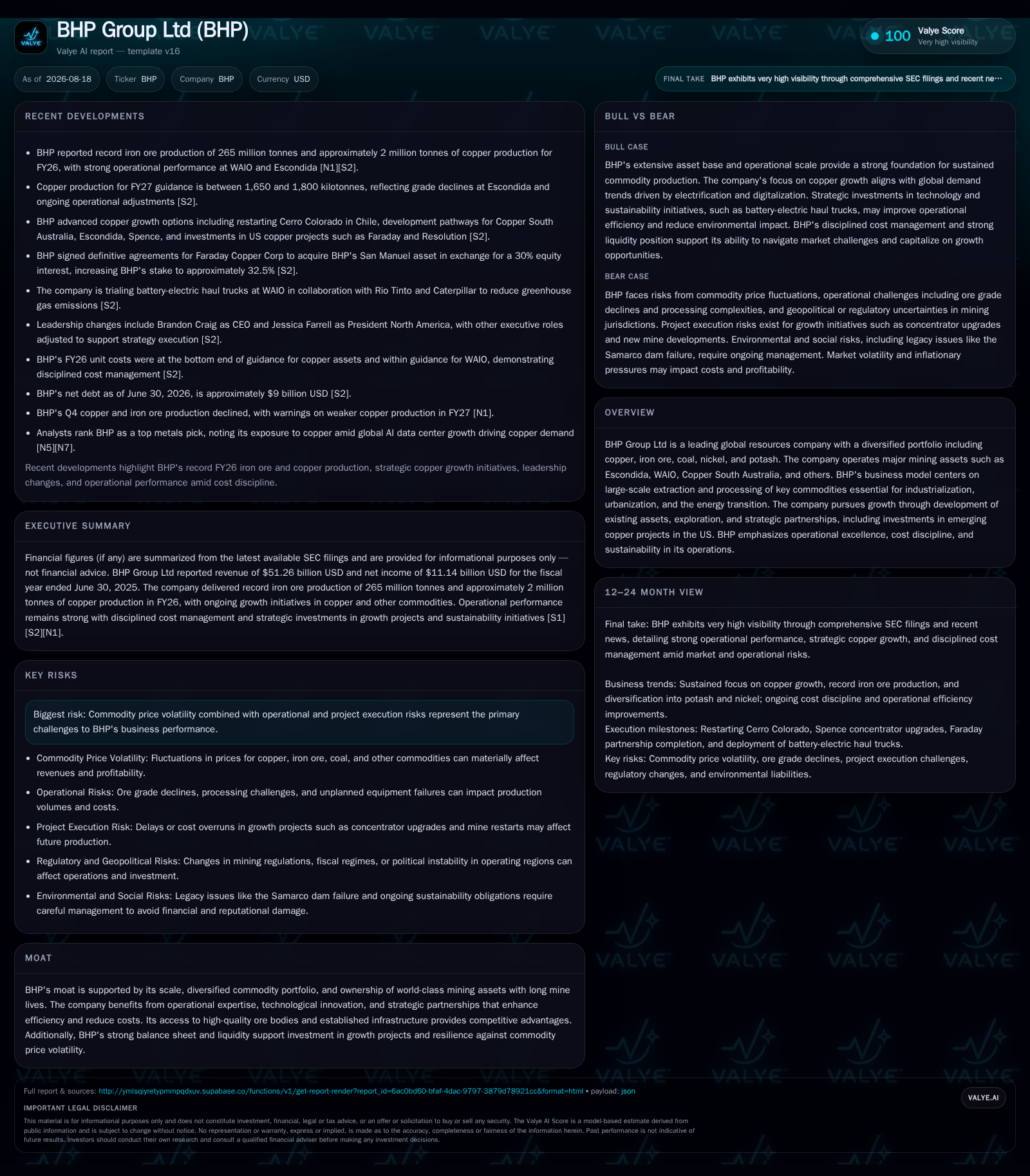
In the fiscal year ended June 2026, BHP Group Ltd produced approximately 2 million tonnes of copper for the second consecutive year and achieved record iron ore production, reflecting operational excellence and a resilient portfolio. Despite challenging macroeconomic conditions including inflation and supply chain disruptions, BHP managed unit costs within guidance ranges, underpinning profitability amid elevated copper prices. The company advanced significant growth projects such as the restart of Cerro Colorado in Chile, development plans in Copper South Australia, and strategic investments in U.S. copper assets, while beginning potash production at the Jansen project in Canada. Leadership transitions positioned the company to leverage technology-focused productivity gains as it navigates ongoing commodity market volatility and structural demand drivers like industrialization and the energy transition.
Latest Operating Update Anchors BHP’s Strategic Momentum
BHP Group’s FY26 operational review revealed a continuation of strong performance trends established in prior years. The company produced around 2 million tonnes (Mt) of copper for the second straight year alongside record iron ore output [S2]. This performance was underpinned by robust operations at flagship mines such as Escondida for copper and Western Australia Iron Ore (WAIO) for iron ore. With copper prices approximately 35% higher than a year ago, revenues benefited from favorable market conditions despite macroeconomic headwinds like inflation, rising diesel costs, and global supply chain constraints.
Cost discipline emerged as a key theme. Every asset operated within or better than unit cost guidance ranges: copper assets reported unit costs at the lower end of expected bands, WAIO costs were maintained within range, while coal operations saw top-end range costs reflecting weather-related impacts [S2]. This tight cost management amidst inflationary pressures underscores operational resilience.
Production guidance for FY27 anticipates some decline in copper volume driven largely by forecasted ore grade diminutions at Escondida—the largest single copper operation—projected to reduce concentrator feed grade from 0.90% to approximately 0.70% [S15]. However, the broader copper portfolio is reinforced by growth options including developments at Copper South Australia (Copper SA), Spence’s flotation upgrade project sanctioned mid-2026 targeting complex ore recovery improvements by FY28, and strategic investments expanding BHP’s footprint in U.S. copper districts through Faraday Copper Corp acquisition (boosting ownership to ~32.5%) [S6,S15].
Iron ore production remains robust with FY26 hitting a record 265 Mt largely due to operational achievements like South Flank exceeding nameplate capacity and high material mined volumes supporting strong supply chain throughput [S12,S20]. FY27 iron ore outlook remains stable between 260–272 Mt supported by expansions such as the newly approved Ministers North project (~US$0.9 billion investment) expected to contribute ~20 Mtpa from FY29 onward utilizing existing infrastructure
Business Model: Leveraging Scale and Diverse Commodity Exposure
BHP operates a diversified mining portfolio focused on base metals—primarily copper—and bulk commodities including iron ore and coal, with emerging stakes in potash via the Jansen mine slated for commercial production next year [S2,S16]. The company’s business model centers on extracting high-quality ore over extended mine lives from large-scale assets strategically located in premier mining jurisdictions such as Chile, Australia, Canada, and the United States.
Revenue generation flows from commodity sales exposed to index-linked pricing mechanisms negotiated through various contracts—ranging from FOB to CFR terms—with revenues driven by volume sold adjusted for quality differentials such as ore grade or moisture content affecting realized prices [S11]. Unit cost control remains critical given the capital-intensive nature of mining operations requiring sustained CapEx alongside OpEx efficiency gains to maintain healthy margins.
BHP emphasizes operational excellence combined with digital transformation initiatives—highlighted by adopting AI-supported Business Operating System (BOS) methodologies—to unlock productivity enhancements across exploration drilling accuracy, processing plant efficiency, tailings management safety, and logistics throughput [S1]. Synergies from joint ventures (e.g., Sierra Gorda SCM collaboration) and strategic partnerships (Faraday Copper) further optimize capital deployment reducing duplication while enhancing resource base size.
Industry Structure and Competitive Positioning
Within diversified mining peers like Rio Tinto, Vale, Anglo American, and Glencore, BHP distinguishes itself by operating some of the highest-quality world-class mines with long-life reserves enabling competitive unit costs that shield profitability during commodity cycles. Its sizable copper portfolio is among the largest globally—a key moat reinforced by reserve replacement strategies via organic exploration success and acquisitions.
Price volatility remains a perennial risk given dependence on global macro factors impacting industrial demand—chiefly urbanization trends in China and infrastructure stimulus programs—as well as downstream technological shifts like electric vehicles boosting demand for copper and nickel [S1]. BHP's broad commodity mix offers portfolio resilience compared with single-commodity-focused peers.
The company also faces specific operational risks including geopolitical exposure—highlighted by progressing restarting operations at Cerro Colorado after submission of an Environmental Impact Assessment—and regulatory compliance complexities inherent to diverse jurisdictions. Infrastructure reliability risks particularly tailings storage facilities and port logistics are managed proactively given potential substantial impacts on continuity of supply chains [S1].
Growth Drivers: Extending Resource Base Amid Transition Demand
Growth catalysts include scaling up copper capacity to meet accelerating electrification needs tied to decarbonization efforts globally. BHP’s advancing projects such as Spence Concentrator Upgrade Recovery project aiming for first production FY28 demonstrate investment prioritization toward processing complex ores successfully [S15]. Concurrently, securing RIGI status for Vicuña’s Josemaria and Filo del Sol deposits guarantees stable fiscal terms fostering long-term investment appeal [S6].
In North America, increasing interests in Faraday’s Arizona projects aim to establish a domestic U.S. copper hub leveraging existing mineral inventory combined with new development opportunities responding well to geopolitical emphasis on localized critical minerals supply chains [S6]. Potash exposure via Jansen Stage 1 near commercial launch broadens revenue sources tapping into agriculture-driven nutrient demand—a distinct but complementary commodity class supporting portfolio diversification away from cyclical base metals [S16,S21].
Technological innovation underpins productivity gains exemplified by trialing battery-electric haul trucks collaboratively implemented at WAIO—a sustainability initiative addressing Scope 1 emissions illustrating integration of ESG principles into core operations alongside digital transformation efforts driving improved operational uptime [S6,S1].
Risks and Watchpoints
Primary risks cluster around ongoing commodity price volatility which directly affects revenue streams due to commodity price sensitivity inherent in mining revenue mechanics [S1,S23]. Operational risks such as potential failures in critical infrastructure—including tailings storage facilities—and possible execution delays or cost overruns on large-scale projects like Jansen Stage 2—which recently revised its capital estimate upward significantly—pose financial uncertainty
Environmental regulations continue tightening globally with implications for permitting timelines; disaster liability risks remain salient following Samarco dam-related obligations influencing financial outcomes notably through settlements [S8]. Labor relations fluctuations demonstrated through industrial actions at Australian iron ore operations potentially disrupt production momentum posing strategic execution challenges.
Currency exchange volatility affects reported earnings given multi-jurisdictional mining activities denominated partly in AUD, USD or CLP affecting unit cost stability especially where prices are dollar linked but costs may be incurred locally.
What To Watch Next
Key milestones include FY27 initial production ramp-up at Jansen Stage 1 set for mid-calendar 2027 thus confirming diversification strategy progress. Progress updates on Cerro Colorado’s restart approval process may materially impact future Chilean copper output projections [S2,S15]. Monitoring Spence Concentrator Upgrade commissioning timing will illuminate improvements in processing margin resilience against ore complexity challenges.
Commodity price trends particularly copper will remain critical demand signals given their direct effect on free cash flow generation capacity which finances further exploration drilling success rate critical for sustaining reserve replacement—an essential KPI underpinning long-term mine life expectations.
Further announcements regarding sustainability initiatives scaling battery-electric fleet usage or additional collaborations leveraging AI-driven BOS will provide insights into medium-term margin expansion capabilities.
Financial Profile Discussion
As of June 30, 2026, BHP maintains a net debt position of approximately US$9 billion reflecting moderate leverage suitable for capital-intensive asset maintenance plus funding growth projects while preserving balance sheet flexibility [S2]. Liquidity remains strong supported by cash equivalents exceeding US$11.8 billion as of June 30, 2025 combined with prudent working capital management resulting in a current ratio of 1.46 [F1]. This financial robustness enables continued capital expenditure planned at about US$11 billion for FY27 focused heavily on sustaining high-quality asset performance and enabling strategic expansion pathways principally driven by potash development (Jansen), copper growth projects domestically (Spence) and internationally (Faraday).
EBITDA margins benefit from disciplined operating expenditure controls evidenced by unit costs pegged at low-end guidance amid inflationary pressures coupled with higher realized commodity prices translating efficiently into enhanced cash flow conversion supporting dividend increases announced alongside profits uplift for FY26 [N3,S2]
Investment impairment charges related to Jansen reflect prudent asset valuation conservatism aligned with updated cost estimates but do not diminish confidence in its role as a Tier-1 low-cost producer upon ramp-up [S8,S21]. Overall capital allocation balances near-term returns with long-term value creation consistent with industry peers focusing on compound productivity improvement fueled through technology adoption rather than aggressive resource depletion.
This analysis reflects information available as of mid-2026 filings without extrapolating forward-looking projections beyond stated corporate guidance or publicly disclosed plans. It aims solely to provide an informed industry perspective integrating recent operational data with sector context relevant to diversified mining stakeholders.
Disclaimer: This is research-only, informational analysis and not investment advice. It may include AI-generated interpretation and general industry context. Always verify important details using primary sources.

Comments