
DynaResource Struggles with Liquidity Under Volatile Gold Price Environment and Limited Operational Scale
DynaResource’s latest quarter reveals ongoing financial strain despite incremental operational progress at its Mexican gold-silver mine.
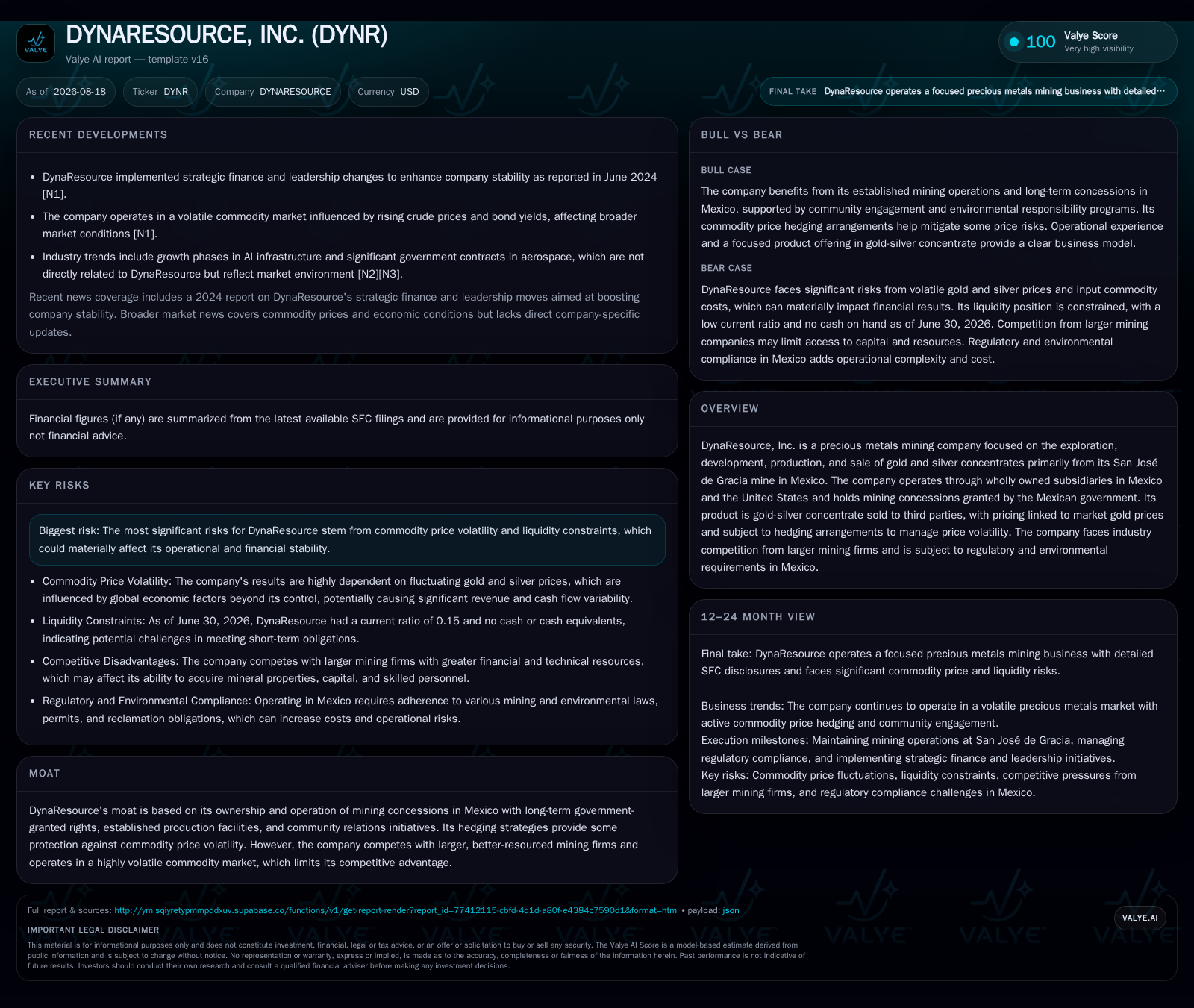
DynaResource, Inc. operates a precious metals mining business focused on its San José de Gracia mine in Mexico, producing gold-silver concentrate sold to third parties. The company remains exposed to significant commodity price volatility, and while it has hedging arrangements covering about 75% of anticipated production, its liquidity position has deteriorated with a strikingly low current ratio of 0.15 as of mid-2026. Operational results show modest net income but the balance sheet highlights substantial working capital deficits, raising going concern issues. Competitive pressures from larger miners and capital intensity constrain growth prospects.
Recent Operating Update: Liquidity Concerns Amid Modest Profitability
DynaResource acknowledges in its filings that the financial statements omit adjustments that would be necessary if it fails to continue as a going concern and explicitly highlights dependence on executing its business plan which includes raising capital through stock sales or debt refinancing [S2]. Such dependence is typical among smaller precious metals producers facing cyclical industry downturns compounded by structural financing challenges.
Business Model: Upstream Precious Metals Mining Focused on Concentrate Sales
DynaResource operates primarily through four Mexican subsidiaries holding government-sanctioned mining concessions centered on the San José de Gracia (SJG) mine in Sinaloa State, Mexico [S1]. Its end product is gold-silver concentrate — finely ground raw material enriched in precious metals but requiring further processing by smelters or refiners [S1]. The company sells these concentrates under pricing formulas tied to assay results referencing London PM gold fixing prices. The receivable price adjusts for payability discounts inherent to concentrate sales contracts.
Revenue depends on ounces produced, ore grade (grams per tonne), concentrate volumes delivered, and precious metals market prices. DynaResource partially mitigates metal price volatility through hedging contracts securing fixed prices on roughly 75% of its anticipated production at $2,495 per ounce since September 2024 [S1]. This risk management strategy smooths revenue streams but does not eliminate exposure entirely. Operational costs are sensitive to commodity inputs such as fuel, electricity, explosives and reagents whose prices are also volatile globally.
Although gold-silver concentrate production allows the company to monetize upstream extraction without direct refining investment, margins are compressed by treatment and refining charges negotiated with third-party purchasers. Maximizing recovery rates during processing at SJG’s facilities is critical to optimizing output and reducing unit costs per ounce mined.
Industry Structure and Competitive Positioning
DynaResource sits firmly in the upstream segment of the precious metals value chain where exploration, extraction and initial concentration take place before further downstream smelting or trading occurs. In terms of competitive scope, DYNR represents a junior/mid-tier producer with concentrated geographic exposure restricted mainly to the single SJG operation.
Its principal peers include large integrated miners like Barrick Gold or Newmont who command vastly superior scale advantages across diversified asset portfolios with deeper balance sheets supporting growth capex and weathering commodity cycle troughs.
In contrast, DynaResource faces heightened risks related to jurisdictional concentration in Mexico where maintaining regulatory and environmental compliance requires ongoing management focus amidst evolving laws governing concession renewals every 50 years. Although DYNR owns long-term government-granted mining concessions considered a moat-like barrier protecting access rights [S1], the company must actively meet requirements such as biannual mining duties payments and annual reporting obligations [S1]. Failure could jeopardize renewal possibilities.
Growth Drivers
Potential expansion drivers include:
- Sustaining or augmenting proven mineral reserve bases through continued geological exploration aimed at extending mine life beyond current estimates.
- Incremental improvements at SJG processing plants raising recovery rates which directly uplift concentrate output per tonne of ore processed.
- Commodity price appreciation boosts realized revenues; despite hedging strategies covering majority production volumes at fixed prices established earlier within this cycle.
- Possibility of strategic acquisitions targeting nearby mineral assets consolidating regional footprint.
- Regulatory stability or favorable amendments facilitating concession renewals enabling long duration operational continuity.
- Capital raising success permitting sustained investment in mine infrastructure upgrades or new equipment reducing operating costs per ounce mined.
Confirmatory KPIs signaling growth would include steady or rising mined tonnage volumes coupled with maintained or increased ore grades (grams/tonne), reduced operating cost ratios per ounce extracted (AISC metrics), and stable hedged production coverage percentages.
Risks and Constraints
The company's foremost risk factors stem from commodity price volatility which directly impacts topline revenue — partial hedge coverage notwithstanding — combined with fluctuating input commodity costs which squeeze margins unpredictably [S1]
Liquidity constraints loom large given reported negative working capital positions making timely settlements of short-term obligations difficult absent external funding sources [F1][S2]
Regulatory compliance risks persist with complex concession renewal protocols requiring continuous diligence including tax payments and environmental standards adherence; failure carries risk of permits revocation impacting production rights [S1]
Operationally DYNR faces concentrated exposure from reliance upon a single operating mine without diversified asset portfolio cushions increasing vulnerability to site-specific disruptions such as labor issues or equipment failures.
Lastly, given capital-intensive nature of mining projects coupled with existing indebtedness restrictions outlined in debt covenants places additional pressure limiting agility for discretionary spending or rapid scaling absent refinancing opportunities [S13]
What To Watch Next
Key upcoming focus points include:
- Quarterly updates on production indicators such as ounces produced including grading quality assessments confirming reserve sustainability.
- Financial disclosures detailing any developments in capital raising efforts including equity issuances or debt facility amendments addressing urgent liquidity needs.
- Progress regarding renewal applications for mining concessions ensuring legal continuity for long-term operations under Mexican regulations.
- Shifts in hedging strategies possibly expanding coverage or renegotiating price floors adapting to evolving gold market dynamics.
- Management commentary on operating cost trends reflecting inflationary pressures across fuel and reagent expenses influencing profit margins.
- Changes in related-party transactions or restructuring moves potentially enhancing financial stability given prior disclosures noting related-party dealings relevant for governance scrutiny.
Financial Profile Discussion
As reflected in the June 2026 quarter filings [S2][F1], DynaResource's financial condition reveals a precarious liquidity state undermining immediate operational flexibility. The company reported zero cash and equivalents as of June 30, 2026, while current liabilities of approximately $45 million substantially exceed current assets of about $6.6 million, resulting in a current ratio near 0.15x [F1]. This indicates significant working capital deficits that elevate refinancing urgency risks.
Total debt levels approximated $1.96 million at end-2021 remain manageable numerically but paired with scant liquidity raise concerns about servicing capacity amid uneven operating cash flow generation typical for early-stage mines dependent on commodity cycles [F1]
Net income figures demonstrate modest profitability; however accumulated deficit exceeding $62 million highlights deep historical losses constraining fresh equity issuance attractiveness absent clear turnaround signals [F1][S2]
Given typical capex demands intrinsic to mining for exploration drilling programs and plant maintenance/rebuild cycles cited indirectly by construction-in-progress assets noted historically there remains ongoing capital demand further pressuring cash flows [S1]
Strategic financing activities will thus be critical enablers defining whether DynaResource can sustain production momentum while navigating sector cyclicality alongside regulatory complexities inherent to its Mexican operations [S13]
This analysis is intended solely for informational purposes without investment advice or research views. It synthesizes publicly available filings and industry context to provide an informed perspective on DynaResource’s current business environment and prospects based on disclosed data as of August 18, 2026.
Disclaimer: This is research-only, informational analysis and not investment advice. It may include AI-generated interpretation and general industry context. Always verify important details using primary sources.

Comments