
VolitionRx Navigates Financial Strain While Advancing Blood-Based Cancer Assays
The company focuses on proprietary cancer detection assays amid liquidity challenges and NYSE American listing compliance efforts.
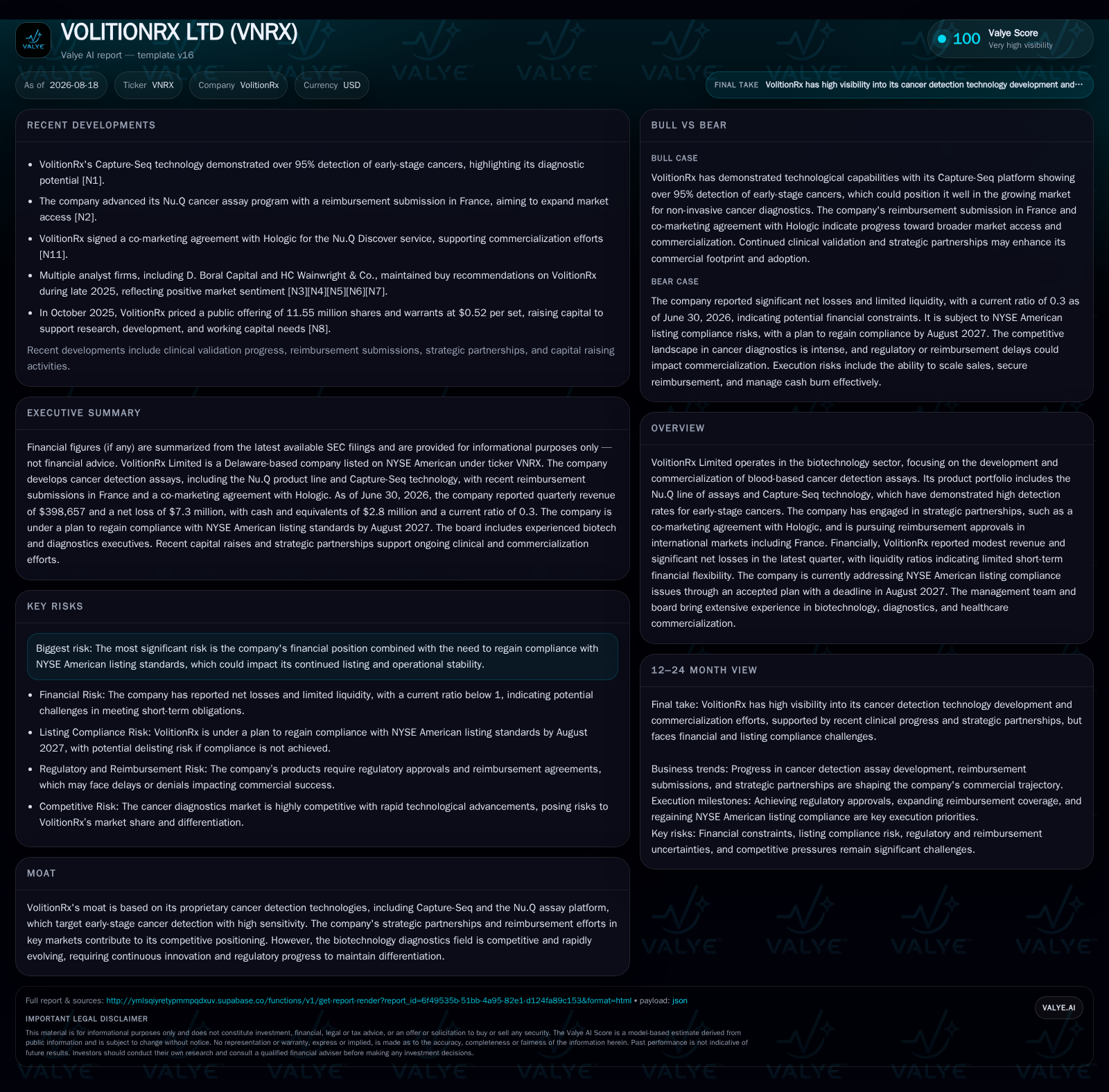
VolitionRx Limited develops blood-based molecular diagnostics focusing on early-stage cancer detection via its Nu.Q assay platform and Capture-Seq technology. The latest quarterly filings reveal modest revenue generation but large net losses, with a precarious liquidity position marked by a low current ratio and significant debt. The firm is actively working to regain NYSE American listing compliance with a plan accepted through August 2027. Strategic partnerships and reimbursement pursuits are key pillars for commercialization, although financial sustainability and market adoption remain critical hurdles.
Recent Operating Update
On the balance sheet front, VolitionRx reported cash and equivalents of approximately $2.8 million as of June 30, 2026 [F1], sharply outpaced by current liabilities of nearly $13.5 million leading to a current ratio of just 0.3 [F1]. Such liquidity constraints signal potential challenges in funding ongoing operations without additional capital infusion, especially given the cash-intensive nature of biotech R&D and commercialization ramp-up.
Debt stands at an estimated $22.5 million with net debt (debt minus cash) close to $19.7 million as of mid-2026 [F1], reflecting high leverage for a diagnostics developer at this stage. These factors underscore financial flexibility risk and heighten reliance on successful fundraising or licensing monetization to sustain progress.
Adding complexity, the company disclosed receipt of NYSE American's acceptance of its plan to remedy prior deficiencies in listing standards relating to minimum stockholders’ equity thresholds [S4]. The plan grants VolitionRx until August 6, 2027 to regain compliance or face potential delisting proceedings. This timeline provides breathing room but places emphasis on improving financial health or market capitalization metrics within this horizon.
Business Model Overview
VolitionRx operates within the molecular diagnostics subsector focused specifically on blood-based cancer detection assays designed for early diagnosis through minimally invasive testing methods. Its proprietary product suite includes the Nu.Q line — assays measuring circulating nucleosomes as tumor markers — accompanied by Capture-Seq technology enhancing biomarker sensitivity [S1]. These platforms are engineered to detect cancers at earlier stages when intervention outcomes improve substantially.
Revenue generation stems primarily from sales of these diagnostic assays to clinical laboratories or healthcare providers who administer tests to patients. Given typical industry practice, pricing depends on negotiated contracts often involving reimbursement approval status which drives payer coverage compelling physician adoption.
Complementing direct sales efforts are strategic partnerships such as the co-marketing agreement with Hologic aimed at amplifying distribution reach within established diagnostic networks [S1]. In addition, ongoing reimbursement submissions particularly targeting European markets like France indicate attempts to secure insurance payor coverage — an essential step for scaling uptake beyond research or niche clinical use environments.
Margins are currently pressured given substantial R&D expenditure relative to revenue base alongside costs associated with regulatory filings and sales infrastructure buildout noted in disclosures indicating elevated operating expense intensity [F1]. Successful attainment of reimbursement approvals coupled with higher test volumes will be critical levers to achieve positive gross margins over time.
Industry Structure and Competitive Positioning
Molecular diagnostics targeting oncology forms a highly dynamic segment characterized by rapid technological evolution, stringent regulatory oversight including FDA clearances where applicable, and complex payer reimbursement landscapes. Early-stage cancer detection via liquid biopsy or blood assays represents a growth focus attracting intense competition from peers such as Exact Sciences Corporation (known for Cologuard), Guardant Health (specializing in circulating tumor DNA), Illumina (sequencing technologies), Myriad Genetics (hereditary risk testing), and Foundation Medicine (genomic profiling).
VolitionRx’s differentiation rests on its unique biomarker approach using nucleosome assays which potentially offer sensitivity benefits specifically geared towards multiple cancer types detectable via simple blood draws [S1]. However, clinical utility must continuously be proved through validation studies showing diagnostic sensitivity and specificity comparable or superior to alternatives while managing regulatory conformity.
The company's relatively small scale compared to established peers necessitates reliance on strategic alliances for marketing and distribution effectiveness — exemplified by its Hologic co-marketing deal — positioning it more as a niche innovator rather than mass-market incumbent currently.
Growth Drivers
Key growth enablers for VolitionRx include rising global awareness around the prognostic value of early cancer detection tests which improve survival rates and reduce treatment costs when diagnosed timely. Advances in molecular biology fueling discovery of novel biomarkers also expand opportunities for enhancing assay performance metrics that underpin customer adoption decisions.
Achieving broader reimbursement coverage plays an outsized role in unlocking clinical market penetration since payor acceptance directly influences clinician ordering patterns in diagnostic workflows. VolitionRx’s active pursuit of international reimbursement approvals signals management focus on this pivotal gatekeeping element [S1].
Further technological refinements reducing cost per test and turnaround time can boost volume scalability by increasing attractiveness relative to invasive biopsy methods or imaging modalities that have higher patient burden or lower sensitivity profiles.
Finally, leveraging strategic partnerships enhances geographic reach and credibility with healthcare providers accelerating trial usage into routine screening protocols if evidence builds favorably.
Risks and Constraints
The company's most prominent risk lies in its fragile financial footing highlighted by low liquidity ratios alongside high net leverage exposing vulnerability to funding shortages amid prolonged operating deficits [F1]. Additional capital raises might dilute existing shareholders or add costly debt burden if unfavorable.
While NYSE American has granted an extension plan to address listing compliance issues until mid-2027 [S4], failure to satisfy equity threshold requirements within this period risks delisting which could materially disrupt trading liquidity further impeding fundraising ability.
Commercial execution risks also loom given formidable competition from larger incumbents wielding more robust technology portfolios and established payor relationships diminishing VolitionRx’s market share potential absent clinical differentiation or faster regulatory wins.
Moreover, regulatory delays or adverse findings during clinical validation could stall time-to-market expansion thereby elongating cash burn cycles without commensurate revenue growth support [S18]
Market acceptance depends heavily on physician education about novel biomarker assays; insufficient uptake would constrain test volumes necessary for improved unit economics.
What To Watch Next
Near-term catalysts include progress updates on reimbursement approval statuses particularly in European jurisdictions where initiatives are underway [S1]. Confirmation of increasing assay commercial volumes or expansion of partner collaborations—especially delivery milestones under the co-marketing agreement—would be positive signals supporting business model scalability.
Monitoring quarterly earnings releases for shifts in operating loss trajectories or improvements in cash runway metrics will illuminate whether liquidity pressures are easing or intensifying [S2], [S3]. Additionally, capital raise announcements or convertible note adjustments should be assessed carefully due to their impact on solvency and shareholder dilution.
Regulatory milestones such as FDA clearance if pursued would represent critical inflection points boosting market credibility alongside potential clinical guideline incorporations enhancing test adoption dynamics.
Finally, adherence progress against the NYSE American compliance plan deadlines will serve as a barometer of corporate governance confidence impacting investor perception.[S4]
Financial Profile Discussion
VolitionRx’s financial snapshot as of mid-2026 reveals constrained liquidity with only about $2.8 million cash against substantial short-term liabilities near $13.5 million yielding a current ratio at roughly 0.3 [F1]. This gap underscores challenges in sustaining near-term obligations without external financing support.
Total debt stood near $22.5 million resulting in significant net leverage around $19.7 million considering available cash resources further emphasizing capital structure vulnerability at this stage [F1]. This financial profile dictates careful resource management pending delivery of commercial milestones that might attract partnership revenues or licensing fees augmenting cash inflows.
In summary, while VolitionRx holds promising proprietary assay technologies addressing promising oncology indications supported by strategic partnerships facilitating market access, it remains reliant on navigating considerable financial headwinds alongside evolving industry competition and regulatory hurdles essential for bridging from developmental phase toward sustainable commercial enterprise.
This analysis is grounded strictly in available filings dated through August 2026 without speculative forecasts or investment research views.
Disclaimer: This is research-only, informational analysis and not investment advice. It may include AI-generated interpretation and general industry context. Always verify important details using primary sources.

Comments