
Greenwave Technology: Strategic Facility Expansion and Market Diversification in Scrap Metal Recycling
Greenwave Technology Solutions deepens its footprint in scrap metal recycling through operational scale-up and targeted logistics investments amid a challenging financial and commodity price environment.
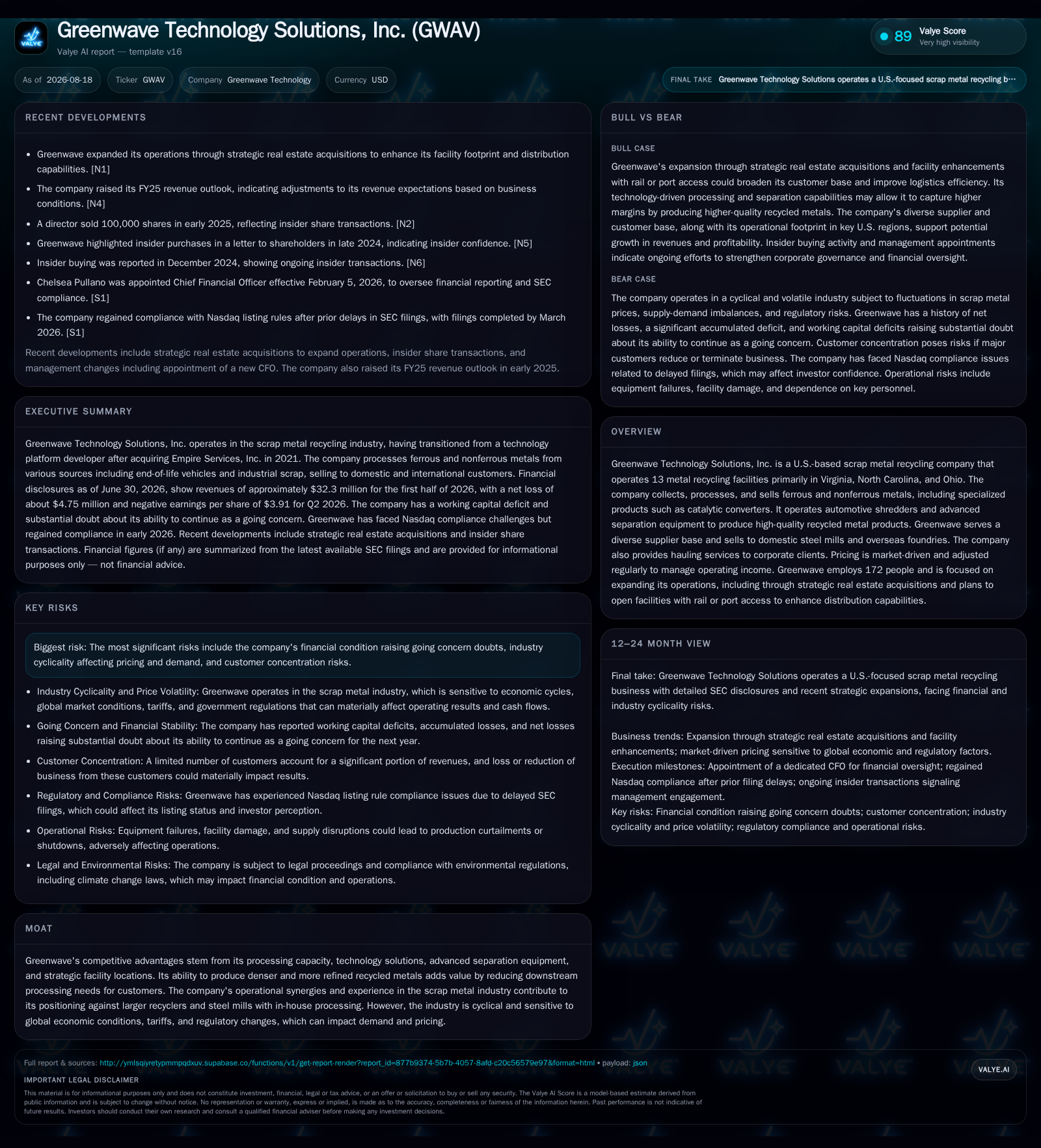
Greenwave Technology Solutions, following its acquisition of Empire Services, has invested in broadening processing capacity across 13 facilities concentrated in Virginia, North Carolina, and Ohio. Its latest quarterly filing highlights rising inventory and accounts receivable balances alongside sales concentration risks. The company prioritizes opening a strategically located rail or port-accessible facility to diversify market reach and enhance distribution efficiency. Industry cyclicality, pricing volatility, and existing financial constraints including a going-concern qualification remain key risks. Execution on capacity expansion and customer diversification will be critical near-term milestones to monitor.
Latest Operational Shifts from Latest Quarterly Filing: Capacity Growth and Customer Dynamics
Greenwave Technology Solutions’ latest quarterly filing dated August 18, 2026 outlines operational shifts reflective of its ongoing transition into an expanded scrap metal processor following the full integration of Empire Services’ operations. Inventory levels increased materially to approximately $3.19 million as of June 30, 2026 from $2.24 million at December 31, 2025 [S9], consistent with growing tonnage processed or stockpiling amid volatile pricing conditions. Accounts receivable rose from about $1.12 million to $1.68 million over the same period [S9], indicating increased sales activity but also heightened exposure to customer credit risk.
Revenue concentration marks a notable risk vector: four customers represented roughly 65% of revenues for the three months ended June 30, 2026 [S12]. Such a high degree of customer concentration heightens revenue volatility since the loss or meaningful volume reduction from any large client poses outsized adverse effects on operating cash flow stability. This dynamic warrants monitoring as Greenwave pursues broader market penetration.
Advanced Processing Techniques Enhancing Product Grade in Ferrous and Nonferrous Scrap Lines
Greenwave’s business model centers on acquiring various scrap inputs including automotive bodies—with catalytic converters removed separately—as well as industrial machinery and construction materials. The company’s two automotive shredders, located in Carrollton, VA and Kelford, NC, are designed to produce shredded metal pieces approximating baseball size [S1]. This shredding capability combined with magnetized conveyor belts and advanced separation equipment enables the sorting of ferrous from nonferrous metals such as zorba (primarily aluminum) and zurik (stainless steel), achieving higher metal density and grade consistency [S1].
This refinement reduces downstream processing required by steel mills or foundries purchasing Greenwave’s products—translating into value-add by reducing their costs—and supports premium pricing aligned with product quality. The ability to produce denser shredded metal is an important differentiation against competitors that yield lower-quality scrap requiring additional reprocessing.
Geographic Expansion Focus: Rail and Port Facility as Key to Market Access Diversification
A critical strategic priority highlighted in Greenwave’s recent annual filing is the planned opening of a new scrap metal processing facility equipped with rail or deep-water port access [S1]. Current operations mostly serve regional buyers mainly along road transport routes within Virginia, North Carolina, and Ohio. Establishing direct rail or port connections expands addressable markets geographically to domestic steel producers outside these states as well as overseas foundries able to import via maritime routes.
The logistical advantages promised include cost reductions in shipping bulk dense metal products over longer distances plus access to higher-margin export markets less constrained by regional demand fluctuations. This infrastructure investment can thus potentially improve both top-line growth prospects via market diversification and operating profitability by lowering per-unit freight costs.
Industry Cyclicality Meets Commodity Price Volatility: Pricing Pressure and Demand Risks
Metal recycling is inherently cyclical given its direct dependence on global steel production volumes and raw material supply-demand imbalances [S1][S2]. Tariffs, quotas, sanctions, import restrictions, and fluctuating currency exchange rates all modulate scrap metal prices from quarter to quarter [S1]. For Greenwave specifically, substantial decreases in scrap prices depress operating results while cyclical downturns reduce volumes through lowered end-user steel mill demand.
These external macro factors impose volatility risks beyond company control impacting average selling prices per ton—a key revenue lever—and subsequently gross margins. While Greenwave employs market-driven pricing adjustments regularly [S1], persistent price softness pressures cash flows and capital allocation decisions.
Customer Concentration Implications for Revenue Stability Amid Market Uncertainty
Accounts receivable detail across multiple filings emphasize that a small number of customers generate a large share of revenues—for example, four customers accounted for over one third of revenues each during recent quarters totaling more than 65% collectively [S6][S12]. This dependency exposes Greenwave to client-specific credit risk as well as demand concentration risk.
Contracts permitting termination with notice increase uncertainty over retention duration; any volume reduction by large customers due to their own market swings or competitive options could swiftly affect Greenwave’s topline growth trajectory [S17]. Risk mitigation through broadening the customer base or locking longer-term agreements thus appears crucial for revenue stability.
Growth Opportunities: Sustainability Trends and Logistics Infrastructure Investments
Greenwave stands positioned to capitalize on secular growth trends favoring recycled metals owing to circular economy initiatives globally seeking environmental impact reductions by minimizing virgin ore extraction. Such tailwinds underpin increasing steel production reliance on recycled ferrous content as well as expanded use cases for refined nonferrous materials.
Investment in an intermodal-capable facility combining proximity to rail lines or ports aligns well with expanding export opportunities given global steelmaking concentrations outside the U.S., enhancing logistic efficiency—an acknowledged cost component particularly relevant for bulky shipments like scrap metals [S1]. Combined with incremental haulage services launched recently using its owned truck fleet [S7], these infrastructure moves can create synergies improving overall operating margins.
Financial Profile Discussion: Liquidity Constraints, Debt Position, and Going Concern Assessment
Despite operational scaling efforts, Greenwave’s financial position evidences significant liquidity constraints. As of June 30, 2026 the company reported cash balances under $655k against current liabilities exceeding $29 million yielding a current ratio near 0.23 [F1][S9]. Total debt figures approximate $3 million netting closely against available liquidity [F1].
The company has recognized recurring losses limiting internal cash generation—operations lost nearly $3.92 million through H1 2026—and management continues flagging substantial doubt about going concern status within SEC filings [S2][S18]. Such conditions impose headwinds on accessing external capital on favorable terms necessary for funding capital expenditures vital for capacity expansions or new facility developments.
Debt maturities clustered within coming quarters combined with limited cash reserves complicate the financial runway further despite profit improvement aspirations anchored on logistics-enabled growth.
What to Watch Next: Facility Opening Milestones, Pricing Trends, Customer Retention Signals
Upcoming catalysts that would signal progress include concrete milestones around commissioning the new rail- or port-accessible recycling center highlighted in corporate priorities [S1]. Successful launch could materially extend market reach beyond current regional confines.
Metal scrap pricing trajectories remain critical leading indicators for margin recovery potential amid cyclical pressures—monitoring raw material cost regimes alongside end-user steel demand offers directional visibility into near-term earnings stability.
Efforts toward customer diversification reflected in receivables composition updates will reveal whether management effectively mitigates concentration risks that have historically impacted revenue predictability [S12]. Monitoring changes here alongside contract renewal announcements warrants attention.
While Greenwave Technology Solutions possesses valuable operational assets—including proprietary shredding setups producing value-enhanced ferrous/nonferrous grades—and strategic logistical ambitions positioning it for broader market participation, firm financial constraints coupled with sector cyclicality pose tangible execution risks. How effectively management navigates these challenges through disciplined capital deployment, enhanced customer diversification strategies, and leveraging infrastructure improvements will shape sustainability of its scaled recycling business model moving forward.
This analysis focuses solely on publicly filed information without expressing investment opinions.
Disclaimer: This is research-only, informational analysis and not investment advice. It may include AI-generated interpretation and general industry context. Always verify important details using primary sources.

Comments