
Estrella Immunopharma Boosts STARLIGHT-1 Trial With New Site Expansion Amid Funding Tightness
Estrella Immunopharma advances its Phase I/II STARLIGHT-1 trial with a new Cleveland site, while tight liquidity raises operational risks.
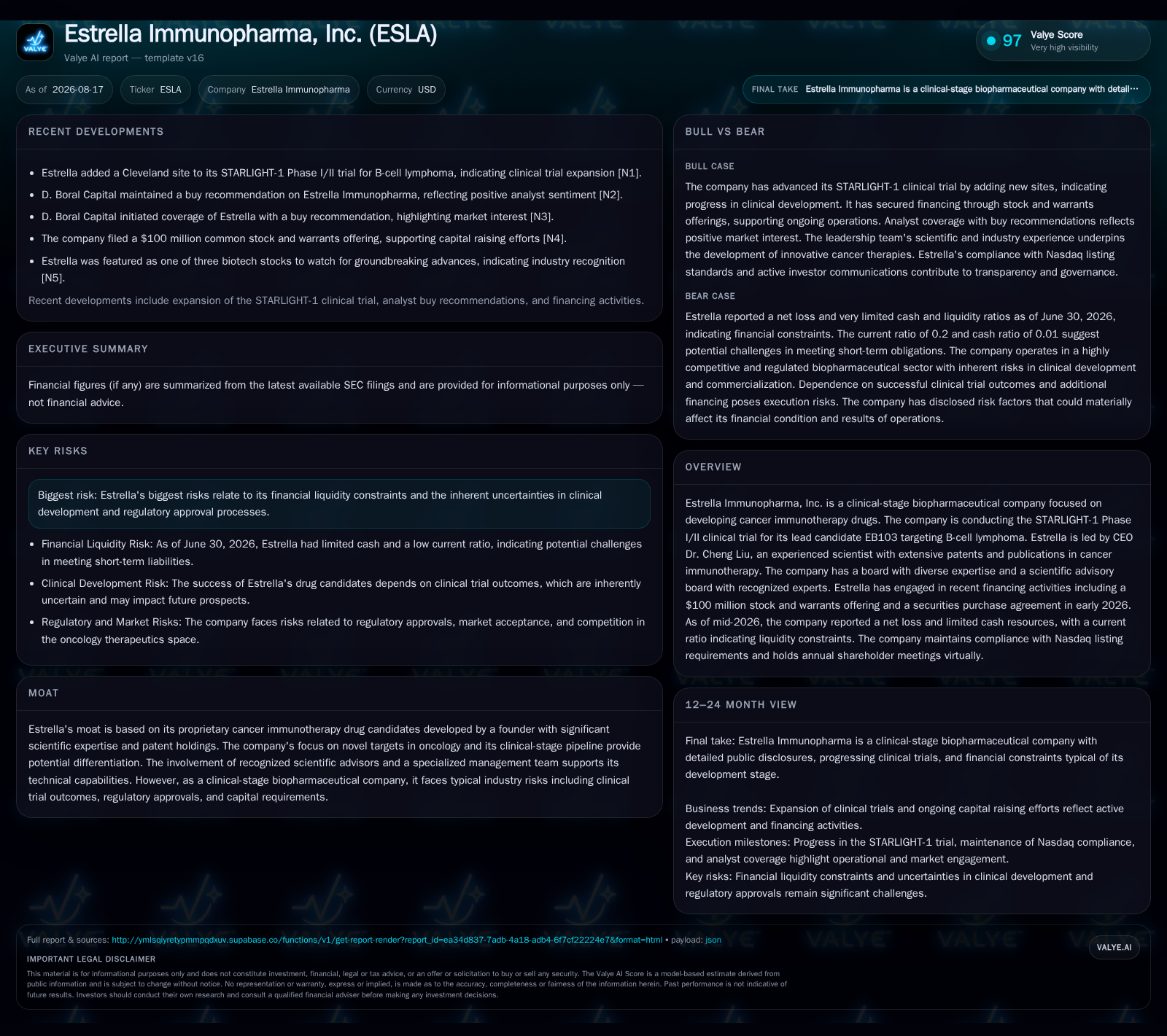
In its August 2026 quarterly filing, Estrella Immunopharma disclosed the addition of a Cleveland clinical site to its STARLIGHT-1 trial, enhancing patient enrollment capacity for its lead immunotherapy candidate targeting B-cell lymphoma. This clinical progress aligns with prior positive safety and dose cohort milestones and reflects a strategic push to accelerate trial phase progression. However, the company faces acute funding constraints, evidenced by a current ratio near 0.2 and limited cash reserves of $100,000 as of June 2026, underscoring the need for timely capital infusion to sustain clinical operations. Estrella’s business model depends heavily on advancing clinical milestones to unlock future licensing or partnership revenues, placing heightened emphasis on trial execution amid financial pressure. The competitive oncology immunotherapy landscape demands swift progress and strong intellectual property protection, areas where Estrella’s scientific leadership strengthens its positioning despite sector-wide risks.
Latest Quarter Signals: Expanded Clinical Trial Footprint Meets Steep Liquidity Challenges
Estrella Immunopharma recently enhanced the STARLIGHT-1 Phase I/II clinical trial by adding a new site in Cleveland focused on B-cell lymphoma patients for its lead immunotherapy candidate EB103 [N1], [S2]. This expansion is a strategic move to accelerate patient enrollment—a critical KPI influencing the pace at which safety and efficacy endpoints can be reached. Efficient enrollment underpins timely Data Safety Monitoring Board (DSMB) reviews and progression through trial phases, which are essential for maintaining investor confidence and advancing toward regulatory submissions.
However, this operational advancement contrasts starkly with the company's precarious financial position. As of June 30, 2026, Estrella held only $100,000 in cash equivalents against current liabilities exceeding $9 million, resulting in a current ratio near 0.2—well below healthy liquidity benchmarks [F1]. This imbalance highlights an urgent need for additional funding to sustain ongoing trial activities without interruption.
The dual reality of expanding clinical operations during constrained liquidity frames the company's immediate challenge: maintaining momentum in patient recruitment and trial execution while navigating financial strain that could imperil these efforts if not addressed promptly.
Business Model Anchored in Milestone-Driven Clinical Development
Estrella's business model typifies that of early-stage biotech firms developing proprietary biologics aimed at oncology immunotherapy. Revenue generation is contingent on reaching clinical milestones—such as successful dose escalation, favorable safety/tolerability profiles from Phase I cohorts, positive DSMB research views enabling Phase II progression, and ultimately regulatory approval—rather than product sales at this stage [S1]
This milestone-driven framework means that capital deployment is heavily skewed toward research and development expenses necessary to conduct complex trials involving biologic manufacturing, patient monitoring, and data management. Intellectual property protection serves as a critical competitive moat; Estrella’s leadership under CEO Dr. Cheng Liu brings notable scientific expertise aligned with strengthening this defensive barrier around their drug candidates [S1].
Without commercial products or recurring revenues, Estrella relies significantly on equity financing rounds and strategic partnerships to fund operations until triggering monetization events.
Competitive Context: Navigating a Crowded Oncology Immunotherapy Landscape
Within the oncology immunotherapy sector, Estrella competes against clinical-stage peers advancing similar therapeutic modalities. Established players like Kite Pharma and Adaptimmune set benchmarks for trial design rigor—including cohort size scaling, endpoint robustness, and safety monitoring protocols—and rapid advancement through Phase I/II stages.
Estrella’s recent successful completion of Phase I dose cohorts followed by positive DSMB research views aligns it with these industry standards but requires continuous demonstration of meaningful differentiation versus existing standard-of-care treatments or alternative immunotherapies to attract partner interest and licensing opportunities [S4], [S5]. The company’s intellectual property portfolio breadth relative to competitors will be instrumental in securing these deals that can extend funding beyond initial clinical milestones.
Manufacturing readiness remains a future consideration as late-stage development approaches but currently is less immediate given focus on early-phase clinical validation.
Growth Drivers: Enrollment Acceleration, DSMB Endorsements, and Financing Infusions
Key growth catalysts stem from operational execution factors. The addition of the Cleveland site directly supports accelerating patient recruitment—a vital input for achieving trial endpoints within targeted timelines [N1]. Rapid enrollment facilitates successive DSMB evaluations that validate safety profiles and justify progression through trial phases; prior DSMB endorsements have already enabled transition into Phase II following positive data from earlier dose cohorts [S4], [S5]. These safety confirmations bolster investor confidence by mitigating execution risk.
Financially, the January 2026 registered direct offering raised approximately $8 million gross proceeds providing essential working capital to fund ongoing R&D activities; however, current liquidity metrics suggest this runway remains tight given persistent cash burn rates typical in biotech development cycles [S17], [F1].
Future partnering or licensing agreements could serve as significant upside triggers contingent upon demonstrating compelling differentiation through interim data or regulatory interactions.
Watchpoints: Liquidity Constraints Amid High Burn Rate Pose Execution Risks
Despite recent fundraising success, Estrella faces acute liquidity challenges threatening continuity if further capital is not secured expeditiously [F1]. The company’s reported cash reserves of $100K versus over $9 million in short-term liabilities illustrate severe working capital constraints that could force operational compromises such as slowing patient enrollment or delaying regulatory filings—both detrimental to valuation and competitive stance
Maintaining uninterrupted clinical momentum requires careful balance between accelerating trial activities—which inherently increase cash outflows—and securing fresh funding or strategic partnerships before depletion risks materialize.
Such dynamics are common among oncology-focused biotechs where lengthy approval processes precede commercial revenues; therefore efficient cash management combined with timely financing execution often dictates survival and ultimate success.
Upcoming Milestones: Enrollment Metrics, DSMB Reviews, and Capital Raising Plans
Investors should monitor forthcoming updates on patient enrollment rates across existing sites plus integration progress at the newly added Cleveland location announced in August 2026 [N1]. Subsequent DSMB findings remain pivotal since their risk-benefit assessments determine ongoing trial phase progression within the STARLIGHT-1 protocol framework previously demonstrated by DSMB approvals facilitating Phase II initiation [S4], [S5].
Additionally, market attention should focus on announcements regarding potential licensing deals or strategic partnerships that would validate pipeline value commercially while addressing pressing liquidity needs.
Finally, disclosures related to future capital raises beyond those completed in January will provide critical insight into the company’s ability to maintain financial health necessary for uninterrupted drug development.
Financial Profile Discussion
As of June 30, 2026, Estrella Immunopharma reported cash and equivalents totaling approximately $100,000 against current liabilities surpassing $9.25 million—yielding a current ratio near 0.2—that signals significant liquidity stress requiring near-term resolution [F1]. Operating losses recorded at about $13 million for calendar year-end December 31, 2025 reflect high R&D spending consistent with early-stage biotech companies without commercialized products.
The January 2026 securities purchase agreement raised roughly $8 million gross proceeds targeting healthcare-focused institutional investors provided a temporary buffer supporting ongoing clinical operations [S17]. Nevertheless, given continuing negative operating income trends coupled with sizeable liabilities levels, sustaining operations demands prompt access to additional capital or strategic collaborations to avoid disruptions that could delay STARLIGHT-1 program progress.
This financial backdrop underscores the critical importance of disciplined cash management and proactive financing strategies commonly observed among peers navigating prolonged development timelines preceding revenue generation.
This analysis synthesizes information from recent SEC filings through August 2026 alongside verifiable news sources while applying biotechnology sector expertise relevant to clinical-stage oncology immunotherapy developers like Estrella Immunopharma. Forward-looking statements remain speculative absent explicit company guidance.
Disclaimer: This is research-only, informational analysis and not investment advice. It may include AI-generated interpretation and general industry context. Always verify important details using primary sources.

Comments