
Atlas Lithium Advances Minas Gerais Project Through Key Permit Expansion
Recent expansion mining permit approval and operational updates from the Minas Gerais Lithium Project signal Atlas Lithium's advancing readiness for lithium concentrate production in Brazil’s Lithium Valley.
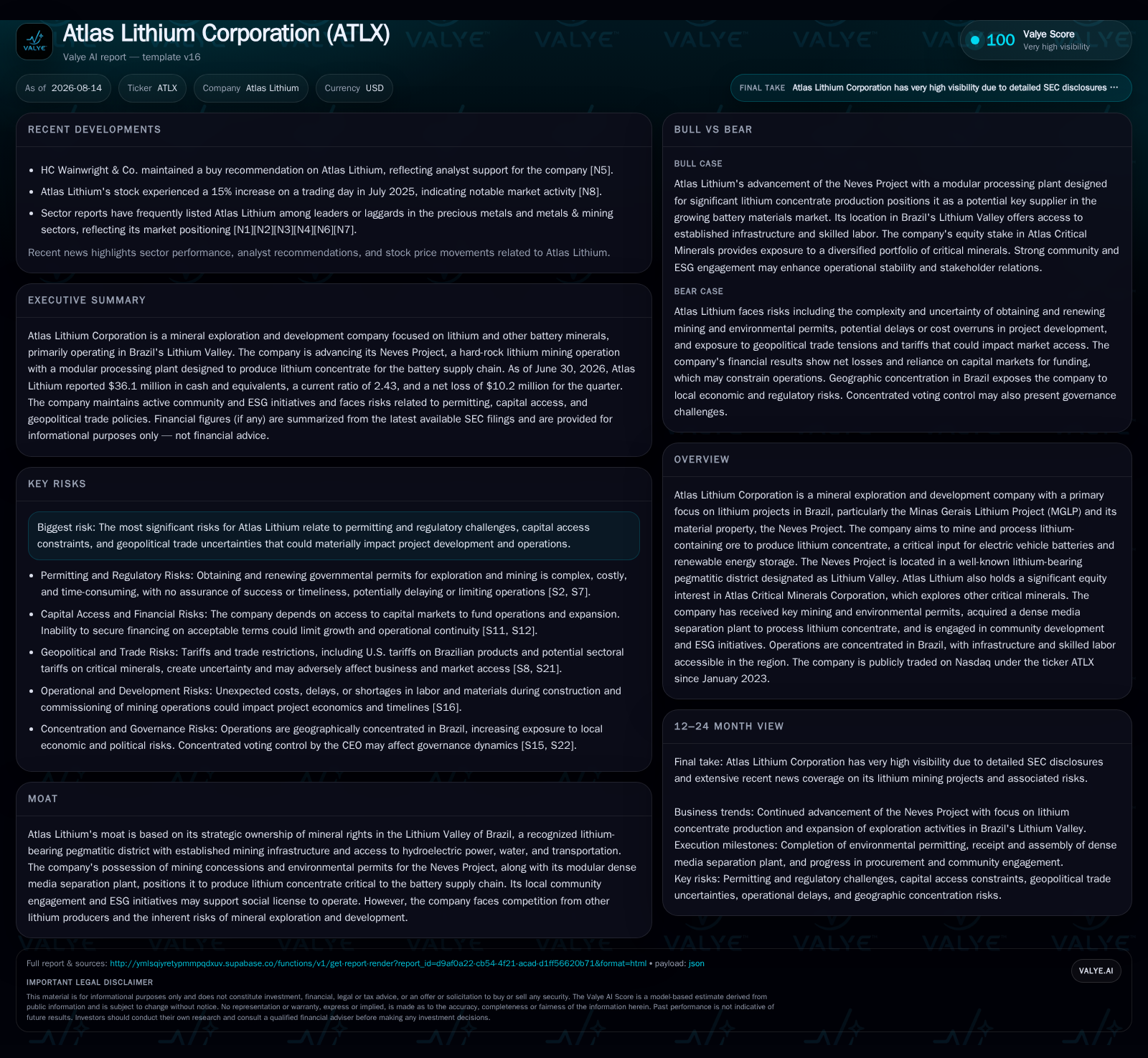
Atlas Lithium Corporation secured a pivotal expansion mining permit in June 2026, extending its operational footprint beyond the initial authorized area at its Minas Gerais Lithium Project in Brazil. This regulatory milestone, coupled with ongoing development of its modular dense media separation processing plant, positions the company to ramp up lithium concentrate production targeting battery supply chain customers. While benefiting from strategic positioning within the Lithium Valley and strong local infrastructure, Atlas must navigate execution risks typical of development-stage hard-rock lithium miners, including permitting timelines, capital needs, and market volatility. The company’s solid liquidity and absence of debt enhance its flexibility amid these challenges.
Expanded Mining Permits Redefine Project Development Scope
Atlas Lithium’s latest quarterly update highlights a significant regulatory milestone achieved in June 2026 — receipt of an expansion mining permit covering additional mining areas beyond the original concession awarded in October 2024 [S3][S1][S2]. This approval followed a protracted application process initiated in November 2024 and was formally published by state authorities shortly after the June vote. Such expanded permits materially increase the company's ability to access mineral reserves within its Minas Gerais Lithium Project (MGLP), enhancing overall resource control and aligning with the Definitive Feasibility Study's scale assumptions [S1][S3].
The importance of this regulatory advancement cannot be overstated in hard-rock lithium projects where permitting pace directly impacts capital deployment windows and revenue ramp timing. In Atlas’s case, the expanded permit enables not only mining operations but also formal assembly and operation of its lithium processing plant onsite—critical to producing battery-grade lithium concentrate [S3]. Achieving this milestone reduces execution uncertainty tied to environmental approvals common in Brazil’s jurisdictional setting.
Processing Capabilities and Hard-Rock Ore Quality Support Concentrate Production
Atlas Lithium operates within hard-rock spodumene pegmatitic deposits that require beneficiation processes such as dense media separation (DMS) to yield lithium concentrate acceptable for downstream chemical conversion into battery materials [S1]. The company has acquired a modular DMS plant designed for onsite processing at its Neves Project area within MGLP, which underpins its business model through product monetization by selling spodumene concentrate to battery manufacturers or chemical processors.
Operational efficiency metrics like processing plant uptime and recovery rates are leading KPIs that will shape near-term volume ramp-ups [S1][S2]. The costly capital outlay inherent in assembling complex DMS equipment necessitates high uptime performance to advance toward commercial production economies of scale. Furthermore, concentrate quality linked to ore grade impacts buyer acceptance and pricing power within the competitive lithium supply chain landscape dominated by large integrated producers such as Albemarle or peer hard-rock developers like Piedmont Lithium
Strategic Position Within Brazil’s Lithium Valley Enhances Regional Infrastructure Access
Atlas’s mineral rights lie precisely within Brazil’s recognized Lithium Valley pegmatitic district — a geographic cluster favored for lithium mining due to previously documented rich spodumene deposits and robust regional infrastructure supporting mining activity [S1]. This location advantage translates into lower energy costs given available hydroelectric power, reliable water resources essential for mineral processing, and transportation networks that facilitate product shipment.
Such factors confer Atlas a competitive edge over more remote or greenfield exploration projects lacking established local support systems. Within this context, Sigma Lithium serves as a Brazilian peer reference point demonstrating how regional positioning can accelerate project advancement through infrastructure leverage despite still facing typical development-stage challenges.
ESG and Community Relations as Enablers of Sustainable Mining Operations
Environmental compliance governed at the state level incorporates strict monitoring protocols that Atlas reportedly meets or exceeds as part of its operational commitment [S1]. The company actively engages with local communities and pursues environmental, social, and governance (ESG) initiatives designed to uphold its social license to operate. This facet is increasingly crucial amid tightening global scrutiny on mining operations’ societal impacts.
Recent resolution of community-related litigation through negotiated agreements involving infrastructure donations exemplifies how proactive engagement mitigates risks related to labor disputes or opposition that might otherwise delay permitting or disrupt operations [S25]. These efforts align with industry-wide trends recognizing ESG metrics as value-inflecting factors alongside traditional operating KPIs.
Growth Catalysts Driven by EV Battery Demand and Regulatory Progress
Macro drivers underpinning Atlas’s growth trajectory include accelerating global adoption of electric vehicles and expanding renewable energy storage solutions fueling demand for lithium-ion batteries. Consequently, spodumene concentrate production remains a sought-after upstream commodity within supply chains prioritizing raw material diversification away from dominant global producers.
Regulatory progress such as the recent permit expansion reduces barriers-to-entry effects typically impeding juniors progressing toward production readiness. Linked KPIs like measured mineral reserves growth potential post-expansion or anticipated production volume targets—as infrastructure upgrades materialize—offer tangible markers validating positive development momentum.
Risks Centered on Permitting Delays, Capital Access, and Market Volatility
Atlas faces sector-standard risks inherent to mineral exploration and development companies: permit renewal uncertainties may still surface despite recent wins due to administrative discretion or additional community challenges; ongoing need for substantial capital expenditures poses funding risk particularly if lithium prices experience cyclical downturns impacting project economics; geopolitical trade tensions between Brazil and major markets may influence export conditions or tariff structures [S9][S11][S26].
Operational risks during mine construction—including potential labor cost escalation or workforce shortages—also present threats that could elongate timelines or increase unit costs relative to peers. Industry peers like Piedmont Lithium have similarly grappled with such scaling risks emphasizing that robust project management capabilities are preconditions for successful transition from feasibility studies to commercially sustainable mining operations.
Financial Health Supports Continued Exploration and Development Activities
While still operating at a developmental stage with reported operating losses reflecting capital-intensive assembly phases (net loss approx $28 million in 2025) [F1], Atlas maintains a strong liquidity position with approximately $36 million in cash and equivalents as of June 30, 2026, against current liabilities under $15.4 million, yielding a current ratio of about 2.43—a solid short-term financial position supporting ongoing expenditures without immediate liquidity strains [F1].
Notably, the company reports no long-term debt on its balance sheet, providing balance sheet flexibility critical given potential variability in capital market conditions influencing future financing costs or availability. This conservative leverage profile aligns with many junior exploration firms prioritizing organic asset growth over debt incurrence during early-stage development.
Looking Ahead: Key Milestones to Monitor for Commercial Scale Production
Future catalysts shaping the investment relevance include sustained throughput increases at the DMS processing facility validating recovery consistency; monitoring progression through subsequent environmental permitting phases encompassing larger mined volumes enabled by the expansion permits; possible announcement of off-take agreements or strategic partnerships indicating market acceptance; updated resource estimations reflecting exploration success expanding reserves capacity; and cost optimization efforts reducing per-tonne concentrate production costs consistent with peer benchmarks.
Delays or cost overruns in these domains would challenge the positive forward thesis while prompt achievement improves prospects for eventual profitability and cash flow generation integral to long-term company viability.
This analysis synthesizes the latest regulatory approvals outlined in Q2-2026 filings alongside operational descriptions internally disclosed by Atlas Lithium Corporation through August 14, 2026. It places special emphasis on permit expansions as fundamental enablers of planned production scale-ups within the context of evolving lithium industry dynamics favoring hard-rock producers embedded in well-infrastructured regions like Brazil’s Lithium Valley.
Disclaimer: This is research-only, informational analysis and not investment advice. It may include AI-generated interpretation and general industry context. Always verify important details using primary sources.

Comments