
Western Uranium & Vanadium Advances Permitting and Proprietary Processing Amid Exploration-Stage Challenges
Latest quarterly updates highlight progress on mine permitting, deployment of proprietary processing technology, and a solid liquidity position supporting near-term development.
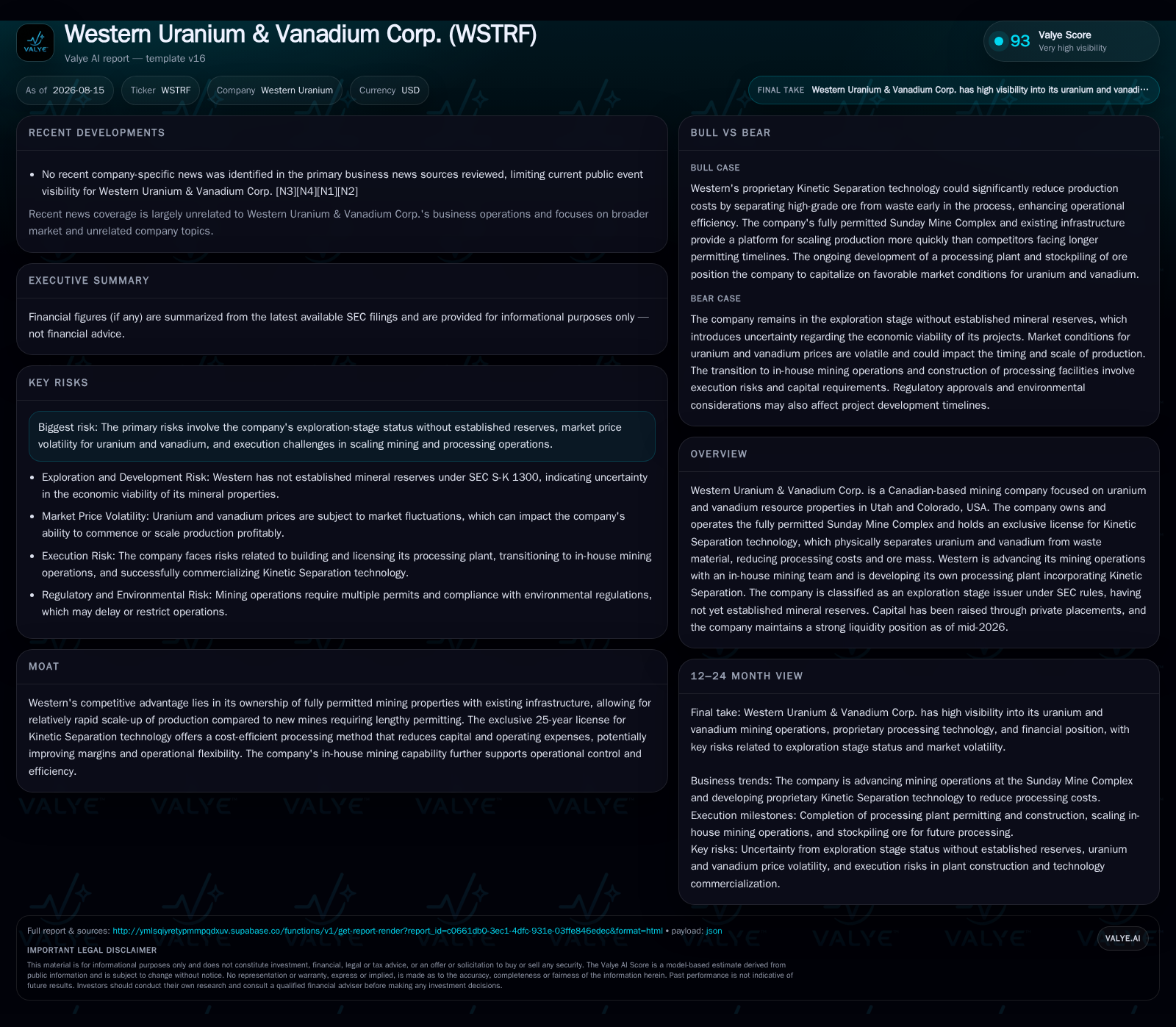
Western Uranium & Vanadium Corp.’s Q2 2026 filing confirms its advancement towards production readiness through leveraging permitted underground mining assets at the Sunday Mine Complex and its exclusive Kinetic Separation technology to reduce processing costs. Despite remaining an exploration-stage issuer without established mineral reserves, Western benefits from existing infrastructure and in-house mining teams while navigating typical execution risks amid a volatile uranium and vanadium commodity environment. The company’s liquidity position remains sound as of June 30, 2026, supporting ongoing capital expenditures tied to mine development and processing plant construction.
Q2 2026 Filing Highlights Operational Progress
Western Uranium & Vanadium Corp.’s latest quarterly report dated August 14, 2026 [S2] underscores continued operational progress without material changes in risk profile. The company maintains valid permits for all five mines within its core Sunday Mine Complex — Sunday, Carnation, St. Jude, West Sunday, and Topaz — with re-permitting actively pursued for the Topaz Mine currently slated for reclamation [S22]. This asset readiness provides a foundation for ramping underground mining operations supported by existing infrastructure such as underground haulageways, ventilation shafts with exhaust fans, paved highway access, electric power availability inside mine declines, and ancillary office/storage facilities [S22].
Liquidity remains adequate to support near-term development; as of June 30, 2026, Western reported cash and equivalents of approximately $3.52 million against current liabilities of $0.66 million yielding a robust current ratio near 6.19 [F1]. This financial footing enables sustained capital expenditures directed at scaling up mining activities internally and advancing the Mustang Mineral Processing Plant project [S1],[S23]. Operating expenses have decreased relative to prior periods due to cost containment measures but continue to prioritize key investments in mining capability [S1],[S23].
Business Model Anchored in Permitted Mines and Proprietary Processing
Western’s business model centers on upstream activities including resource acquisition, permitting/licensing, underground mine development, and ore processing innovation [S1],[S22]. The Sunday Mine Complex is a distinct competitive asset given its fully permitted status across multiple mines coupled with valuable infrastructure allowing faster operational scale-up compared with greenfield projects burdened by lengthy permitting cycles [S22].
A critical differentiator is Western’s exclusive license for its patented Kinetic Separation technology—valid for 25 years—which applies a physical separation method that isolates uranium and vanadium minerals from barren waste without chemical usage while achieving high recovery rates early in the process chain [S22]. This technique can reduce ore mass requiring downstream milling by roughly 85%-90%, thereby decreasing transportation costs, acid and power consumption during milling stages, tailings volume post-milling, and employee radiometric exposure risks [S22]. Such efficiencies are pivotal given energy consumption’s sizable role in operating costs within uranium milling.
Potential Cost Advantages from Kinetic Separation
By substantially lowering ore throughput requirements at the mill stage through pre-processing mass reduction, Kinetic Separation could materially reduce both capital (CapEx) and operating expenses (OpEx) relative to conventional wet milling approaches prevalent among uranium producers [S22]. Lower radiometric exposure times also enhance operational safety compliance under strict regulatory limits governing worker radiation doses. While precise cost-per-pound figures remain undisclosed pending commercial-scale validation, this technology offers a pathway toward improved operating margins by minimizing processing volumes while maintaining recovery rates above industry benchmarks [S22].
Industry Context: Supply Deficits Support Demand Outlook
Western’s filings highlight structural supply deficits in global uranium markets as utilities rebuild depleted inventories amid nuclear power expansion initiatives worldwide [S1]. These trends present positive demand drivers underpinning potential price appreciation over medium-to-long term horizons. Additionally, vanadium demand growth driven by steel alloy applications and emerging energy storage technologies complements Western’s multi-commodity exposure [S1]. However, timing of production scale-up hinges on commodity prices reaching levels sufficient to justify capital-intensive mining and processing investments.
Risks: Exploration Stage Status and Capital Requirements
Despite permitting progress and proprietary technology advantages, Western remains classified as an exploration-stage issuer without formally established mineral reserves or proven commercial production under SEC definitions—a critical risk factor consistently noted in filings [S1],[S2]. Absence of long-term off-take agreements or definitive reserve estimates introduces uncertainty around project economics sensitive to uranium/vanadium spot price volatility [S1],[S2]. Funding requirements remain significant; management emphasizes dependency on debt or equity financing to sustain mine development activities and Mustang plant construction [S1],[S2],[S23],[F1]. Failure to secure adequate capital could delay or restrict operational milestones. Execution risk further includes challenges inherent in underground mining scale-up alongside environmental compliance obligations.
Near-Term Catalysts: Licensing Approvals and Construction Milestones
Key upcoming value inflection points include obtaining full regulatory licensing for commercial deployment of Kinetic Separation machinery integrated into Mustang Mineral Processing Plant facilities designed specifically around this technology [S1],[S3]. Progress on plant construction will be a tangible indicator of production readiness once mining volumes from Sunday Mine Complex reach requisite feedstock levels supporting steady-state processing throughput [S1],[S3]. Re-permitting status updates at Topaz Mine also merit monitoring as they affect potential feedstock availability expansion [S25]. Market dynamics such as sustained upward price momentum or accelerated utility inventory restocking would further validate project feasibility timelines implied by management commentary.
Financial Profile Discussion
At quarter-end June 30, 2026, Western holds approximately $3.52 million in cash with current assets exceeding current liabilities by nearly sixfold (current ratio 6.19), providing short-term liquidity support for continued development activities [F1],[S2]. Total debt remains low based on last available data ($0.5 million from mid-2018), yielding a net cash positive position exceeding $3 million after accounting for liabilities [F1]. Nevertheless, annualized net losses reflecting ongoing investments into exploratory mining operations and processing plant buildout indicate that fresh capital raises remain essential absent revenue generation from mineral sales. Recent financings have primarily involved equity private placements without significant new debt issuance; tight expense management has extended operational runway but advancing Mustang plant construction will require additional funding according to management plans [S23],[S18].[F1]
Overall, Western Uranium & Vanadium emerges from its latest filings demonstrating concrete operational advancements anchored in permitted underground mines augmented by proprietary kinetic separation technology aimed at transforming ore beneficiation cost structures ahead of commercial production decisions. This positioning provides optionality beyond typical explorers lacking permit depth or technological differentiation but simultaneously demands overcoming exploration-stage hurdles including reserve confirmation delays coupled with market-driven capital constraints. Close attention to upcoming licensing milestones for kinetic separation authorization alongside Mustang plant construction progress will be critical indicators of transition toward producer status.
Disclaimer: This analysis is based exclusively on publicly available SEC filings dated August 14, 2026 or earlier supplemented by general industry knowledge frameworks. It does not constitute investment advice or research views regarding securities mentioned herein.
Disclaimer: This is research-only, informational analysis and not investment advice. It may include AI-generated interpretation and general industry context. Always verify important details using primary sources.

Comments