
OLB Group Advances Tokenized Securities Platform Amid Regulatory and Development Challenges
Development stage of CrowdPay-based application highlights tech and regulatory hurdles while equity raises support ongoing operations.
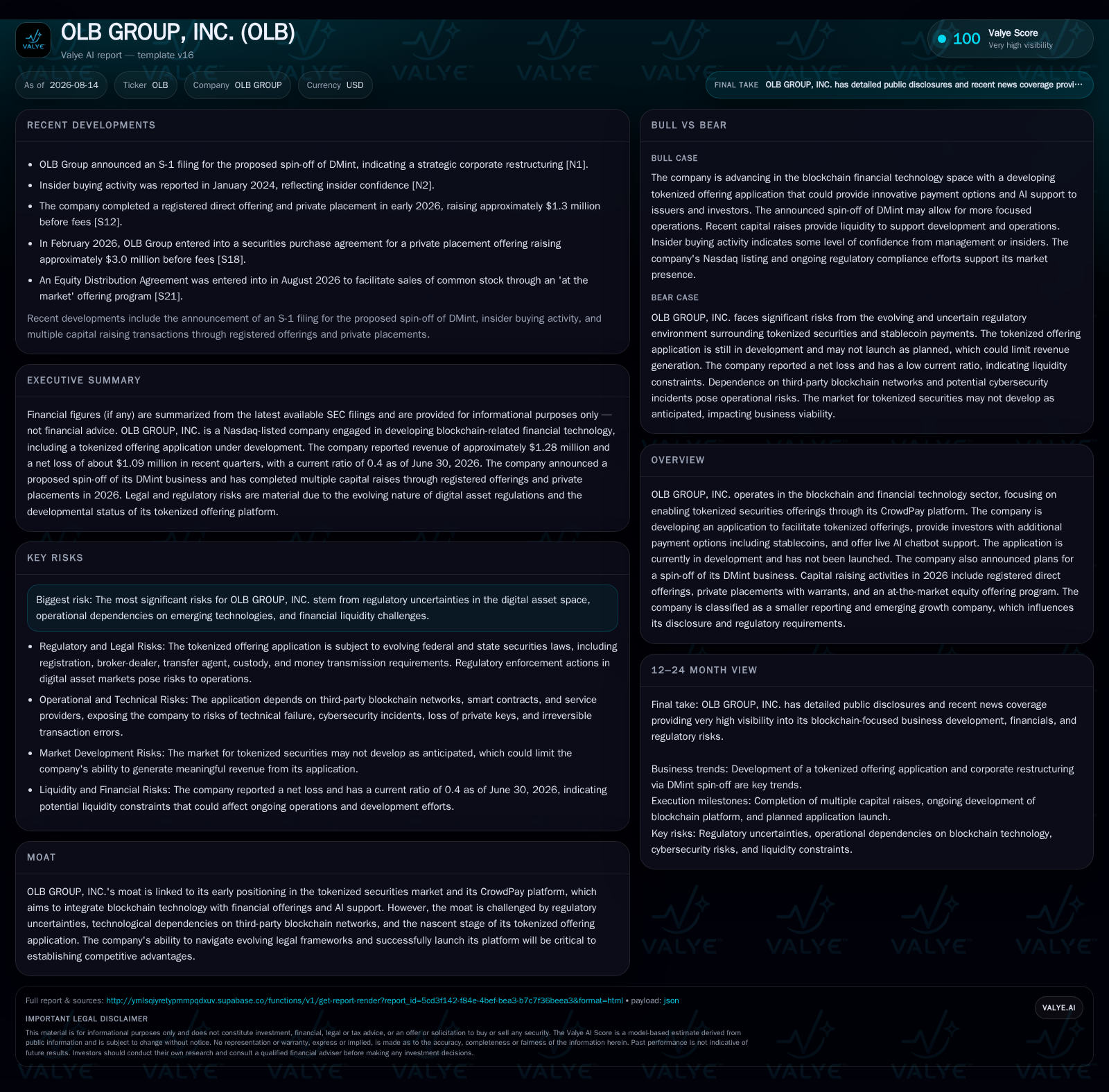
OLB Group, Inc. is developing a blockchain-powered application designed to facilitate tokenized securities offerings through its CrowdPay platform, integrating stablecoin payments and AI chatbot support. While the application remains in development with a tentative launch expected by early 2027, regulatory ambiguity around tokenized securities and stablecoin usage presents material risks. The company is pursuing capital raises via registered direct offerings and at-the-market programs to support operations amid ongoing technology build-out and spin-off plans for its DMint business. The success of OLB’s platform depends on regulatory clarity, third-party blockchain reliability, and market adoption of tokenized securities.
Recent Operating Update
OLB Group's latest 10-Q filing for the quarter ended June 30, 2026 reaffirms that its tokenized securities offering application remains in active development but has yet to launch [S2]. The company expects an initial update during Q4 2026 with a full launch targeted for early 2027, though this timeline carries uncertainty due to the complexities involved in both technology build and regulatory approvals.
Alongside product developments, OLB entered into an Equity Distribution Agreement with Maxim Group LLC in August 2026 to enable continuous at-the-market sales of common stock to bolster liquidity [S3]. This arrangement complements prior capital raises earlier in 2026 including registered direct offerings combined with warrants as well as private placements under Placement Agency Agreements [S6], [S11]. These financings reflect an ongoing need for operational capital during extended R&D cycles.
Importantly, OLB also announced plans to spin off its DMint business segment earlier in 2026, aiming to concentrate efforts on the blockchain-fintech CrowdPay platform while potentially unlocking value through a separate entity [S13]
Business Model
OLB positions itself within the blockchain-financial technology sector by focusing on delivering software infrastructure that facilitates "security token offerings" (STOs) through its CrowdPay platform. The core proposition centers on enabling issuers to create compliant tokenized securities distributed over public or permissioned blockchain networks leveraging smart contracts.
Revenue generation is expected from fees linked to transactions executed via the platform as well as value-added services such as investor payment processing through integrated stablecoins and AI-enabled chat support functionality. The planned application aims to streamline supply chain complexity behind digital securities issuance by embedding alternative payment rails beyond traditional fiat systems.
However, as the offering remains pre-launch, monetization currently depends heavily on continued capital infusion rather than recurring operating income [S2]. Cost structure likely sees elevated research & development expenses alongside legal/compliance overhead given the need for navigating federal/state frameworks impacting broker-dealers, transfer agents, custody requirements, and licensed money transmitters inherent in digital asset markets
The incorporation of live AI chatbot support is a strategic differentiator intended to improve investor decision-making experience and reduce customer acquisition costs over time — a key KPI for fintech platforms competing for user retention.
Industry Structure and Competitive Landscape
OLB operates upstream as a platform provider within the blockchain-fintech value chain focused on security token issuance. Peers include blockchain-based security token platforms such as tZERO and Securitize that offer integrated issuance, compliance tooling, digital wallet custody services, and secondary trading capabilities.
Unlike major digital asset exchanges like Coinbase or Circle which focus broadly on trading or stablecoin issuance/payment infrastructure respectively, OLB’s model zeroes in specifically on STO facilitation with bundled payment options including stablecoins provided by third parties. This specialization targets a niche yet expanding segment driven by investor demand for programmable assets but constrained by regulatory ambiguity.
A critical competitive hurdle is OLB's dependence on third-party blockchain networks—operational risks tied to smart contract execution failures or private key compromises present systemic vulnerabilities common across providers relying on distributed ledger technology.
Moreover, regulatory uncertainty regarding classification of tokenized securities under federal securities laws as well as state money transmission licensure requirements stymies faster industry adoption which benefits incumbents able to demonstrate compliance robustness.
Growth Drivers
Key growth catalysts include:
- Increasing institutional and retail interest in accessing alternative investment vehicles through tokenized securities reflecting digitization trends across financial markets.
- Progressing regulatory clarity facilitating broader STO issuances; legislative movements toward defined frameworks for security tokens underpin confidence.
- Advancements in blockchain scalability improving transaction speeds/costs thereby enhancing platform usability.
- Growing acceptance of stablecoins as viable payment rails inside digital finance ecosystems promoting interoperability.
- Integration of AI-driven automation improving investor engagement efficiency paralleling broader fintech trends toward personalization.
- Expansion potential via decentralized finance (DeFi) collaborations extending service scope beyond primary issuance into secondary markets.
- Strategic partnerships planned or potential with financial institutions enhancing distribution reach and trustworthiness.
Monitoring KPIs such as number of tokenized offerings facilitated upon full launch, volume transacted via the platform once operational, uptake rate of integrated payment options especially stablecoins, plus successful smart contract executions will be critical demand markers going forward.
Risks and Constraints
Regulatory risk stands paramount; evolving federal/state oversight introduces uncertainty over licensing needs potentially affecting platform features or forcing business model pivots [S2]. Enforcement actions in digital asset markets underscore reputational risks that could depress user confidence or invite litigation costs.
Dependency on third-party blockchains results in exposure to technical outages or irreversible errors that can degrade service reliability — a crucial factor given fintech customers’ expectations for near-perfect uptime [S2]. Cybersecurity threats remain an omnipresent hazard particularly concerning private key management.
The market for tokenized securities itself may not develop at forecasted pace due to investor skepticism or traditional incumbent resistance slowing mainstream financial ecosystem integration. Delays in product rollout compound these market adoption challenges.
Financially, limited liquidity with a current ratio approximating 0.4 signals tight short-term funding headroom that heightens reliance on continued equity issuance programs like the ATM sales agreement with Maxim Group [F1], [S3]. Sustained negative operating income from ongoing R&D spending underscores cash burn risk until commercial traction is attained [F1].
What to Watch Next
Key execution milestones will include:
- Delivery of the initial tokenized offering platform update expected in late 2026 followed by tracking progress toward full launch targeted early 2027 [S2].
- Regulatory developments impacting interpretation/enforcement of broker-dealer registration obligations and money transmission licenses affecting the application’s operational model.
- Progress reports or announcements clarifying status/terms of stablecoin providers’ licensing maintaining payment option viability.
- Updates on the DMint business spin-off process clarifying capital allocation focus.
- Capital raise outcomes through at-the-market program performance metrics including share volume sold and net proceeds realized under the Maxim Group agreement [S3].
- Platform usage KPIs post-launch: volume of offerings facilitated, active issuer/investor counts, transaction success rates reflecting operational stability.
Financial Profile Discussion
As of June 30, 2026, OLB reported current assets totaling approximately $2.7 million against current liabilities exceeding $6.7 million resulting in a low current ratio near 0.4 signaling potential liquidity constraints [F1]. This shortfall highlights dependence on equity financing activity which was notably active earlier in 2026 involving registered direct offerings raising roughly $1.3 million net along with private placements entailing warrants exercisable over multiyear horizons [S11], [S19].
Operating losses remain substantial; calendar year-end 2025 filings recorded operating income losses north of $5 million underscoring sustained investment phase status without material revenue generation thus far [F1]. Cash & equivalents are modest around $29 thousand reflecting concentrated cash usage primarily directed toward research & development alongside compliance/legal expenditure commitments inherent in fintech innovation paths [F1].
No recent debt refinancing or covenant-related disclosures limit assessment but net debt calculations suggest moderate leverage relative to scale emphasizing importance of additional funding events via equity sales or potentially strategic partnerships if platform adoption delays amplify cash burn risk [F1], [S3].
Maintaining access to capital markets at reasonable dilution levels while demonstrating visible progress against product roadmap will be paramount given upfront heavy investment characteristic of blockchain fintech platforms transitioning from concept to commercialization.
This analysis synthesizes reported SEC filings up to August 14, 2026 without attempting projections beyond stated guidance timelines. All operational interpretations assume no unforeseeable changes occur post-current disclosures.
Disclaimer: This is research-only, informational analysis and not investment advice. It may include AI-generated interpretation and general industry context. Always verify important details using primary sources.

Comments