
Atlassian’s Cloud Pivot and AI Ambitions Reshape Growth Trajectory
Atlassian reports nuanced Q3 2026 subscription metrics amid rising cloud adoption and substantial AI-driven R&D investment, reflecting a pivotal shift in its SaaS growth dynamics.
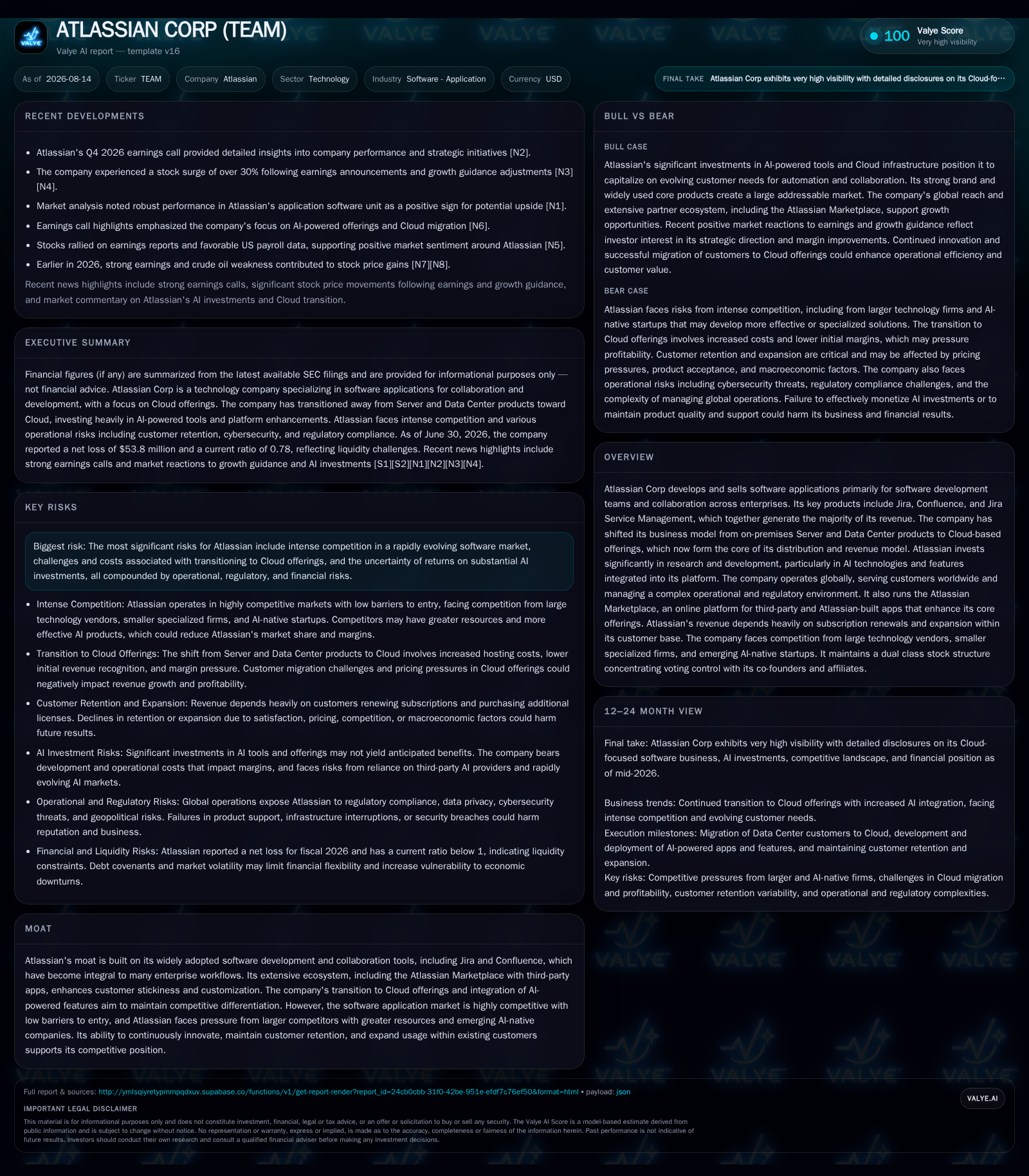
In its latest quarterly filing, Atlassian disclosed a moderation in subscription ARR growth but simultaneous acceleration in cloud revenue mix, underscoring progress in its strategic migration from legacy on-premises licenses to a cloud-centric model. The company’s intensified R&D focus on AI integration aims to strengthen competitive differentiation within a crowded software market. Marketplace third-party apps continue to enhance platform stickiness, supporting recurring revenue. However, challenges persist around sustaining high net revenue retention and managing competition from larger cloud incumbents and emerging AI-native firms. Financially, Atlassian maintains a net cash position after accounting for debt, enabling ongoing investments despite margin pressures.
Q3 2026 Key Operational Shifts in Subscriptions and Cloud Mix
This shift is material because it impacts gross margin profiles; cloud offerings generally yield higher margins over time but require significant upfront capital expenditures in infrastructure, R&D for service reliability enhancements, and sales/marketing adjustments. Atlassian noted improvement in certain operational efficiencies tied to cloud but also cited incremental costs associated with onboarding legacy customers onto newer models ([N1], [S3]). This transitional challenge modifies the company’s historical rapid growth narrative into a more nuanced scaling story.
Rethinking Customer Loyalty: Subscription Renewals and Net Retention Trends
Subscription renewals remain the backbone of Atlassian’s financial health. The company emphasized stable net revenue retention (NRR) rates fueled by seat expansion within existing accounts alongside high gross revenue retention (GRR), although absolute churn levels have introduced some headwinds for overall ARR acceleration ([S1], [S2]). Seat expansion refers to customers adding new users or teams on top of standard licenses – a key organic growth lever.
High NRR is essential for SaaS companies seeking durable organic growth without disproportionate acquisition spend. For Atlassian’s products like Jira and Confluence deeply embedded in developer workflows, platform inertia enhances stickiness. Still, management acknowledged potential cyclical softness or adoption drag given intense competition for wallet share among large enterprises ([N4]). Maintaining renewal discipline amid macro uncertainty is critical.
Marketplace Ecosystem's Role in Strengthening Atlassian’s Platform Stickiness
A distinctive feature of Atlassian’s model is its extensive Marketplace hosting thousands of third-party apps complementing core products. This ecosystem expands value beyond base subscriptions by offering tailored integrations which lock users deeper into the platform due to customization benefits ([S1]).
Marketplace transaction volumes contribute additional non-subscription revenue streams through app purchases or subscriptions alongside usage-based fees where applicable. This diversification supports resilience by reducing dependence on direct product upgrades alone. More importantly, it raises switching costs – migrating away means rebuilding custom workflows reliant on these ecosystem apps.
AI-Driven Innovation: Assessing R&D Investments and Strategic Differentiation
Atlassian is investing heavily in AI integration across its portfolio aiming not just for incremental feature enhancement but strategic differentiation amid intensifying competition ([S1]). Research & Development expenses have increased markedly with much directed toward embedding intelligent automation for collaboration insights, code review assistance, anomaly detection in workflows, and natural language querying capabilities.
These investments attempt to preempt rival moves by larger-scale peers such as Microsoft Azure DevOps / Teams or ServiceNow who have aggressively incorporated AI tooling themselves. Smaller AI-native startups also pressure incumbents by pushing innovation boundaries faster. However, the risk remains that returns on these investments hinge on both technical feasibility and market acceptance – requiring disciplined execution alongside scalable rollouts.
Competitive Contours: SaaS Peer Benchmarking on Growth, Retention, and Margins
Within the enterprise SaaS collaboration segment, Atlassian occupies a solid if challenging position. Its ARR growth rates and net retention metrics generally align well with peers like Salesforce or Adobe yet show signs of margin compression linked to its cloud migration costs ().
Compared with Microsoft Teams or Slack (Salesforce), which benefit from broader ecosystems or bundling advantages with office suites or CRM platforms respectively, Atlassian relies heavily on organic expansion through platform extensibility plus increasing seat counts across developer-heavy organizations.
readers may want to monitor that while Atlassian's marketplace breadth helps anchor recurring revenues uniquely compared to many competitors lacking such ecosystems — margin pressures from investment spending weigh on near-term profit conversion.
Growth Drivers: Seat Expansion, Enterprise Adoption, and Cross-Selling Potential
Key drivers underpinning Atlassian's sustained revenue gains include continued seat expansion within existing corporate accounts prompted by accelerated digital transformation mandates stressing remote collaboration tools ([N2], [S2]). New feature releases bundled with AI capabilities may facilitate upsell opportunities.
Moreover, enterprise-wide adoption beyond software teams remains an aspirational vector – making products like Confluence viable tools for broader organizational knowledge management helps broaden usage scopes. Cross-selling premium modules (e.g., advanced analytics or service management tiers) also fosters per-account monetization gains.
Marketplace app proliferation further catalyzes usage depth especially when combined with integrations across heterogeneous IT stacks.
Risks to Momentum: Cloud Transition Challenges and Intensifying Market Rivalry
Despite clear structural catalysts for cloud migration benefits at scale over time, transition complexities pose tangible short- to medium-term risks ([S16], [S21]). Customers accustomed to on-premises arrangements may resist migrations or delay renewals due to integration disruptions or contract term negotiations.
Competitive threats from larger cloud software vendors with extensive resources compound these challenges as do emerging pure-play AI-driven startups targeting niche collaborative workflows with innovative propositions.
Additional risks encompass evolving regulatory scrutiny notably concerning data privacy laws globally heightened by integration of AI features demanding transparency safeguards ([S15], [S28]). Operational scalability constraints tied to global infrastructure footprint expansions could also hinder execution pacing.
Macroeconomic volatility impacting IT budgets risks compressing spending cycles unpredictably impacting net new sales or renewal levels particularly amongst mid-market clients.
"What Investors Should Monitor": Upcoming Milestones and Guidance Indicators
Near term investors should emphasize tracking quarterly subscription ARR trends specifically any acceleration signs post recent slowdown alongside shifts in renewal rates reflecting customer satisfaction during transitional phases ([S3]).
Management disclosures regarding timing or impact estimates related to new AI-powered product features deployment will be telling regarding R&D payoff assumptions. Similarly monitoring Marketplace gross merchandise value progress offers insight into ecosystem monetization health.
Margin trajectory improvements reflective of scaling efficiencies returning from cloud investments are an important signal for sustainable earnings power beyond top-line metrics.
Stable or improving sales cycle lengths—particularly shortening cycles—would suggest resolving sales friction points potentially arising from strategic repositioning efforts.
Financial Profile Discussion: Capital Structure, Margins, and Cash Flow Context
As of June 30, 2026, Atlassian held approximately $1.24 billion in cash and equivalents against nearly $990 million in total debt, implying a net cash position near $250 million ([F1]). Operating income was modestly positive at about $10 million while net income showed a loss near $54 million largely due to elevated R&D expenses driving strategic initiatives especially AI development ([F1]). High reinvestment levels suppress profitability visibility near term but are aimed at creating durable competitive advantages.
Debt covenants described provide flexibility but include financial maintenance terms which management appears confident meeting absent unforeseen shocks ([S4], [S6]).
This analysis combines recent SEC filings with industry-specific operating metrics framing the evolving trajectory of Atlassian's strategic shift toward cloud dominance augmented by AI innovation amidst an intensely competitive SaaS landscape. While growth faces transition-related moderation risks coupled with market rivalry pressures, strong ecosystem effects via Marketplace apps alongside disciplined capital positioning support the company’s ability to invest through ongoing transformation phases without jeopardizing financial health.
Disclaimer: This is research-only, informational analysis and not investment advice. It may include AI-generated interpretation and general industry context. Always verify important details using primary sources.

Comments