
Capricor Therapeutics Faces FDA Review of Duchenne Cell Therapy with Commercialization Plans in Progress
Capricor advances its lead cell therapy for Duchenne muscular dystrophy amid pivotal FDA regulatory milestones and manufacturing scale-up efforts.
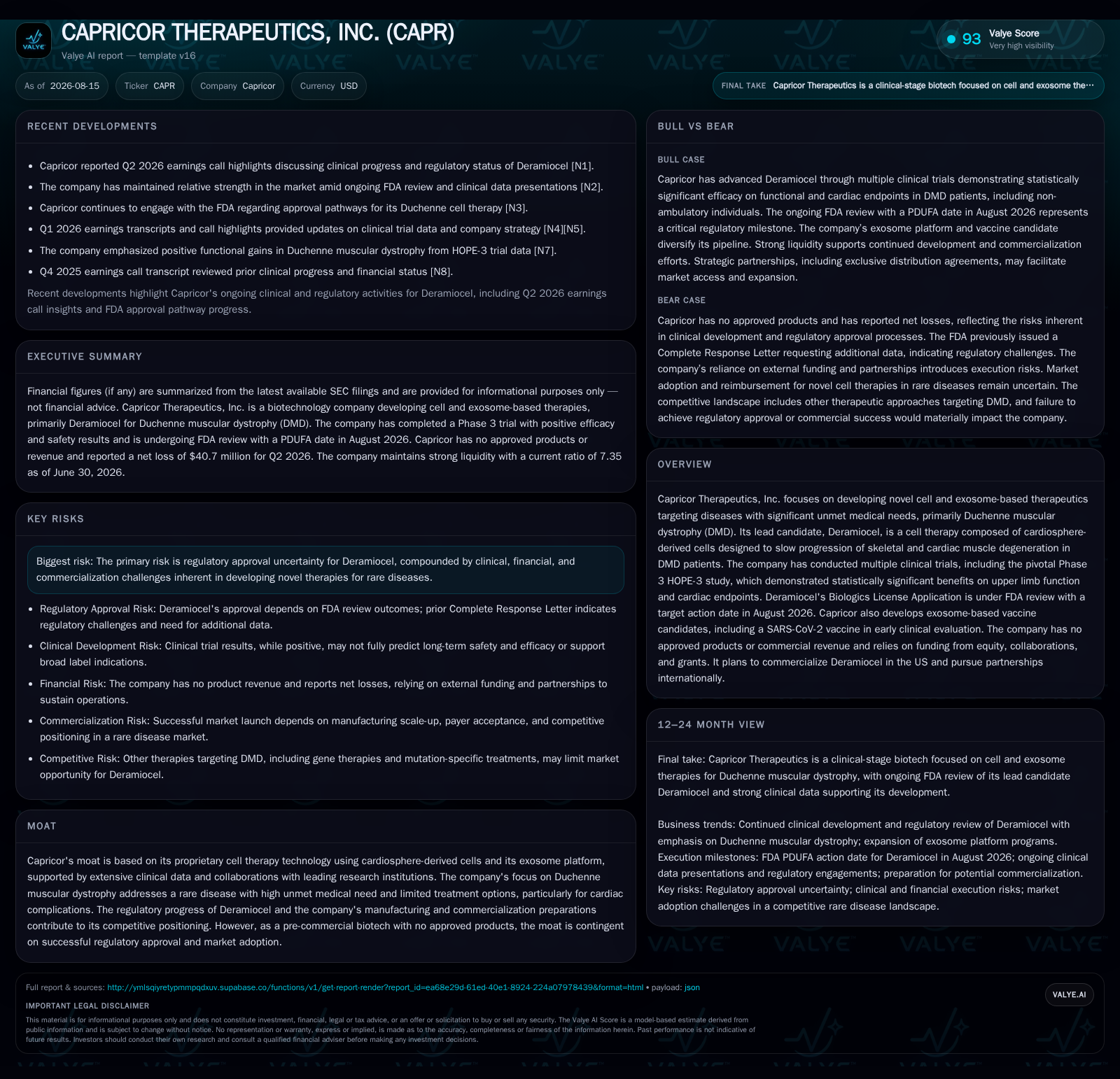
Capricor Therapeutics, Inc. is at a critical juncture with its lead product Deramiocel, a cell therapy targeting Duchenne muscular dystrophy (DMD), undergoing FDA review expected by August 2026. The company’s Phase 3 clinical data demonstrated functional and cardiac benefits, but regulatory scrutiny and manufacturing scale-up remain key risks. Pre-commercialization activities are underway alongside development of exosome-based platforms. With moderate cash reserves and no debt, execution on approval and market entry will be essential for value realization.
Recent Operating Update
Capricor Therapeutics is advancing through a critical regulatory milestone with the FDA's review of its Biologics License Application (BLA) for Deramiocel, a cell therapy targeting Duchenne muscular dystrophy (DMD). The PDUFA target action date is August 22, 2026, as detailed in the latest quarterly report filed August 14, 2026 [S2]. This follows completion of the Phase 3 HOPE-3 trial which demonstrated statistically significant improvements in upper limb function and cardiac measures—addressing key unmet medical needs in DMD management [S1]. Although product revenue remains absent at this stage, Capricor is intensifying commercialization preparations conditional on regulatory approval [S3].
Nonetheless, recent FDA advisory panel feedback raised concerns about the fragility of the clinical data despite statistical significance. This skepticism introduces uncertainty around approval timing and label scope that could affect market access strategies [N5][N6]
Business Model
Capricor develops innovative cell therapies based on cardiosphere-derived cells (CDCs), isolated from donated human hearts. Deramiocel aims to slow DMD progression through immunomodulatory, anti-inflammatory, pro-angiogenic, and anti-fibrotic effects mediated partly by exosomes containing microRNAs and signaling molecules influencing muscle repair pathways [S1]. This mechanism diverges from mutation-targeted therapies like exon-skipping or gene replacement by addressing both skeletal muscle deterioration and cardiac fibrosis—a major mortality driver in DMD.
Revenue generation depends first on regulatory approval followed by successful U.S. commercialization led directly by Capricor. Internationally, the company plans to leverage strategic licensing or distribution partnerships given regulatory complexity and resource limitations [S1]. Monetization will largely rely on securing reimbursement coverage through government payors such as Medicare and Medicaid given the orphan status and rarity of DMD [S24]. Until approval is obtained, funding derives mainly from equity financing and collaborations rather than product sales.
Margins during pre-commercial stages are pressured by manufacturing complexity. Producing CDCs requires high-quality donor tissue procurement under stringent current Good Manufacturing Practices (cGMP), elevating costs typical for late-stage biotech firms still operating at a loss [S14][S15]
Industry Structure & Competitive Position
Within rare disease biotechnology focused on cell therapies, Capricor competes against companies developing mutation-specific gene therapies (e.g., Sarepta Therapeutics) or alternative cellular approaches (e.g., Rocket Pharmaceuticals). Its platform uniquely targets both skeletal muscle pathology and cardiac complications prevalent in DMD patients, potentially addressing a broader clinical need.
The sector faces long clinical timelines and capital-intensive manufacturing scale-up challenges. Critical KPIs include patient enrollment rates given small populations, achieving regulatory milestones such as advisory panel outcomes, improving manufacturing yields to meet commercial demands, and forming partnerships to expand geographic reach.
Risks extend beyond efficacy to include securing robust reimbursement amid evolving pricing reforms such as most-favored-nation models that could constrain post-launch revenues—a key consideration given the orphan biologics context [S19][S26]
Growth Drivers
Growth catalysts include:
- FDA Approval: The pending decision is pivotal for transitioning Deramiocel into revenue-generating status.
- Label Expansion: Future studies may broaden approved indications or patient populations.
- Manufacturing Scale-Up: Establishing scalable donor tissue sourcing and cGMP-compliant production is essential for commercial supply.
- Strategic Partnerships: Collaborations can facilitate international market access.
- Orphan Drug Incentives: Regulatory exclusivity may protect market share.
- Exosome Platform Development: Early-stage vaccine candidates diversify pipeline potential beyond DMD.
Tracking metrics such as time-to-market approvals, manufacturing validation benchmarks, partnership deals, and pipeline progression will provide insight into value inflection points post-approval.
Risks & Watchpoints
Regulatory risk remains elevated due to prior advisory panel concerns questioning data robustness. Delays or label restrictions could impact launch timing or market positioning [N5][S10]. Manufacturing risks are pronounced given dependency on donor heart availability coupled with stringent cGMP requirements—challenges that could constrain supply at launch [S14][S15].
Financially, Capricor operates without product revenue; cash reserves stood at approximately $20.9 million as of June 2026 with no debt reported [F1]. Compliance complexities around healthcare pricing transparency laws and reimbursement coding add potential legal risks requiring vigilant management to avoid penalties or reputational damage [S4–S27].
Competitive pressures from emerging genetic editing technologies maintaining focus on dystrophin restoration further underscore the need for compelling clinical durability and adoption evidence.
What to Watch Next
Key near-term developments include:
- The FDA’s final BLA decision expected August 22, 2026; any post-approval requirements or labeling limitations will influence commercial strategy.
- Updates on manufacturing scale-up validation critical for meeting anticipated launch demand.
- Announcements of strategic partnerships for international commercialization expanding geographic footprint.
- Progress reports on exosome-based vaccine candidates informing long-term diversification potential.
- Financial disclosures revealing cash burn trends and capital raise activities shaping sustainability amid pre-commercial investment.
These milestones collectively frame Capricor’s path toward transitioning from a clinical-stage developer into a commercially active biotech contingent on successful execution.
Financial Profile Discussion
As of June 30, 2026, Capricor held approximately $20.9 million in cash and equivalents with no debt reported, resulting in a strong current ratio of about 7.35—indicating solid short-term liquidity relative to obligations [F1]
Given typical late-stage biotech financing dynamics approaching regulatory decisions, near-term capital raises or milestone-driven partnership inflows will likely be necessary to fund commercialization infrastructure upon FDA approval. Timing of these financial events will critically affect operational continuity and ability to capitalize swiftly on market opportunities.
This analysis synthesizes publicly filed information including Capricor Therapeutics’ latest quarterly filing dated August 14, 2026 ([S2]), recent SEC event filing ([S3]), annual report dated March 17, 2026 ([S1]), contemporaneous industry insights, relevant news coverage ([N1]-[N9]), and validated financial data ([F1]) without speculative forecasts or investment advice.
Disclaimer: This is research-only, informational analysis and not investment advice. It may include AI-generated interpretation and general industry context. Always verify important details using primary sources.

Comments