
Phoenix Asia’s Shift Toward Pharma Challenges Contract-Based Construction Model
Recent filings reveal Phoenix Asia’s pivot into pharmaceuticals via acquisition, raising questions about the durability of its traditional construction substructure business model.
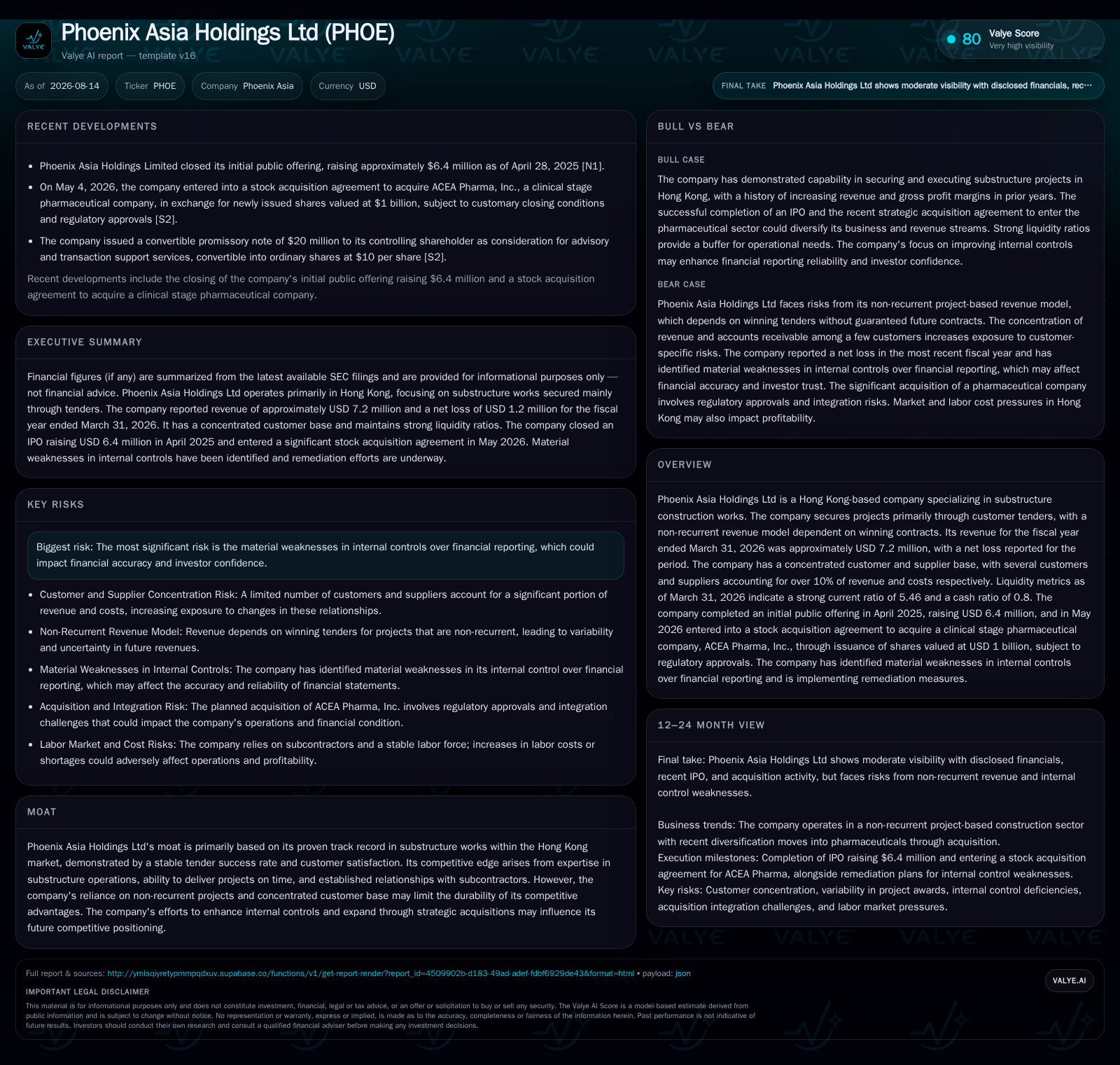
Phoenix Asia Holdings Ltd reported a net loss of $1.2 million for fiscal 2026 on revenues near $7.2 million, reflecting the volatility inherent in its tender-based substructure construction business in Hong Kong. The company's current liquidity remains strong with a current ratio above 5, but its revenue remains concentrated among a few customers and suppliers. In May 2026, Phoenix Asia agreed to acquire ACEA Pharma, a clinical stage pharmaceutical company, through an equity issuance valued at $1 billion, marking a strategic pivot that could significantly alter its risk profile and operational focus. Management continues to address material internal control weaknesses, which remain a critical risk to financial reporting integrity.
Recent Operating Update
Most notably, on May 4, 2026, Phoenix Asia entered into a stock acquisition agreement to acquire ACEA Pharma, Inc., a clinical stage pharmaceutical company focusing on cancer and autoimmune diseases, valued at one billion dollars through issuance of new shares representing a dramatic shift away from its legacy construction services business model [S2], [S3]. The transaction awaits standard regulatory approvals including antitrust reviews and Nasdaq confirmation before closing later in Q2 2026.
Additionally, Phoenix Asia issued a $20 million convertible promissory note to its controlling shareholder as consideration for advisory services related to recent transactions, reflecting strategic capital management accompanying this acquisition phase [S2]
Business Model: Construction Roots Meet Pharmaceutical Ambitions
Historically, Phoenix Asia operates as a specialist substructure contractor based exclusively in Hong Kong. Its business revolves around foundational civil works such as piling, excavation, diaphragm walls—crucial components ensuring building stability especially for high-rise urban developments common there. Revenue is generated primarily from fixed-price contracts won through competitive tendering processes initiated by customers including developers and general contractors within public and private sectors [S1]. This tender-driven model renders revenues inherently lumpy and unpredictable as projects are non-recurrent.
Critical operating levers include estimating project costs accurately—encompassing labor allocation, subcontractor management (the majority of site works are subcontracted), material procurement (notably steel and concrete), equipment rental expenses—and ensuring timely delivery against contract milestones without incurring costly overruns or penalties for delays or safety failures. Margins hinge largely on managing these variables efficiently under tight fixed-price agreements where excess cost cannot usually be passed onto clients unless codified variants are negotiated post-award [S1].
Tender success rates hover around roughly 11%, consistent but reflecting intense competition within the local niche substructure market segment where reputational trust built through prior quality delivery plays an outsized role during bid evaluations. Over concentration risks persist with just two customers accounting for more than 10% of revenue annually while three suppliers comprise over 10% of total costs, contributing both bargaining challenges and credit exposure risks in working capital cycles [S1], [S23].
The strategic decision to acquire ACEA Pharma represents an unusual departure from this highly localized project-driven construction business toward one characterized by long development cycles, heavy R&D investment requirements (although ACEA is post initial discovery), regulatory complexities distinct from construction permits or safety codes, intellectual property considerations, and capital markets sensitivity typical of life sciences ventures rather than civil engineering service providers [S2], [S3]. This extensive diversification effort implies a redefined corporate identity with potential financial profile disruption given pharmaceutical ventures' scaling needs and milestone-based valuation metrics contrasting starkly with recurring contract wins.
Industry Structure & Competitive Positioning
Within Hong Kong’s specialized substructure construction sector, firms like Phoenix Asia compete mainly on demonstrated track records of completing foundation works reliably on time under fixed-price tenders. Larger peers might benefit from broader geographic reach or diversified service lines; however, this specialization confers domain expertise valued by repeat customers seeking quality assurance under complex urban site constraints.
Phoenix Asia’s moderate tender success rate demonstrates competitive positioning but also reflects inherent market fragmentation which limits backlog predictability [S1]. Reliance on several key subcontractors is operationally typical but raises risk; failure or poor performance by a principal subcontractor may jeopardize contract fulfillment timelines causing client penalties which Phoenix Asia absorbs despite contractual rights potentially enabling cost recovery—these rights often remain unenforced pragmatically to maintain subcontractor relations
Its margin profile improved notably through FY2025 reaching almost 30%, boosted by variation orders at higher markups on sizable public projects alongside selectively priced private projects executed under compressed schedules allowing premium pricing. This mix benefit underscores margin cyclicality linked closely to project scale and customer type within the regional market context.
Growth Drivers
Growth hinges fundamentally on infrastructure expansions undertaken by Hong Kong’s government-led public works programs alongside buoyant real estate development cycles catalyzing demand for new foundations. Expansion opportunities exist through securing higher-value tenders leveraging reputation gains. Additionally, enhanced subcontractor network reliability and improved cost estimating accuracy can incrementally lift gross margins.
The newly announced pharmaceutical acquisition may unlock distinct growth channels if successfully integrated—potentially through new capital market avenues supporting ACEA Pharma’s clinical progressions—but how this complements or supersedes core construction revenues remains uncertain pending completion and subsequent operational execution clarity.
Risks & Constraints
The most immediate structural risk lies in the company’s own admission of material weaknesses in internal controls over financial reporting leading to potential inaccuracies or delays detrimental to investor confidence—their remediation plan involves hiring experienced finance personnel and consultants specializing in SOX compliance but success is unguaranteed within foreseeable timeframes [S22].
Operationally needed improvements include better subcontractor quality assurance measures given exposure to safety-related penalties ultimately borne by the company despite indemnities. Customer/supplier concentration exposes it to disproportionate counterparty risk should any key relationship sour or market conditions tighten credit terms.
Commercially relevant too is that stabilization of revenue depends on sustained tender wins—a variable with no forecast certainty—and any reduction in local construction activity could sharply depress income vis-à-vis fixed overheads.
Finally, the execution risk inherent in integrating an unrelated pharmaceutical entity looms large since it trades off core competencies against unproven diversification benefits while complicating governance structures.
What To Watch Next
Key near-term monitors include progress updates on the ACEA Pharma acquisition completion reflecting regulatory clearance status particularly antitrust approvals under the Hart-Scott-Rodino Act plus Nasdaq listing permissions outlined at signing; delay or denial may materially affect strategic plans [S2], [S3].
Remediation outcomes addressing internal control weaknesses warrant close scrutiny via disclosures or audit committee commentaries since unresolved issues could impose regulatory penalties or impair capital-raising capacity.
Tender pipeline volume trending combined with tender success rate changes will further crystallize medium-term revenue prospects given project non-recurrence character.
Financial Profile Discussion
Increasing general administrative expenses driven predominantly by transaction-related professional fees and expanded overhead reflect both the IPO aftermath and preliminary acquisition activities which raise immediate burden yet underscore managerial ambition toward scaling beyond construction niches thereby impacting near-term profitability while offering longer-run enterprise value opportunities pending integration success.
Phoenix Asia's leverage is minimal at present alongside modest finance lease obligations, providing some structural flexibility; however, sustained losses without successful new contract captures or synergistic benefits from ACEA Pharma exposure could necessitate external financing windows introducing dilution or debt servicing risks complicating shareholder returns profiles further [F1]
This analysis synthesizes latest SEC filings up to August 14, 2026 including Q4 fiscal results ending March 31 and material event filings through May based strictly on documented disclosures without speculative forward projections outside stated facts. It highlights operating realities rooted in project-based contract dynamics while critically evaluating transformation risks imposed by recent diversification moves.
Readers should consider this report purely informational without any form of investment research view.
Disclaimer: This is research-only, informational analysis and not investment advice. It may include AI-generated interpretation and general industry context. Always verify important details using primary sources.

Comments