
New Providence Acquisition Corp. III Pursues Abra Deal with Trust Account and Deadline Pressures
As a Cayman Islands-incorporated SPAC, NPAC's capital raise and acquisition approach hinge on management execution amid competitive deal sourcing.
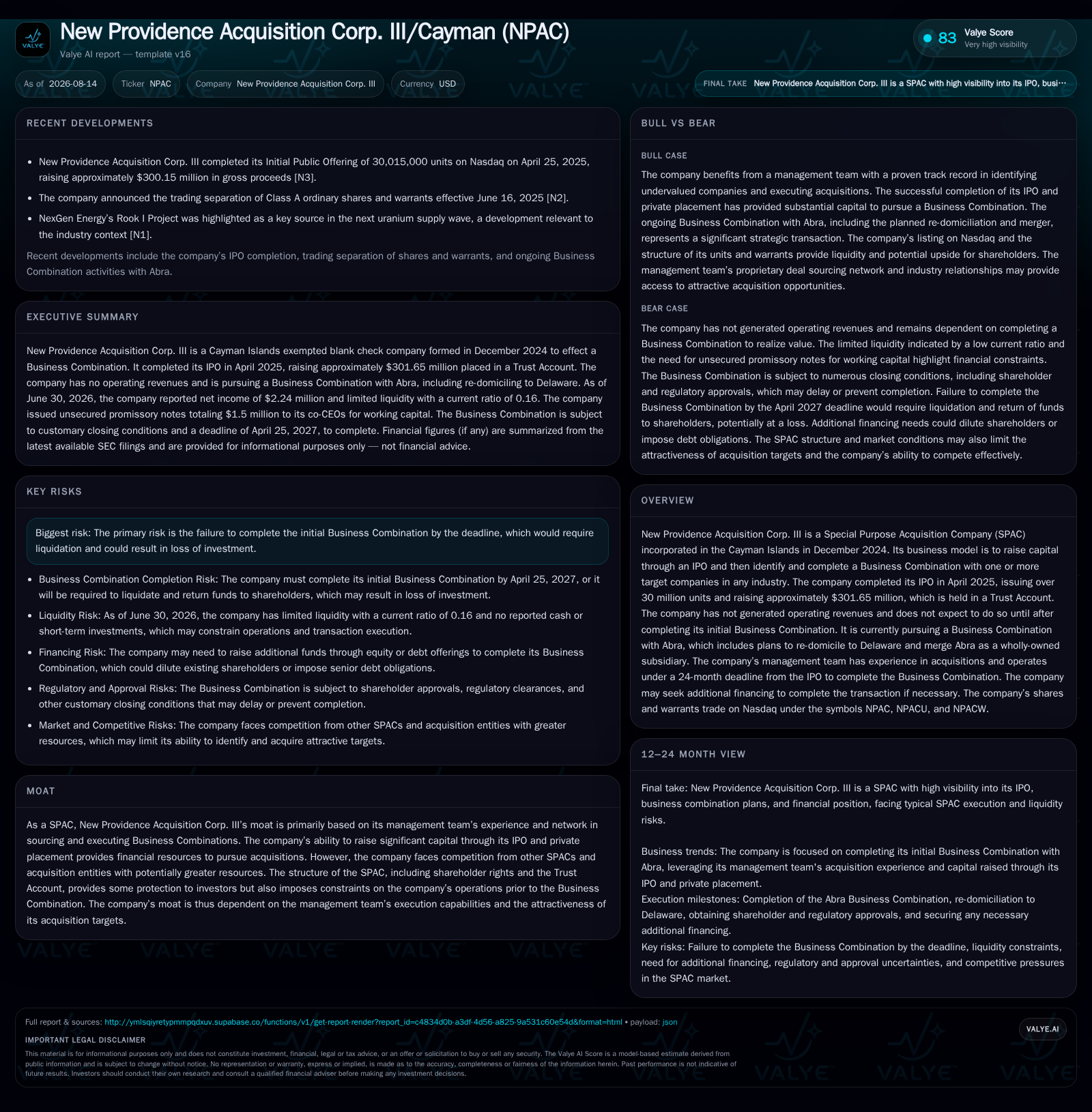
New Providence Acquisition Corp. III (NPAC) is a blank-check company formed to complete a Business Combination within 24 months of its April 2025 IPO. It has raised over $301 million held in a Trust Account, currently targeting an acquisition of Abra, with plans to re-domicile post-merger. Management’s acquisition experience is central to navigating fierce SPAC competition for attractive targets and meeting deadlines. Working capital was supplemented recently through unsecured promissory notes from the CEO co-leads. The company has no operating revenues and will only generate revenue post-Business Combination. Key risks include failure to close a deal timely and dilution from shareholder redemptions or new financing.
Recent Operating Update
New Providence Acquisition Corp. III (NPAC) reported its latest quarter ending June 30, 2026 in an August 14th Form 10-Q, reaffirming that it remains focused on completing its initial Business Combination by the April 25, 2027 deadline set by its Combination Period. During this period, NPAC’s sole activities continue to be identification and negotiation of a target, now centered on Abra, with which it intends to merge and re-domicile into Delaware [S2], [S1].
Operationally, NPAC has not generated revenues as expected for a Special Purpose Acquisition Company; instead, it incurs minimal operational expenses pre-combination, reflected by current assets of $225,930 against current liabilities exceeding $1.39 million as of June 2026—yielding a low current ratio of approximately 0.16—demonstrating typical working-capital pressure inherent in the SPAC phase before transaction completion [F1], [S2]. To cover ongoing working capital needs without drawing down cash held outside the Trust Account (which must remain intact for shareholders), NPAC issued unsecured promissory notes totaling $1.5 million to its two co-CEOs in June 2026, maturing either at deal close or upon liquidation [S3].
Business Model Overview
NPAC is a Cayman Islands-exempted blank check company formed in December 2024 specifically to raise capital through an Initial Public Offering (IPO) and then complete a so-called Business Combination — essentially a reverse merger — with one or more private companies within a defined timeframe of 24 months post-IPO [S1]. Its IPO closed on April 25, 2025, raising roughly $300 million through issuance of over 30 million Units priced at $10 each. Each Unit comprises one public share plus one-third of one redeemable warrant exercisable at $11.50 per share. Alongside the public offering, a private placement added approximately $8.7 million from the Sponsor and Cantor at similar terms. Post-offering proceeds totaling about $301.65 million were placed in the Trust Account to safeguard investor capital until deployed or returned if no combination closes successfully [S1].
The sponsor-led management team does not generate operating revenue during this phase; value accrues upon identifying a target business that meets specific investment criteria: scalable consumer-sector growth potential leveraged by management’s operational expertise. The final goal is combining with such target(s), thereby bringing them public without undergoing a traditional IPO process — commonly lengthier, costlier, and subject to greater market uncertainties [S1], [S13], [S21].
Revenue economics after Business Combination typically derive from the acquired entity’s operations—a dynamic absent currently but critical to future earnings profiles.
Industry Structure and Competitive Position
Operating within the specialized SPAC ecosystem places NPAC upstream in the capital markets value chain—it acts as both capital aggregator and acquisition vehicle but lacks intrinsic business operations until consummation of the Business Combination. This model makes management experience paramount in terms of sourcing viable targets amid intense competition.
Approximately hundreds of other SPACs launched in recent years chase attractive private businesses across sectors such as technology, consumer products, healthcare, etc., often creating oversupply pressures in deal flow. This has driven several challenges: heightened valuations demanded by target companies due to multiple suitors; increased public skepticism following high-profile SPAC failures; and regulatory scrutiny tightening disclosure norms around sponsors' conflicts and warrants dilution risks [S1], [S7], [S13].
NPAC situates itself with a management team seasoned through prior New Providence acquisitions (NPA I and II), aiming to differentiate via proprietary networks among consumer sector intermediaries — including private equity firms and investment bankers — that provide access to off-market opportunities possibly overlooked by less connected competitors [S1], [S21]. However, financing scale remains limited relative to some larger rivals restricting access to mega-deals.
Shareholder protections embedded in NPAC's structure include redemption rights allowing investors to opt out at combination time—this introduces variability in available cash for closing deals if many elect redemption—forcing NPAC potentially toward dilutive additional equity issuances or debt financings shown by recent promissory notes from executives supporting liquidity beyond trust funds reserved for redemptions [S3], [S13], [S19].
These drivers realize value only upon successful closing of combinations delivering scale and post-combination operational momentum.
Risks and Constraints
Primary existential risk inherent in NPAC’s SPAC structure remains failing to consummate an initial Business Combination before contractually mandated deadline (April 25, 2027) [S1]. Failure triggers orderly liquidation returning trust funds minus expenses but terminates any shareholder upside potential permanently restricting return profile to principal recovery levels only—negative outcome for investors betting on high-growth target post combination outcomes
Additional risks include competition intensifying pricing pressure reducing deal attractiveness; redemptions reducing available deal equity complicating financing structure requiring debt raises that elevate leverage risk; dilution impact arising from warrant exercises eroding shareholder value; potential declines in investor sentiment toward SPACs influencing share trading dynamics pre-transaction; regulatory shifts introducing compliance costs or procedural hurdles delaying combination timing; management reliance where limited personnel devoting variable time overheads create execution capacity bottlenecks; conflicts between sponsor interests versus public shareholders occasionally influencing transaction terms unfavorably; absence of operating history prior combination limiting informed investment valuation baselines posing adverse selection issues; and uncertainty about target company performance post-combination adding future operational integration challenges unquantifiable ex-ante [S1], [S7], [S13].
What To Watch Next
Key upcoming milestones entail progression toward finalizing definitive agreements with Abra including shareholder vote preparations requiring substantial proxy disclosures around fairness opinion summaries and registration document filings required by SEC rules affecting transaction pace prep scheduling; monitoring shareholder redemption election levels which will inform net cash proceeds retained from the trust account available for closing consideration impacting negotiation leverage or potential need for supplemental fundraising indicated by recent promissory note reliance on executive loans hinting working capital tightness pre-closing; tracking any extension requests for the Combination Period which would require shareholder consent signaling possible delays or due diligence complexities encountered; observing regulatory dialogue changes especially related to de-SPAC processes subjecting timeline impacts; auditing progress toward Abra’s audited financial statements delivering unqualified opinions enabling SEC registration statement posting essential for solicitation materials distribution ahead of vote dates; finally noting market perception reflected via NPAC share price movements revealing confidence or apprehension about deal success prospects [S2], [S3], [S8].
Financial Profile Discussion
Although NPAC holds substantial funds under the Trust Account earmarked exclusively for deployment into its targeted Business Combination or return upon liquidation—the liquid balance itself is insulated from usage except permitted exceptions—operationally it has squeezed working capital availability evidenced by negligible current assets ($225,930) versus markedly higher current liabilities ($1,397,044) resulting in illiquid ratios typical for defunct operating-stage assets absent revenues or earnings generation prior transaction closing end-state. This shortfall prompted issuance of $1.5 million non-interest bearing unsecured promissory notes from co-Chief Executive Officers recently in June 2026 addressing interim liquidity constraints essential in funding general corporate overhead pending consummation event without tapping restricted Trust Account cash requiring eventual payoff timing matching closing or liquidation scenarios per note covenants ensuring no disruption burden looming if delay occurs [F1], [S2], [S3].
Income metrics are muted naturally given blank check company status albeit FY-end net income reflected positive impact likely attributable to non-operating factors including interest earned on trust monies partially offsetting administrative expenses leading to negative operating income [F1]. This financial profile is commonplace among SPACs during pre-merger phases emphasizing that investor returns hinge almost entirely on successful business combinations unlocking long-term growth rather than near-term profitability.
Disclaimer: This analysis does not constitute investment advice or solicitation but reflects an independent review based solely on publicly available filings dated up to August 14th, 2026.
Disclaimer: This is research-only, informational analysis and not investment advice. It may include AI-generated interpretation and general industry context. Always verify important details using primary sources.

Comments