
Berto Acquisition’s SPAC Model Faces Dilution and Liquidity Challenges Ahead of Business Combination Deadline
As of mid-2026, Berto Acquisition remains a blank check company with significant dilution risks and tight liquidity conditions while pursuing an elusive initial business combination.
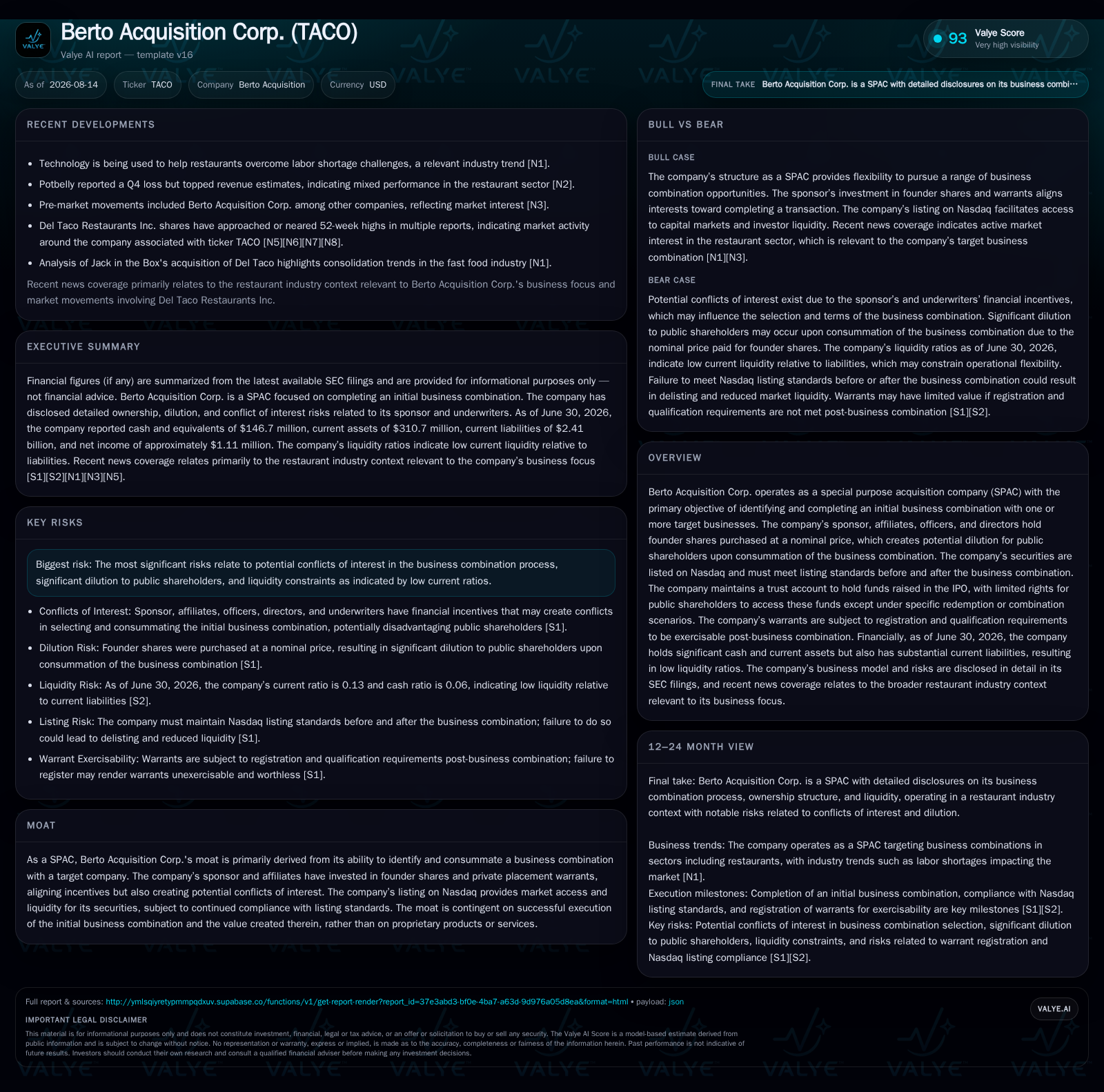
Berto Acquisition Corp. (TACO) operates as a typical SPAC, having raised approximately $300 million in its IPO and holding funds in a trust account while seeking to consummate a business combination primarily targeting AI and wellness sectors. The latest quarterly filing reveals severe liquidity constraints with a current ratio of only 0.13, signaling potential difficulty in covering near-term liabilities absent deal completion or additional funding. Given its founder share structure and warrant issuance, public shareholders face substantial dilution risk upon merger execution. The company’s moat ultimately depends on successful deal sourcing and execution within the mandated timeframe, but no transaction has yet been announced, heightening regulatory and execution risks.
Recent Operating Update
Berto Acquisition Corp. filed its latest quarterly report on August 14, 2026, providing limited operational developments beyond reiterating known risk factors [S2]. No new business combinations or target acquisitions were disclosed, underscoring that the company remains a blank check entity actively seeking its initial deal. Financial disclosures flag an acute liquidity constraint with current assets far short of current liabilities (current ratio at 0.13) reflecting an imbalance that could strain operations if not resolved swiftly through merger completion or other financing means [F1]. This puts pressure on management to finalize an acquisition or consider other alternatives ahead of the mandated deadline.
Business Model and Strategic Position
As a Special Purpose Acquisition Company (SPAC), Berto Acquisition Corp.'s business model centers entirely around capital formation followed by identification and consummation of a business combination with a private firm [S1]. The company completed its IPO in May 2025 raising approximately $300 million gross proceeds by selling over 30 million units priced at $10 each [S1]. These proceeds were placed in a trust account managed under stringent investment guidelines primarily involving US government securities or cash deposits at large banks [S1]. This structure safeguards investor capital until the effectuation of a qualifying transaction.
Revenue generation prior to business combination is negligible—reflecting typical SPAC operation—and financial results are largely administrative expenses incurred during deal sourcing and governance activities with operating income negative for the latest annual period [F1]. The company benefits from sponsor interests through founder shares issued cheaply upfront alongside private placement warrants which provide upside upon successful merger completion but produce notable dilution for public investors.
Monetization only occurs post-business combination when the merged entity gains operational revenues. Until then, losses accumulate due to ongoing administrative costs and fees payable to underwriters if additional financing arrangements occur post-IPO [S1]. Public shareholders' value realization hinges on the quality and valuation of the acquired firm plus market conditions following listing.
Industry Structure and Competitive Context
Berto Acquisition participates in the highly active yet increasingly scrutinized SPAC sector characterized by dozens of similar blank check companies competing to source attractive private targets, often within trending growth sectors such as AI technologies and wellness/longevity markets—both cited focus areas for this SPAC [S1]. While the SPAC model temporarily sidelines traditional IPO processes for private companies desiring public equity access, competition among sponsors is intense with differentiation largely reliant on sponsor reputation, network access to quality deals, rapid execution capability, and structuring sophistication.
Compared to established competitors who may boast proven track records or sector specialization, Berto Acquisition's lack of completed deals to date after more than one year potentially weakens investor confidence relative to peers that have successfully closed mergers within typical completion windows (usually within two years post-IPO). Moreover, regulatory skepticism about SPAC valuations and shareholder protections has increased recently nationwide.
This environment pressures sponsors like Berto Acquisition to either accelerate deal announcements or face redemption waves that can erode available capital; investor scrutiny will focus on how the sponsor navigates evident conflicts of interest arising from their founder share holdings and relationships with underwriters tasked with ancillary advisory roles post-IPO [S1].
Growth Drivers
While inherently dependent on completing a qualifying acquisition within prescribed deadlines (commonly two years from IPO), several structural growth drivers favor Berto Acquisition’s opportunity set if it can execute efficiently:
- Investor appetite persists for alternative investment vehicles enabling faster public market entry compared to traditional IPOs.
- Target industries including AI innovation platforms and wellness/longevity enterprises attract capital flows due to secular demand trends around technology integration and aging population dynamics.
- Favorable regulatory conditions or clarifications could reduce friction for business combination approvals enhancing deal flow velocity.
- Sponsor expertise coupled with strategic underwriting partnerships can facilitate selective access to high-potential targets not readily available through conventional channels.
These drivers underscore the importance for Berto Acquisition to effectively leverage its network while managing investor expectations closely tied to timing metrics such as remaining completion window duration and preliminary indication of deal pipeline quality.
Risks and Constraints
Berto Acquisition faces several material risks typical for SPACs but intensified by its current financial posture:
- Business Combination Uncertainty: Failure to complete an acquisition within required timelines obligates liquidation returning trust capital minus expenses—resulting in sponsor equity wipeout but complicated public shareholder outcomes due to dilution potential.
- Dilution Risk: Founder shares awarded at nominal cost plus private placement warrants substantially dilute public shareholders’ equity stakes upon consummation impacting long-term value retention.
- Liquidity Constraints: The reported current ratio of just 0.13 highlights an imbalance between current assets and liabilities, indicating potential challenges in covering short-term obligations without merger completion or alternative financing [F1].
- Conflicts of Interest: Sponsor incentives diverge from public investors given concentrated ownership positions risking less favorable terms during negotiation phases; underwriters providing advisory services add complexity possibly skewing transaction pricing or structure unfavorably.
- Regulatory Compliance: Maintaining Nasdaq listing standards after merger announcement requires adherence to detailed governance policies; failure risks delisting potentially disrupting trading liquidity.
- Market Volatility: Share price fluctuations impact redemption behavior influencing available cash pool size post-business combination vote complicating funding assumptions.
These factors form critical watchpoints deeply intertwined with operational execution effectiveness.
What To Watch Next
Monitoring Berto Acquisition’s progress hinges on key upcoming milestones:
- Business Combination Announcement: Confirmation of signed definitive agreements with specific targets will signal transition from mere shell status toward active operating company status.
- Completion Window Countdown: Tracking calendar deadlines approaching when either merger must close or liquidation initiated; extensions require shareholder approval coupled with increased funding requirements.
- Redemption Rates: Assessing proportion of public shareholders exercising redemption rights affects net proceeds available for post-merger entity capitalization impacting new enterprise growth trajectory.
- Sponsor/Warrant Holder Actions: Any exercises of warrants or additional placements inform dilution impact magnitude; changes here affect shareholder wealth distribution post-deal closure.
- Regulatory Filings: Scrutinizing updates around SEC comment letters or Nasdaq communications provides early warning signals regarding compliance hurdles potentially delaying transaction timelines.
Transparent communication around these parameters will critically influence investor confidence trajectories moving forward.
Financial Profile Discussion
Disclaimer: This is research-only, informational analysis and not investment advice. It may include AI-generated interpretation and general industry context. Always verify important details using primary sources.

Comments