
Greenland Mines Balances Biopharma Innovation and Mining Expansion Amid Early-Stage Gene Therapy Risks
Greenland Mines Ltd advances proprietary neurodegenerative gene therapies while diversifying into critical minerals mining after a recent acquisition.
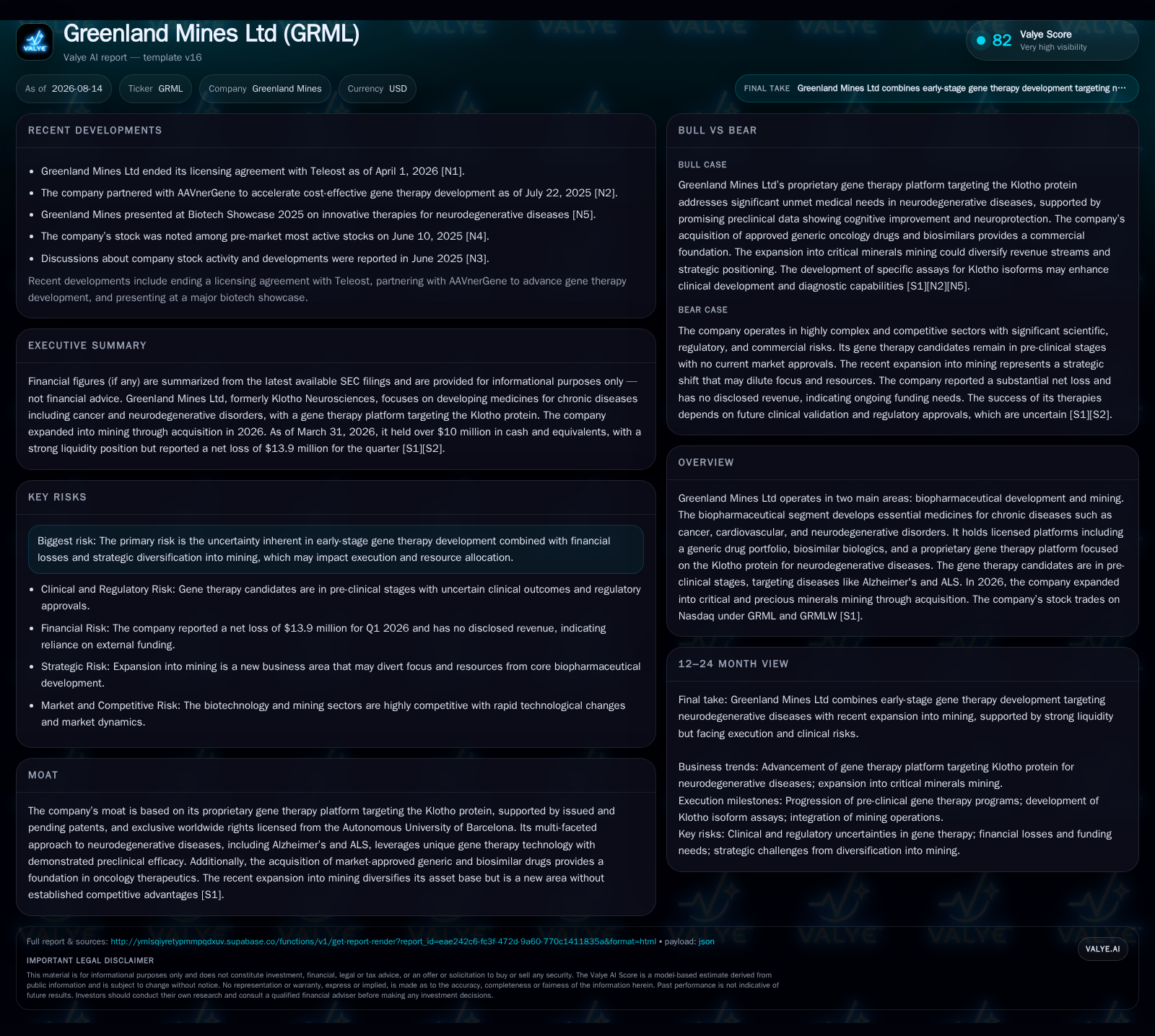
Greenland Mines Ltd has recently expanded its operational scope from biopharmaceutical development—focused on generic drugs, biosimilars, and a novel gene therapy platform targeting neurodegenerative diseases—to include critical and precious minerals mining through acquisition. Its gene therapy pipeline targeting the Klotho protein remains in preclinical stages, reflecting high developmental risk but potential for durable intellectual property moat. The dual-sector business model introduces strategic complexity amid ongoing cash burn and absence of operating revenues. Near-term focus centers on clinical progress, milestone payments, and managing resource allocation between biotech R&D and nascent mining operations.
Recent Operating Update
Greenland Mines Ltd's latest quarterly report through March 31, 2026 [S2] reaffirms that it continues to operate primarily as a research and development stage company without generating operating revenue to date. The bulk of its expense base is directed toward developing its proprietary gene therapy platform targeting neurodegenerative diseases alongside maintaining its licensed generic drug portfolio focused mainly on oncology. Significantly, in March 2026 the company completed an acquisition of Greenland Mines Corp., marking an entry into the mineral resources sector focused on critical and precious metals — a strategic diversification shift from its biopharmaceutical origins [S1]. While this broadens asset exposure, the new mining operations are at an early stage with no evidence yet of meaningful revenue or competitive moat.
Business Model Analysis
Greenland Mines operates a hybrid business model straddling biotech/pharma innovation and mineral exploitation. On the biopharmaceutical side, revenue prospects rely heavily on a multi-component licensing framework encompassing milestone payments triggered by clinical development events and low single-digit royalties (notably 2% net sales) post-commercialization of licensed products [S1]. Critical here are two licensed platforms: an "off-patent" generic oncology portfolio comprising market-approved anti-cancer drugs integral to standard regimens such as FOLFOX/FOLFIRI used across colorectal, gastric, and lung cancers in European markets; and a biosimilar biologics platform featuring off-patent antibodies acquired from Reliance Life Sciences. These portfolios provide immediate market presence albeit constrained by intense competition typical of generics/biosimilars where pricing pressure from managed care payors in the US (and similar regulators abroad) typically compresses margins over time.
The next-generation ambition lies within Greenland’s proprietary gene therapy platform centered on expression of the Klotho protein aimed at treating neurodegenerative diseases like Alzheimer's disease (AD) and amyotrophic lateral sclerosis (ALS). This pipeline is firmly in preclinical stages with key patents exclusively licensed worldwide from the Autonomous University of Barcelona [S1]. This gene therapy approach utilizes viral vectors or other delivery mechanisms to upregulate Klotho—a therapeutic protein associated with aging modulation—positioning the company within pioneering but high-risk biotech subsectors characterized by extensive R&D timelines and uncertain regulatory paths.
Revenue generation in this gene therapy segment will depend on multiple milestone achievements linked sequentially to phase 1 and phase 3 clinical trial initiations ($150k–$200k milestone payments respectively), as well as eventual product approvals. Commercial success requires overcoming technical risks inherent in first-in-class biologics coupled with navigating complex reimbursement landscapes for advanced therapies. Overall margins are likely negative during R&D-heavy years given no current product sales; monetization will only materialize upon favorable trial outcomes paired with timely regulatory approval.
The recent pivot into mineral mining adds a non-traditional dimension divergent from Greenland’s core pharma competencies. This new segment aims to capitalize on demand for critical metals vital to emerging clean energy technologies. However, mining operations generally require substantial capital expenditure cycles distinct supply chain expertise plus compliance with environmental regulations — factors that introduce execution complexity alongside existing biotech commitments. There is no indication that this segment currently contributes materially to revenue or profit pools.
Industry Structure and Competitive Positioning
Within biotechnology and pharmaceutical development—especially small firms pursuing novel gene therapies—the trajectory toward value creation is often protracted and resource-intensive. With comparable peers such as Amgen or Biogen focusing prominently on advanced biologic pipelines, Greenland's patent-protected Klotho platform presents potential differentiation in niche neurodegenerative indications; however, it faces significant peer competition broadly across gene therapies addressing orphan diseases.
The generic drug landscape is intensely commoditized; companies like Teva Pharmaceuticals typify scale-driven defensive positioning via volume optimization amid pricing pressures. Greenland’s smaller scale generic oncology footprint implies limited pricing power but serves as foundational recurring revenue insertion pending broader development milestones.
Market authorization demands rigorous demonstration of safety/efficacy especially in regulated geographies including US FDA approval pathways alongside EU EMA assessments—plus securing managed care coverage remains crucial to viable commercial uptake post-launch [S1]. Regulatory timelines often span years; failure or delay escalates cash burn without counterpart revenues.
The mining sector integration moves Greenland away from purely science-driven pharma risk profiles toward commodity market cyclicality exposure subject to fluctuating metal prices and project permitting timelines. Such diversification may hedge otherwise biotech-specific volatility but simultaneously dilute strategic focus in established expertise areas.
Growth Drivers
Key growth drivers for Greenland Mines encompass progress advancing preclinical gene therapy candidates into formal clinical trials—particularly phase 1 studies initiating milestone payment triggers—and subsequent successful navigation toward phase 3 pivotal trials that unlock further license fees plus future royalties upon commercialization. Additionally, expansion or optimization of generic/biosimilar product sales in marketing regions can incrementally bolster revenue streams once regulatory marketing authorizations translate into prescription uptake.
Partnerships or out-licensing transactions represent additional levers to monetize proprietary technologies without sole reliance on internal commercialization infrastructure.
Simultaneously developed mining assets aimed at critical minerals represent potential longer-term value creation if operationalized efficiently; however initial financial impact remains speculative absent explicit disclosure showing revenue contribution or capital investments executed post-acquisition.
Demographic trends such as aging populations globally underpin sustained demand for treatments targeting neurodegenerative disorders while oncology generics remain staples of cancer care protocols worldwide, collectively supporting underlying demand baselines.
Risks and Watchpoints
The primary risk landscape centers around intrinsic early-stage biopharma uncertainties: preclinical-to-clinical transition failures; regulatory setbacks impacting trial approval or data acceptability; intellectual property challenges notwithstanding patent holdings; adverse pricing environments driven by managed care payor policies; and tightening reimbursement constraints affecting biosimilars’ market penetration.
High cash burn rates commensurate with expansive R&D pipelines engender financing risks particularly without near-term operating revenues to offset expenses [F1]. Strategic diversification into mining introduces layered execution risks given unfamiliarity with resource extraction markets combined with capital allocation trade-offs possibly detracting focus/resources from biotech progress.
Commercialization challenges subsist around market acceptance dynamics for novel gene therapies addressing orphan or age-related neurological diseases—where physician adoption pathways remain evolving—and negotiation complexities over payor coverage given elevated cost profiles associated with advanced biologics.
Environmental regulation adherence plus geopolitical supply chain disruptions may adversely affect any emergent mining operations specifically tied to critical metals needed for technology sectors.
Investors should closely monitor:
- Timelines for initiating phase 1 clinical trials of lead gene therapy candidates including documented start dates triggering milestone payment obligations,
- Progression milestones towards phase 3 trial commencement,
- Updates regarding effective integration of mining assets including capital deployment plans,
- Changes in licensing arrangements or royalty agreements,
- Cash burn rates juxtaposed against fundraising capacity,
- Management commentary addressing navigational strategies balancing both verticals.
What to Watch Next
Upcoming catalysts revolve chiefly around evidencing tangible momentum crossing preclinical thresholds to human trials for the Klotho-targeted gene therapies—expected triggers for meaningful licensing revenue recognition events per contractual obligations described [S1]. Closely watching scheduled milestones tied explicitly to Phase 1 trial initiation timing carries importance given their impact on near-term liquidity via contractually defined payments
Additionally, any concrete announcements regarding agreement finalizations for commercialization partnerships within either biopharma platforms will materially affect revenue models long term [S3]. The company’s stockholder meetings rescheduled towards late 2026 hint at governance developments possibly influencing strategic direction amid diversified operations
Operational disclosures about how Greenland plans resource allocation across two disparate industries will help assess whether management can sustain disciplined execution without compromising innovation pipelines or mining project development timelines.
Financial Profile Discussion
Greenland Mines’ financial snapshot as of March 31, 2026 reveals cash and cash equivalents at approximately $10 million against minimal total debt estimated near $0.3 million recorded at end-2022 [F1], indicating a net cash position beneficial for short-to-medium term funding runway during ongoing R&D activities. The current ratio stands robustly high near 19.7x reflecting strong liquidity relative to current liabilities under approximately $0.55 million—a typical characteristic among early-stage biotech companies relying heavily on financing rather than product cash flows [F1].
Operating losses continue sizeable given cumulative investment in research platforms: operating income reported negative $7.15 million at end-2025 while net loss exceeded $10.5 million reflecting non-revenue status amid developmental expenditures consistent with biotech startups prior to product commercialization [F1]
The absence of meaningful debt reduces refinancing risk though sustained negative earnings necessitate prudent capital management via equity offerings, partnerships or licensing deals to support pipeline advancement. Capital allocation decisions balancing between drug development ambitions versus new mining-related infrastructure investments will be critical operational watchpoints moving forward.
This analysis synthesizes public filings up through August 14, 2026. It highlights Greenland Mines Ltd’s unique dual-sector positioning combining early-stage biotech innovation with resource sector expansion characterized by distinct risk/reward profiles requiring continued monitoring across scientific pipeline maturation milestones alongside emerging mining operational integration.
Disclaimer: This is research-only, informational analysis and not investment advice. It may include AI-generated interpretation and general industry context. Always verify important details using primary sources.

Comments