
Liminatus Pharma’s Oncology Pipeline Expansion and Merger Reshape Early-Stage Biotech Profile
Liminatus Pharma advances merger with InnocsAI LLC and strengthens its oncology pipeline while navigating typical biotech liquidity constraints.
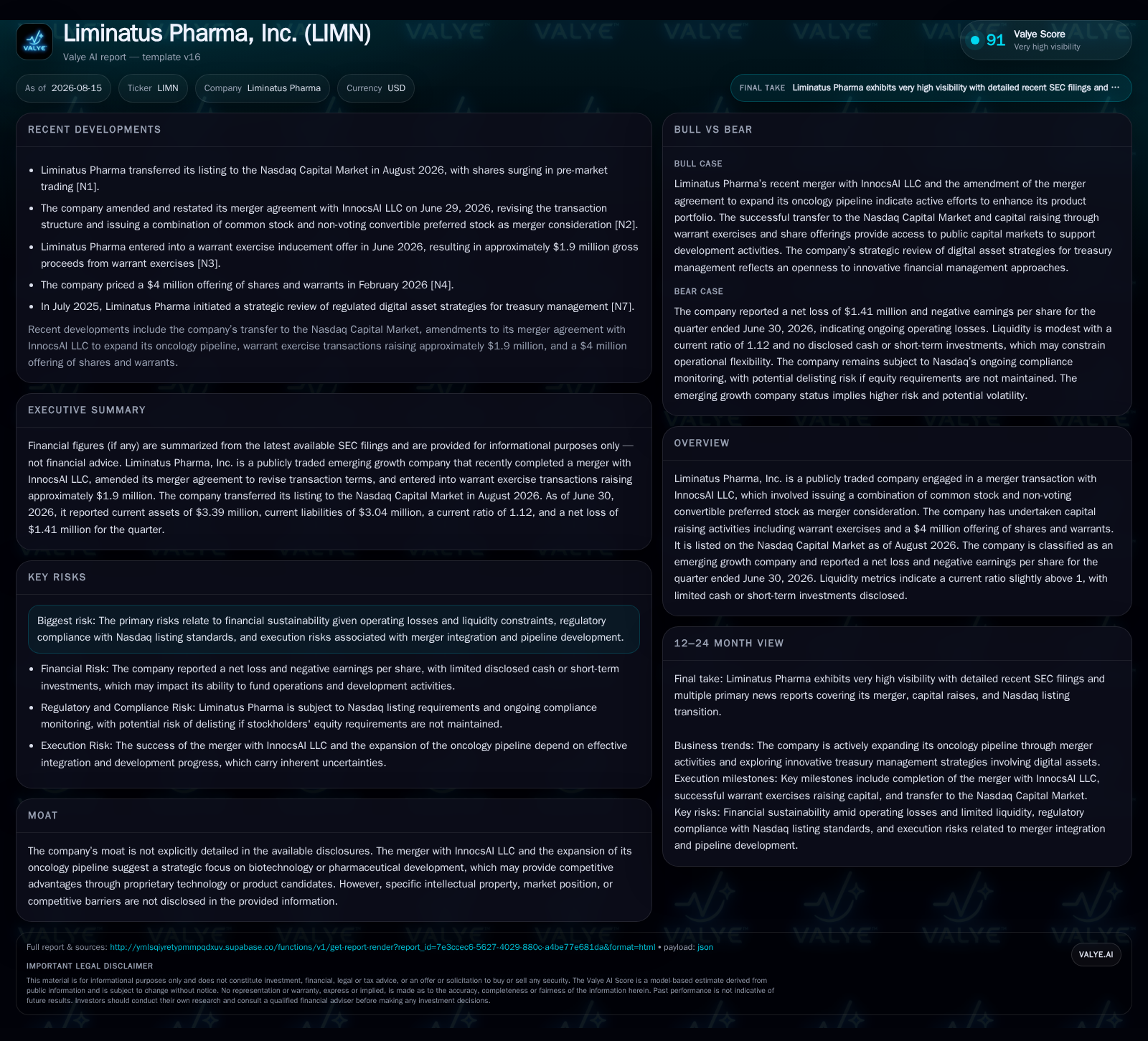
In Q2 2026, Liminatus Pharma, Inc. completed significant merger-related restructuring that broadened its oncology pipeline through an amended deal with InnocsAI LLC, involving a combination of common stock and non-voting convertible preferred stock as merger consideration. The company is now listed on the Nasdaq Capital Market and continues to manage capital raising activities including warrant exercises and equity offerings to fund R&D investments. Despite net losses and negative earnings per share, Liminatus maintains modest liquidity with a current ratio slightly above one, reflecting typical financial dynamics for an emerging biotech in clinical-stage development.
Recent Operating Developments Anchor Strategic Transformation
Liminatus Pharma’s latest quarterly filing dated August 14, 2026 ([S2]) discloses continuation of its merger transaction with InnocsAI LLC. The transaction structure was notably revised in an amended and restated merger agreement executed June 29, 2026 ([S16]), introducing a dual-component consideration of common stock plus newly designated non-voting convertible preferred stock totaling 1.6 billion shares to InnocsAI members. This change enables closing before stockholder approval, facilitating expedited integration. Such structural adjustments suggest a strategic priority to rapidly augment Liminatus's oncology drug pipeline through acquisition of InnocsAI’s assets and capabilities.
The recent transfer to the Nasdaq Capital Market in early August ([N2], [S3]) underscores an effort to stabilize trading liquidity and visibility at a more suitable exchange tier amid prior compliance challenges with Nasdaq listing standards. However, the company remains under monitoring for minimum shareholder equity requirements on the Nasdaq Capital Market, highlighting ongoing regulatory risk entailed by operating losses and limited capital base ([S8], [S9]).
Capital raising remains active as a critical support lever: warrant exercises combined with a $4 million equity offering (details in filings not fully itemized here) provide essential funding to maintain R&D programs central to progressing the merged company’s expanded drug pipeline ([N1], [S26]). This reflects typical early-stage biotech financing mechanics where operational burn outpaces revenue generation.
Business Model: Oncology Pipeline Development Fueled by Equity Capital
Liminatus operates primarily as a clinical-stage biotechnology firm focusing on oncology drug discovery and development. The company generates value internally through proprietary research programs enhanced by strategic mergers like that with InnocsAI LLC which brings additional candidates or technology into the portfolio ([S1]). Revenue from product sales is currently absent; instead, monetization relies on milestone payments embedded in partnership/lifecycle agreements and prospective licensing deals post-regulatory approvals.
Operating expenses are heavily weighted towards R&D expenditure which consumes most available cash resources and fuels negative net income typical of emerging growth companies in biotech ([F1]). The business model depends critically on capital markets access to fund trials extending over long cycles governed by regulatory oversight. Pricing power or margin leverage will only materialize post-commercialization after navigating phase transitions successfully.
The valuation impact from issuing both common shares and convertible preferred stock to acquire InnocsAI assets introduces complexity in capital structure; non-voting preferred stock may affect future dilution patterns and governance influence but provides immediate merger consideration attractive to existing InnocsAI stakeholders ([S16]).
Industry Structure and Competitive Positioning
Liminatus occupies the early-to-mid segments of the pharmaceutical value chain focusing on discovery through clinical development stages within oncology, an intensely competitive yet high-demand subsector due to unmet medical needs in cancer therapeutics. Peers include similarly sized emerging growth biotech firms listed on Nasdaq focusing on oncology indications such as Moderna’s earlier oncology initiatives or BioNTech’s diversified mRNA-driven pipeline.
Competition is driven by speed of clinical progress, differentiation of therapeutic approach (e.g., novel mechanisms or biomarkers), intellectual property robustness, and ability to secure partnerships with larger pharma players for late-stage development and commercialization support. Liminatus’s recent merger activity positions it to expand drug candidate breadth — a key competitive metric — though details on specific candidates or IP portfolios remain limited ([S1], [N1]).
Regulatory compliance dynamics, particularly regarding Nasdaq listing standards amid financial volatility, add operational pressure uncommon among larger peers better-capitalized for extended development timelines.
Growth Drivers: Pipeline Expansion and Milestone Progression
The amended merger expands Liminatus's oncology pipeline potentially accelerating time-to-clinic or diversification across multiple cancer indications ([N1], [S16]). Successful integration of InnocsAI's assets could unlock synergistic R&D capabilities enabling differentiated clinical trial designs or biomarker-driven patient stratification.
Capital raises underpinning cash runway enable continued investment across preclinical validation and clinical trial phases—two KPIs intrinsic to value creation in this industry segment. Advancement through regulatory milestones (IND filings, phase transitions) represent discrete valuation inflection points.
Moreover, the growing investor interest in oncology therapeutics combined with favorable regulatory environments supporting accelerated approvals could furnish more partnership or licensing options enhancing revenue visibility beyond purely dilutive financing activities.
Risks and Watchpoints: Financial Sustainability and Execution Challenges
Key risks hinge on continued operating losses outpacing available liquidity evidenced by a modest current ratio of 1.12 as of the end of Q2 2026 ([F1]), implying tight buffer against unexpected expenses or delays. Limited cash reserves necessitate ongoing capital raises which introduce dilution risk that must be balanced against strategic gains from enhanced pipeline assets.
Regulatory uncertainty looms over clinical trial outcomes and approval timelines integral to realizing value from acquired drug candidates. Failure or delay impacts burn rate extension without near-term revenue prospects.
Nasdaq compliance represents both an operational burden and reputational factor; failure to sustain minimum equity thresholds could trigger delisting risks affecting investor access.
Integration complexity from InnocsAI merger—covering harmonization of research teams, data sets, corporate governance structures—poses execution risk potentially delaying synergy realization.
Lastly, competitive pressures from larger biotech/pharma entities advancing overlapping oncology programs challenge differentiated positioning unless Liminatus compounds unique scientific advantages promptly.
What To Watch Next: Regulatory Milestones & Capital Moves
Future proxy filings related to merger approval will clarify shareholder endorsement levels critical for finalizing the transaction ([S19], [S25]). Market reaction around these votes may reflect confidence in strategic direction.
Monitoring announcements regarding progression of drug candidates into new clinical phases or regulatory submissions will serve as concrete demand markers confirming pipeline momentum.
Liquidity developments such as additional warrant exercises or equity offerings will reveal capability to extend cash runway necessary for sustained R&D spend amid operating losses.
Nasdaq compliance updates especially concerning minimum bid price or shareholder equity standards will inform risk profile adjustments related to listing status stability.
Financial Profile Discussion
As of June 30, 2026, Liminatus held current assets of approximately $3.39 million against current liabilities near $3.04 million resulting in a current ratio slightly above 1 (1.12), signaling narrowly positive short-term liquidity ([F1]). Total debt stood at roughly $1.44 million indicating modest leverage relative to asset base but meaningful given limited cash buffers indicated by net debt balance ([F1]).
Capital raises through exercise of warrants combined with a recent $4 million share/warrant offering supplement cash resources aimed at supporting R&D expenditures tied closely to merger integration activities and clinical program advancement ([N1], [S26]).
Overall financial posture matches archetypal emerging growth biotech firms balancing asset expansion via strategic acquisitions against typical losses until validating pipeline value through clinical trial success or partner agreements.
Disclaimer: This analysis is based solely on publicly available information from SEC filings dated through August 14, 2026, supplemented by industry-standard knowledge frameworks relevant to biotechnology companies engaged in oncology drug development. It does not constitute investment advice nor endorse specific outcomes related to Liminatus Pharma’s operations or securities.
Disclaimer: This is research-only, informational analysis and not investment advice. It may include AI-generated interpretation and general industry context. Always verify important details using primary sources.

Comments