
Bally's Corp Forges Ahead with Rigorous Cybersecurity and Liquidity Management Despite Operating Challenges
Bally's 2026 Q2 results reveal ongoing profitability pressures amid heavy investment in digital integration and regulatory compliance within a leveraged capital structure.
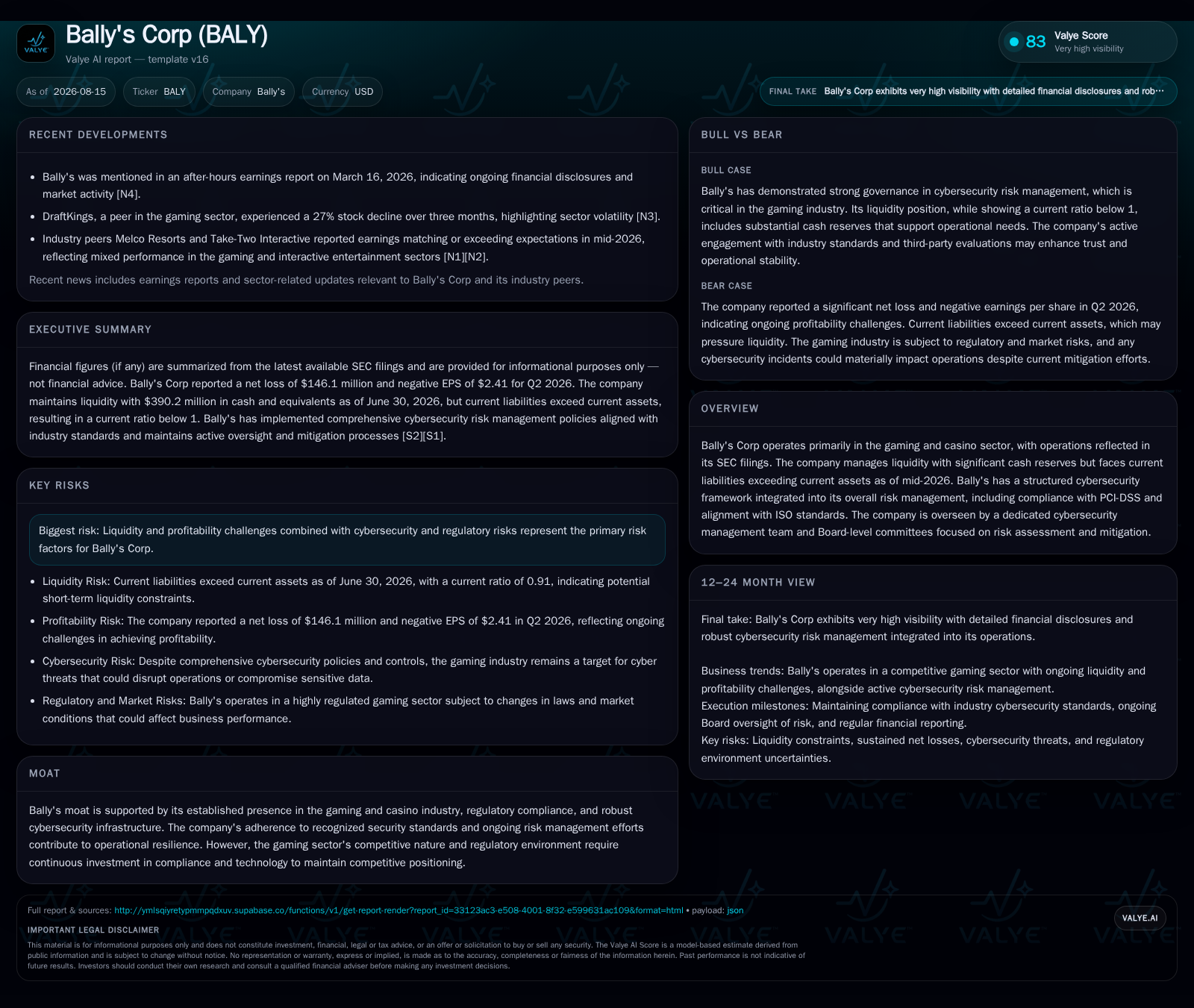
In its latest quarterly filing, Bally's Corp reported continued operating losses and a sub-1 current ratio underscoring tight liquidity despite healthy cash reserves of $390 million against $4.9 billion in total debt. The company’s business model spans traditional casino gaming, sports betting, online wagering, and hospitality, requiring robust cybersecurity frameworks aligned with PCI-DSS and ISO standards to maintain regulatory compliance and operational resilience. Bally’s competitive position reflects the need to balance capital-intensive physical assets against scalable digital growth alongside peers like MGM Resorts and DraftKings. Key risks include ongoing liquidity management challenges, regulatory complexity, and market competition from integrated resorts and digital platforms. Monitoring upcoming earnings, regulatory shifts, and sports betting trends will be critical to assessing Bally’s execution toward sustainable profitability.
Q2 Operating Update Reveals Profitability Pressures Amid Growth Investments
Bally's Corp’s second quarter 2026 filing underscores the company continues to operate at a loss as it pursues strategic growth initiatives across its gaming footprint [S2]. Operating income remains negative, indicating persistent margin pressures likely tied to capital investments in both brick-and-mortar properties and digital platform enhancements. Net income follows similar stress patterns, reinforcing near-term profitability challenges.
Liquidity appears tight: Bally's current assets totaled roughly $965 million while current liabilities stand at approximately $1.06 billion by mid-2026, translating into a current ratio just below 1 at 0.91 [F1]. This signals working capital constraints consistent with the gaming sector’s capital intensity and cyclical demand profiles. Nevertheless, the firm holds significant cash reserves around $390 million at quarter-end balanced against total debt eclipsing $4.9 billion, leaving net leverage notably elevated near $4.5 billion of net debt [F1]. Such leverage situates Bally’s financial flexibility under pressure but manageable within its operational scale.
Notably, Bally's reports no material cybersecurity incidents or operational disruptions recently that impact core business strategy—a positive sign amid increasing cyber threats common across gaming operators [S1]. This stability speaks to their proactive risk management infrastructure.
Integrated Gaming Revenue Mix Reflects Core Business Model Dynamics
Bally's revenue streams arise from multiple interconnected segments: traditional casino floor gaming generates gross gaming revenue (“gaming win”), supported by ancillary non-gaming amenities such as hospitality offerings which drive customer visitation counts vital for sustaining floor utilization [S1]. Additionally, the company operates expanding sportsbook verticals combining retail sports betting outlets with growing online wagering platforms—a reflection of current industry trends favoring omnichannel engagement.
This blended model addresses diverse customer segments ranging from high-value casino patrons attracted to slot machines and table games (captured partly via hold percentages and average daily theoretical spend) to digitally native users who participate through mobile or web sports betting products. Bally’s ability to bridge these touchpoints creates operational synergies but also poses margin management challenges given disparate cost structures: physical casinos require heavy fixed investments while digital platforms offer higher scalability albeit in a fiercely competitive landscape.
Compared to peers like MGM Resorts International or Caesars Entertainment—who emphasize integrated resort experiences combining accommodations with gaming—Bally's aims for similar diversification but must maintain agility against specialized online incumbents such as DraftKings who dominate in digital wagering innovation [S1]. Thus, Bally’s multi-channel approach positions it between traditional land-based operators and newer digital-first firms.
Cybersecurity Risk Controls Embedded in Strategic Operations: Safeguarding Customer Data and Trust
The annual disclosure affirms Bally’s comprehensive cybersecurity framework integrated into enterprise-wide risk governance designed to address confidentiality, integrity, and availability of company information systems [S1]. Key controls include adherence to the Payment Card Industry Data Security Standard (PCI-DSS), a mandatory baseline for any operator handling card payments ensuring secure processing environments.
Further bolstering security posture is an Information Security Management System (ISMS) structured in alignment with ISO 27001 standards along with a Privacy Information Management System corresponding with ISO 27701 privacy extensions. These frameworks underscore a proactive stance towards data protection beyond regulatory minimums through continuous monitoring, penetration testing by both internal teams and external experts, plus independent third-party evaluations to assess control effectiveness periodically.
Bally also deploys a vendor risk management program targeting high-risk data processors—significant given the outsourcing prevalent in technology stacks supporting online wagering—and mandates cybersecurity awareness training for all staff having access to sensitive systems. Such layers mitigate exposure risks that if realized would materially disrupt revenues or incur regulatory penalties given stringent compliance regimes governing licensed gaming operators.
Overall, this robust cybersecurity integration strengthens operating resilience—a moat factor critical not only for regulatory adherence but also for maintaining consumer trust which directly impacts visitation frequency and wallet share.
Competitive Dynamics in Gaming and Sports Betting: Bally's Position Relative to Key Peers
Within the broader gaming ecosystem, Bally competes alongside integrated casino-hospitality companies like MGM Resorts International and Caesars Entertainment that deploy expansive physical resort footprints paired with diverse entertainment offerings. These peers benefit from scale advantages in customer loyalty programs and cross-property marketing but face similar margin pressures from property maintenance costs.
Conversely, digital-first entities exemplified by DraftKings provide stiff competition within online sports betting landscapes through superior platform technology, brand recognition among younger demographics, and greater agility launching new product features rapidly.
Penn National Gaming represents a hybrid benchmark offering diversified multi-jurisdictional assets combining land-based casinos with significant online presence—thus providing insights into balancing asset utilization with digital volume growth.
Bally’s strategic challenge lies in harmonizing its capital-heavy casino investments while scaling its digital sportsbook robustly enough to preserve operating leverage benefits without eroding margins under competition-driven promotional spending.
Growth Trajectory Driven by Digital Integration and Market Expansion Opportunities
Legalized sports betting expansion across U.S. states continues fueling potential addressable markets for Bally’s sportsbooks both physical and digital. Regulatory approvals unlocking new jurisdictions allow for geographic expansion that can enhance overall handle volumes—a key driver for revenue gains given typical variable margin profiles tied closely to betting activity levels rather than fixed capital costs alone.
Additionally, technological adoption aimed at elevating user interface experiences alongside data-driven customer loyalty enhancements supports deeper engagement across multiple channels—critical for increasing online active users who contribute recurring wagering revenue streams less seasonal than land-based visitation.
Partnerships or acquisitions remain viable avenues for broadening product offerings quickly without linear capex increases typical of new property development.
These factors collectively represent growth vectors balancing legacy casino economics with increasingly important scalable digital platform models.
'Risk Factors' Spotlight on Liquidity Constraints, Regulatory Complexity, and Market Competition
Bally faces multifaceted risks detailed extensively in filings including:
- Liquidity constraints highlighted by a current ratio below unity alongside substantial net debt exceeding four times current cash reserves emphasize sensitivity to cash flow disruptions particularly because gaming revenues generally fluctuate cyclically with macroeconomic conditions [F1][S2].
- Regulatory risk remains acute given frequent changes in licensing requirements coupled with costly ongoing compliance investments notably for cybersecurity standards adherence; failure could lead to license restrictions or fines adversely impacting operations [S1].
- Competitive pressures from both entrenched integrated resorts leveraging scale advantages plus nimble digital operators erode pricing power potentially compressing hold percentages or necessitating incremental marketing expenses reducing margins.[S2]
- Cybersecurity threats pose constant challenges; although no material breaches have been reported recently this area maintains high vigilance given potential for reputational harm or operational interruption [S1].
Taken together these underscore heightened execution risks during periods of capital expansion requiring nimble financial management alongside continuous technology refreshment.
'What to Watch': Execution Milestones, Regulatory Signposts & Demand Signals Ahead
Key near-term indicators include upcoming quarterly earnings releases capable of affirming trends in operating margins improvement or further contraction reflecting success/failure in integrating digital platforms profitably alongside casino estate performance [S2].
Regulatory developments such as licenses granted in additional states or approvals enabling new gaming verticals (e.g., iGaming expansions) serve as important catalysts potentially unlocking revenue growth pockets.
Tracking metrics like sports betting handle growth rates or monthly active user counts on Bally’s online platforms provide timely signals on market reception velocity—particularly relevant against competitors aggressively ramping user acquisition efforts.
Close monitoring here yields insights into sustainability of recent investments before meaningful shifts in financial outcomes materialize.
Financial Profile Discussion: Balancing Leverage, Cash Reserves, and Capital Costs
As of June 30, 2026, Bally’s balance sheet reflects $390 million liquid cash resources offset against nearly $4.9 billion total debt carrying significant net leverage close to $4.5 billion—factors that constrain financial flexibility especially given the industry's cyclicality inherent in discretionary consumer spending patterns [F1]
While large-scale debt is common among integrated gaming operators due to property-intensive nature akin to peer MGM Resorts or Caesars Entertainment—success depends on converting invested capital into positive free cash flows through improved operating margins driven by mix optimization between gaming floor yield improvements versus higher-margin digital revenues.
Thus financial stewardship including refinancing terms management and prioritization of profitable growth initiatives remains pivotal shaping Bally’s trajectory amid challenging industry dynamics [F1][S2].
Disclaimer: This analysis is based solely on publicly available SEC filings dated August 14th, 2026 and related evidence without projection or investment advice.
Disclaimer: This is research-only, informational analysis and not investment advice. It may include AI-generated interpretation and general industry context. Always verify important details using primary sources.

Comments