
iSpecimen Inc. Faces Operating Headwinds Amid Drastic Revenue Decline and Elevated Marketing Spend
iSpecimen’s quarterly report highlights severe top-line pressure, ballooning sales expenses, and persistent going-concern doubts amid efforts to digitize biospecimen procurement.
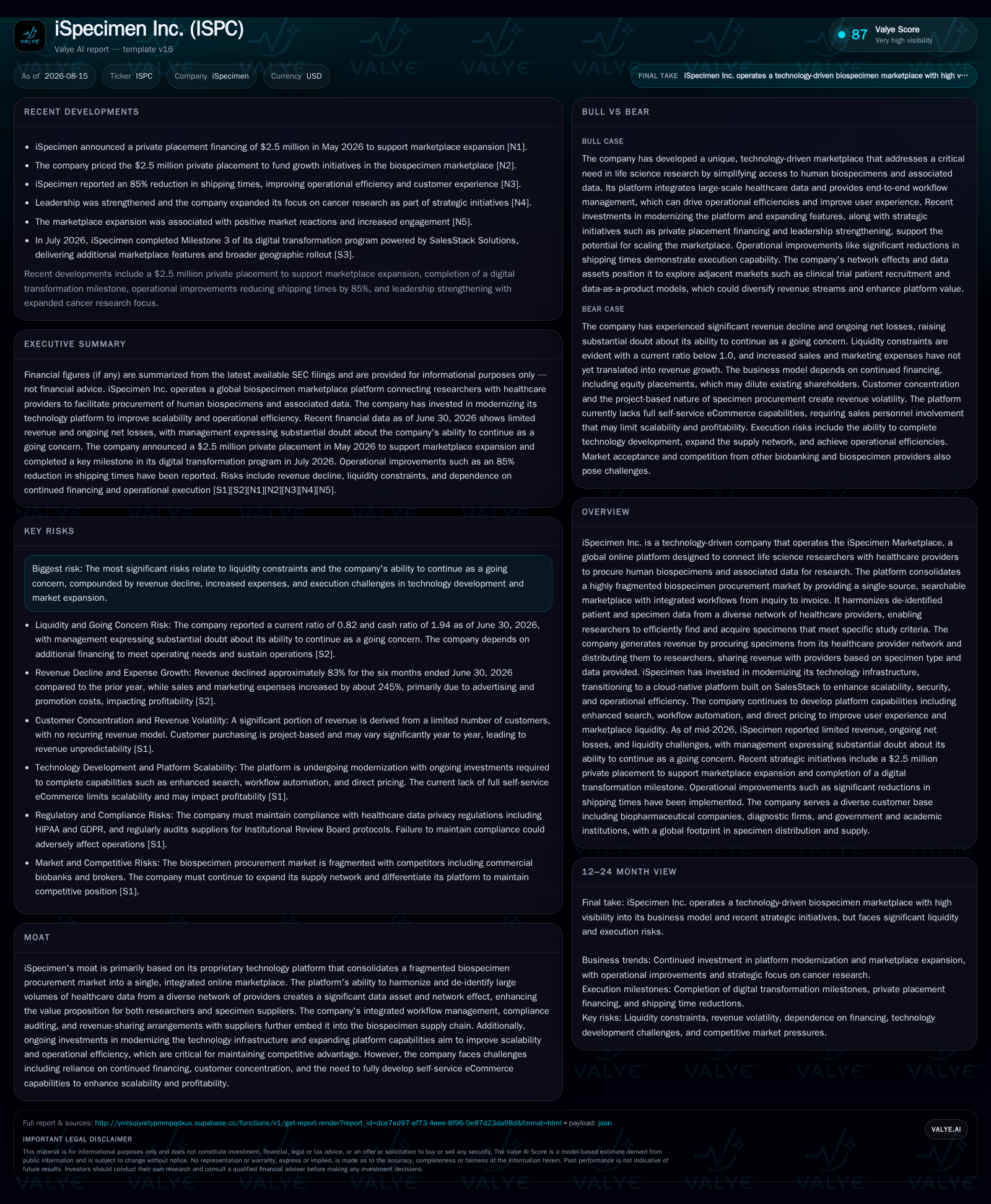
iSpecimen Inc., a marketplace platform connecting biospecimen suppliers and life science researchers, reported an 83% revenue decline year-over-year in the first half of 2026 while incurring substantial increases in marketing spending. Management disclosed sustained concerns about the company’s liquidity and ability to continue as a going concern. The company’s core business model builds on consolidating a fragmented biospecimen procurement market by harmonizing de-identified patient data from healthcare providers into an online marketplace, but recent financial strains and execution challenges cloud near-term prospects. The firm's ability to modernize its platform technology and expand its healthcare network remain critical for future growth.
Recent Operating Update
iSpecimen Inc.'s latest quarterly filing (10-Q dated August 14, 2026) reveals a critical deterioration in operating performance where revenue for the first half of 2026 declined approximately 83% compared to the same period last year [S2]. This precipitous drop signals acute challenges either in customer demand, contract renewals, or platform utilization by life science researchers seeking biospecimens. The company simultaneously increased sales and marketing expenses by nearly 245%, primarily driven by heightened advertising and promotional activities aimed at stimulating interest in its online marketplace offering despite contracting revenues [S2]. This combination reflects an aggressive yet costly attempt to arrest slowing adoption that has strained cash resources.
Compounding concerns, management explicitly stated that substantial doubt exists regarding iSpecimen's ability to continue as a going concern with no probable plans sufficiently mitigating such risk [S2]. Such disclosures are consistent with the company's prolonged unprofitability since inception—and specifically over recent years—with the latest annual report confirming net losses exceeding $10 million in 2025 alongside an accumulated deficit above $82 million since founding [S1][F1]. Elevated losses correspond with ongoing investments in technology development and network expansion but raise questions on sustainability absent new financing or operational pivot.
An August 12, 2026 event filing detailed engagement of external marketing consulting services designed to enhance communication with financial stakeholders and support investor relations during challenging business conditions [S3]. While not an operational driver per se, this highlights management’s recognition of the need to rebuild confidence externally during performance volatility.
Business Model
iSpecimen operates a technology-driven digital marketplace—termed the iSpecimen Marketplace—that connects two main constituencies: healthcare organizations holding vast inventories of human biospecimens (such as blood samples, tissues, biofluids) along with de-identified patient data; and researchers from pharmaceutical companies, academic institutions, and government entities requiring these biospecimens for biomedical research purposes [S1]. The underlying procurement landscape historically suffers fragmentation as hospitals, clinics, biobanks, and other providers manage specimens internally or through opaque channels.
The platform’s value proposition lies in consolidating this fragmented supply into a unified online environment that is searchable with advanced filtering tools resembling consumer travel websites for flights or hotels. By integrating data feeds from electronic medical records (EMR), laboratory information systems (LIS), biobank inventory systems, and others—often harmonizing diverse data formats into a common dataset—the company enables researchers to find precise specimen types matched to specific clinical criteria more efficiently than manual processes would allow [S1].
Revenue generation primarily occurs through transaction fees on specimen procurements facilitated over the platform. iSpecimen shares a portion of this revenue with providers based on specimen type and richness of associated data delivered. This incentive structure aims to grow the healthcare provider network's size and breadth while maximizing researcher engagement. Workflow integration includes end-to-end processes from initial inquiry to ordering (invoice), quality compliance auditing to meet regulatory standards such as HIPAA for patient privacy protection, thereby embedding itself deeply into the specimen supply chain logistics.
Industry Structure and Competitive Position
iSpecimen occupies an intermediary role within the life science biospecimen marketplace sector—a niche distinguished by specialized requirements for human biological materials coupled with sensitive patient data handling. The industry includes commercial biobanks (e.g., BioIVT), which often control physical specimen inventories but typically lack scalable integrated marketplaces; biospecimen brokers that aggregate specimens but may rely on less digitalized models; healthcare IT firms focusing on EMR/LIS data integration but without direct specimen distribution functionality; as well as larger life science research service conglomerates like Labcorp or Thermo Fisher Scientific utilizing different approaches.
The iSpecimen Marketplace differentiates itself through proprietary technology harmonizing disparate provider networks’ data into a seamless search-and-order interface with embedded compliance workflows. Its business model fosters network effects: greater provider participation enriches specimen diversity attracting more researchers; higher researcher volume incentivizes providers to list more specimens—all reinforcing platform value.
However, competition manifests not only from alternate sourcing options including direct biobank contracts or traditional brokers but also from internal provider initiatives developing bespoke solutions reducing third-party dependence. Additionally, regulatory constraints on patient data privacy necessitate robust compliance auditing—any lapses could erode trust across participants.
Growth Drivers
Long-term growth opportunities revolve around several vectors:
Expanding Healthcare Provider Network: Increasing the number and diversity of participating hospitals, clinics, biobanks globally enhances available specimen inventory breadth—a critical determinant of researcher choice and platform utility.
Advancing Data Harmonization Technologies: Continuous improvements in real-time EMR/LIS integration reduce latency between specimen availability updates allowing up-to-date sourcing information beneficial for urgent or precision-based research needs.
Scaling Specimen Types and Geographic Reach: Adding rare or complex biospecimens alongside expansion into underrepresented regions presents fresh markets for pharmaceutical R&D as well as academic institutions pursuing precision medicine.
Regulatory Encouragement: Policies promoting clinical data transparency can lower institutional barriers toward sharing under strictly controlled frameworks potentially increasing supply.
Digitization Trend: Growing adoption of digital marketplaces over manual procurement processes drives efficiency adoption among both providers and researchers who seek streamlined workflows and compliance assurance.
Success hinges on maintaining high compliance audit pass rates ensuring trustworthiness while managing order fulfillment cycle times crucial for customer satisfaction.
Risks and Watchpoints
iSpecimen faces substantive risks linked mainly to financial sustainability amid persistently negative operating margins exacerbated by rising expenses focused on marketing to rejuvenate growth [S2]. Liquidity constraints are underscored by current balance sheet metrics where cash approximates $4.4 million at mid-2026 versus current liabilities near $5.47 million rendering a current ratio below one (0.82), elevating short-term solvency concerns [F1]. Without new financing or meaningful revenue rebound, operational continuity may be imperiled.
Legal disputes have previously interrupted service operations notably during early 2025 when vendor litigation disabled the commerce platform leading to downtime lasting over two weeks before settlement arrangements reinstated access—with associated remedial costs including third-party developer engagement adding complexity to expense management [S1]. Such contingencies represent both operational vulnerabilities disrupting client reliance and financial drains.
Execution risk around ongoing technology modernization endeavors is material—as platform scalability improvements are essential for handling larger transaction volumes efficiently without degrading user experience or service reliability [S1]. Failure to successfully deploy these upgrades could stall network growth or impair retention among researchers accustomed to seamless online interactions familiar from high-quality B2C marketplaces.
Regulatory compliance demands regarding patient privacy data persist as a continuous risk factor given evolving frameworks like HIPAA in the U.S. or GDPR in Europe meaning any breach could cascade reputational damage deterring participant engagement.
What To Watch Next
Key milestones include quarterly updates signaling stabilization or reversal of revenue declines notably through increased biospecimen transactions facilitated via enhanced platform tools. Monitoring changes in average revenue per specimen transacted may illuminate whether pricing power improves or deteriorates amid competitive pressures.
Provider network expansion metrics such as new major healthcare system sign-ons or contract renewals will indicate success in sourcing growth commitments vital for replenishing inventory depth.
Progress on technology upgrades aimed at reducing order fulfillment cycle time offers clarity on operational efficiency targets central to scaling business volume profitably.
Tracking cash burn trends aligned with cost control measures especially marketing spending effectiveness will provide early warnings about liquidity trajectories supporting continuing operations without disruptive capital raises.
Finally, any updates related to legal settlements or new disputes impacting platform uptime remain important given historical precedents affecting client confidence.
Financial Profile Discussion
iSpecimen’s latest financial snapshot illustrates significant funding pressure indicative of its fragile financial health status. As of June 30, 2026, cash and equivalents stood near $4.4 million contrasted against current liabilities approximating $5.47 million yielding a current ratio of roughly 0.82—below the threshold generally considered sufficient for short-term obligations coverage [F1]. The absence of explicit recent debt refinancing disclosures alongside recurring net losses underscores elevated liquidity risk profiles.
Operationally, net losses exceeded $10 million annually as reflected in full-year 2025 results where operating income remained deeply negative at nearly -$9 million highlighting persistent high fixed costs related to R&D investments in technology plus elevated SG&A expenditures dominated by sales/marketing efforts aimed at customer acquisition amidst slowing revenue trends [F1][S1][S2]
Cash flow preservation depends critically on curbing burn rates through balanced mix of revenue recovery initiatives combined with disciplined expenditure controls while exploring alternative financing pathways including equity placements or strategic partnerships given going concern reservations disclosed by management [S2]
Overall financial metrics reflect a company in transformational transition challenged by industry-specific capital intensity inherent in marketplace development—especially within regulated healthcare environments demanding compliant data handling infrastructure—which must be balanced against market adoption velocities ultimately determining path toward sustainable profitability.
Disclaimer: This is research-only, informational analysis and not investment advice. It may include AI-generated interpretation and general industry context. Always verify important details using primary sources.

Comments