
Bone Biologics Advances NELL-1 Bone Regeneration Amid Regulatory and Capital Challenges
Clinical progress and shelf-life extension highlight development, while Nasdaq compliance and capital needs remain key risks.
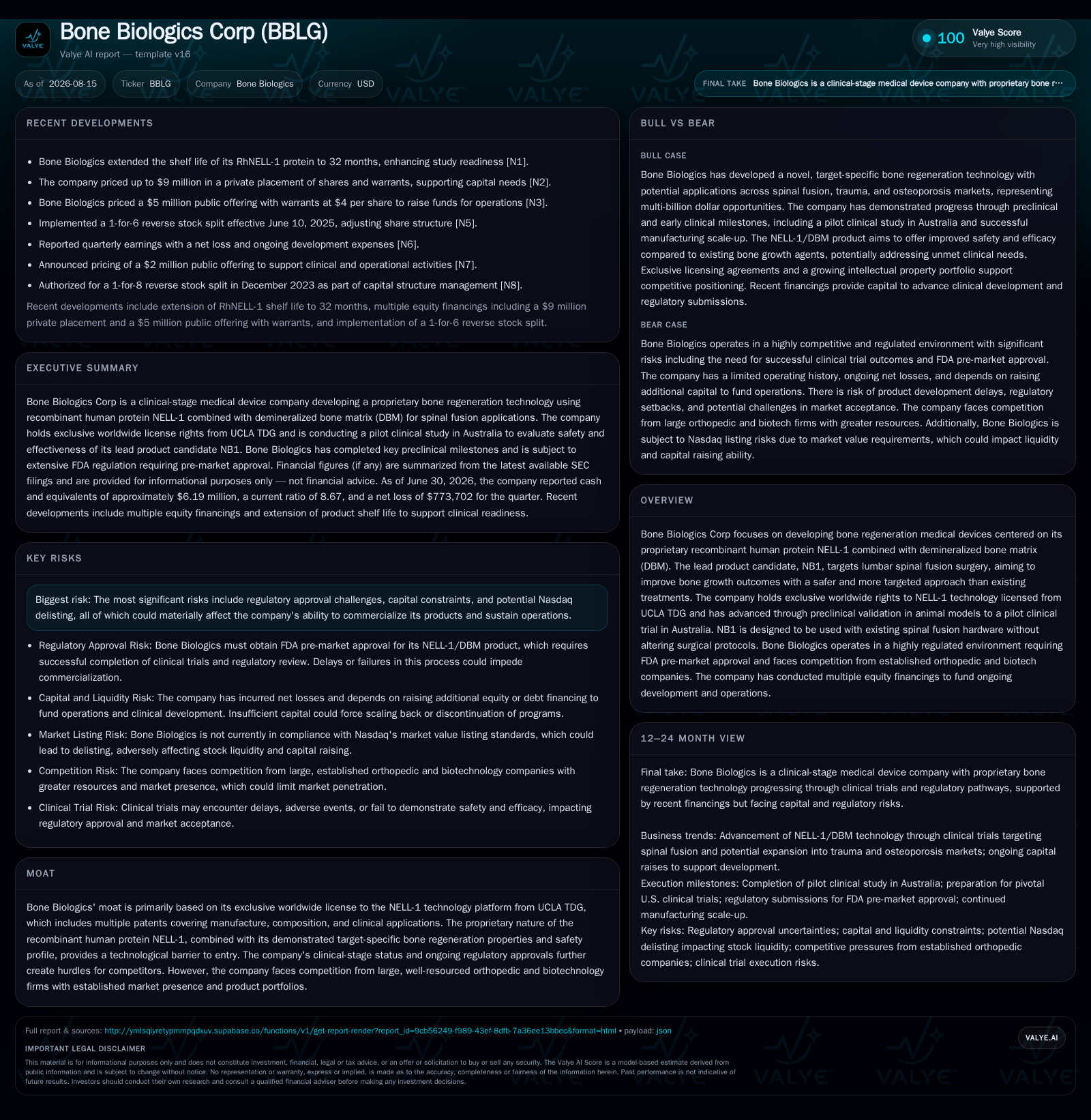
Bone Biologics Corp’s latest quarter underscores steady clinical advancement with its NB1 bone regeneration product, leveraging proprietary recombinant human protein NELL-1 combined with demineralized bone matrix for spinal fusion. The company continues navigating an FDA device/drug combination product pathway that demands extensive trials before commercialization. While the extended shelf life of its rhNELL-1 protein improves study readiness, ongoing challenges include regulatory approval timelines, maintaining Nasdaq listing compliance under new market value requirements, and capital raising to support costly development. Its strong patent portfolio licensed from UCLA anchors a technological moat in a capital-intensive medtech/biotech intersection.
Recent Operating Update
Bone Biologics Corp’s August 2026 quarterly filing reiterates its developmental progress centered on NB1, a bone graft device combining recombinant human NELL-1 protein with demineralized bone matrix (DBM) aimed at enhancing outcomes in lumbar spinal fusion procedures [S2]. The filing highlights no material changes to previously disclosed risk factors but underscores the pressing issue of the company’s non-compliance with Nasdaq's recently approved market value of listed securities requirement ($5 million), which if enforced without remediation could lead to delisting within 30 business days [S2]. This puts renewed urgency on capital-raising efforts.
Supporting this need was a recent private placement offering up to $9 million through shares and warrants—announced in July 2026—intended to finance ongoing R&D and clinical operations [N2]. Operationally, Bone Biologics also disclosed a scientifically significant update extending the shelf life of its rhNELL-1 protein to 32 months, improving logistical readiness for ongoing or upcoming clinical trials by reducing constraints related to material stability [N1].
The pilot clinical trial underway in Australia remains the key near-term catalyst; this randomized controlled study evaluates NB1’s safety and effectiveness in transforaminal lumbar interbody fusion (TLIF) patients suffering degenerative disc disease. Use of NB1 requires no alteration of existing surgical hardware or techniques, aiming instead at improved osteopromotive control via target-specific bone regeneration facilitated by NELL-1 combined with DBM matrix [S1]. Completion of this study phase is critical for advancing towards FDA approval submission.
Business Model Overview
Bone Biologics operates as a clinical-stage medical device company developing proprietary biologic-device combination products focused on bone regeneration technologies. The core innovation is rooted in the recombinant human protein NELL-1, which has demonstrated osteopromotive properties providing targeted bone growth control when paired with DBM as the scaffold matrix [S1]. This combination classifies NB1 as a device/drug combination requiring pre-market approval (PMA) by the FDA—a more rigorous regulatory pathway than typical single-component devices.
Revenue generation post-commercialization will likely depend on direct product sales to hospitals, surgical facilities, and orthopedic providers primarily performing spinal fusion surgeries. Given the nature of orthopedic purchasing decisions—heavily influenced by clinical evidence, surgeon preference, reimbursement dynamics, and regulatory clearance—the company's route to market acceptance hinges on successful demonstration of superior efficacy and safety over incumbent bone graft substitutes such as BMP-based products distributed by larger medtech players.
Monetization will also encompass milestone payments or licensing fees tied back to its exclusive license agreement with UCLA TDG, including royalties calculated at 3% of net sales plus minimum annual royalties beginning upon first commercial sale [S1]. However, revenues remain elusive during clinical phases necessitating continuous equity financing rounds to sustain funded operations.
Industry Structure and Competitive Position
The intersection of regenerative medicine biotechnology and orthopedic medical devices is marked by extensive regulation, high R&D intensity, and substantial capital outlays prior to product commercialization. Bone Biologics stands upstream in this ecosystem as an innovator developing patented biologic-device technology integrated into surgical workflows rather than hardware alone. This differentiates NB1 compared to traditional implant manufacturers who supplement their offerings with biologic adjuncts.
Competitors span large orthopedic firms like Medtronic and Stryker that possess established distribution channels combined with biologic adjunct lines (e.g., BMPs), as well as biotech companies such as Amgen focusing on protein-based growth factor therapies for bone repair. Bone Biologics’ proprietary technology benefits from an exclusive worldwide license portfolio secured from UCLA TDG encompassing multiple patents on composition, manufacture, and applications of NELL-1 protein. This IP position constitutes a meaningful barrier but requires vigilant defense against potential litigation or design-around threats common in biotech sectors.
Clinical trial successes serve not only as validation points but also competitive differentiators given that regulatory status defines entry barriers. Navigating the FDA’s PMA process for combination devices involves complex scientific data sets validating both device functionality and biologic safety—a costly endeavor that slows competitors lacking deep pockets or specialized expertise.
Growth Drivers
Key growth drivers hinge on several converging industry trends:
- An aging population increases incidence rates of spinal degenerative diseases necessitating interventions such as lumbar fusion surgery where NB1 is targeted.
- Rising awareness and adoption of regenerative medicine approaches by surgeons seeking safer alternatives with fewer complications than existing BMP therapies.
- Clinical validation progress: successfully completing pivotal trials leading to FDA PMA submissions will materially uplift commercial prospects.
- Patent portfolio robustness enables potential expansion into additional orthopedic indications beyond spinal fusion such as trauma repair or osteoporosis-related surgery support.
- Strategic partnerships or licensing deals may facilitate access to manufacturing scale-up partners or expand geographic reach internationally where regulatory approvals are underway or feasible.
Operationally, extending product shelf life directly supports flexible clinical logistics while minimizing waste—a notable advantage for both trial conductors and eventual commercial distributors across diverse healthcare facilities.
Risks and Watchpoints
Despite promising technology foundations, Bone Biologics faces multifaceted risks:
- Regulatory delays or failures remain dominant uncertainties; any adverse events or slow enrollment may prolong trial timelines causing capital burn pressures [S4][S11].
- Clinical trial enrollment can be challenging due to stringent patient selection criteria inherent in spine surgery studies limiting subject availability.
- Capital scarcity under Nasdaq market value concerns represents existential risk; failure to maintain listing could impair share liquidity and hinder further fundraising efforts impacting R&D continuity [S2].
- Dependence on third-party suppliers for raw materials like recombinant proteins and CROs for trial management introduces operational vulnerabilities [S11].
- Intellectual property disputes or inability to maintain comprehensive patent coverage could erode competitive positioning especially against larger rivals skilled at exploiting legal avenues [S12][S25].
- Market acceptance post-commercial launch is uncertain; convincing orthopedic surgeons entrenched with legacy technologies requires compelling clinical evidence coupled with reimbursements aligned incentives which are not guaranteed.
- Nasdaq delisting jeopardizes stockholder confidence leading potentially to downgrades in analyst coverage or institutional investor interest [S2].
What To Watch Next
The company’s path forward centers on several milestones:
- Enrollment progress updates from the ongoing Australian pilot clinical trial evaluating NB1 will signal feasibility toward pivotal studies.
- Regulatory interactions or feedback regarding PMA package composition will shape commercialization timelines.
- Further financing transactions evidencing ability to sustain operating costs beyond initial pilot phases remain critical.
- Monitoring compliance status vis-à-vis Nasdaq’s MVLS Requirement clarifies sustained listing viability affecting overall financial flexibility.
- Expansion announcements around new patents or licensing arrangements would indicate strategic IP strengthening necessary to underpin growth beyond spinal indications.
Financial markers such as quarterly burn rate relative to freshly raised capital will confirm runway sufficiency supporting timely regulatory submissions.
Financial Profile Discussion
As of June 30, 2026, Bone Biologics reported approximately $4.4 million in current assets against $0.5 million in current liabilities yielding a strong current ratio near 8.7 indicating short-term liquidity adequacy [F1]. The absence of debt reduces fixed financial burden but also reflects reliance on ongoing equity capital raises evidenced by recent private placements targeting $9 million infusion [N2][S3]. Historical losses persist consistent with typical early-stage biotech-device firms investing heavily in R&D before realizing commercial revenues; operating losses exceeded $3 million at year-end 2025 [F1]. Net cash burn will remain a focal point given limited working capital reserves versus lengthy anticipated development horizon dictated by rigorous FDA PMA combination product requirements.[F1][S9]
This financial profile aligns with peers at similar developmental stages facing prolonged pre-commercial phases demanding equity funding cycles that dilute ownership yet enable incremental value creation upon regulatory validation milestones.
This analysis synthesizes publicly available information incorporating SEC filings up through mid-August 2026 alongside recent corporate disclosures reflecting Bone Biologics' evolving operational landscape within the highly specialized field intersecting medical devices and biopharmaceuticals targeting bone regeneration therapies. It aims to provide clarity on fundamental business dynamics without investment advice or forecasts.
Disclaimer: This is research-only, informational analysis and not investment advice. It may include AI-generated interpretation and general industry context. Always verify important details using primary sources.

Comments