
Modular Medical’s Pivot Pump Launch Tests Market Adoption Amid Capital Constraints
Modular Medical began commercial shipments of its FDA-cleared Pivot tubeless insulin pump in mid-2026, aiming to penetrate underserved diabetes patients with a cost-effective, simpler device but faces steep competitive and liquidity challenges.
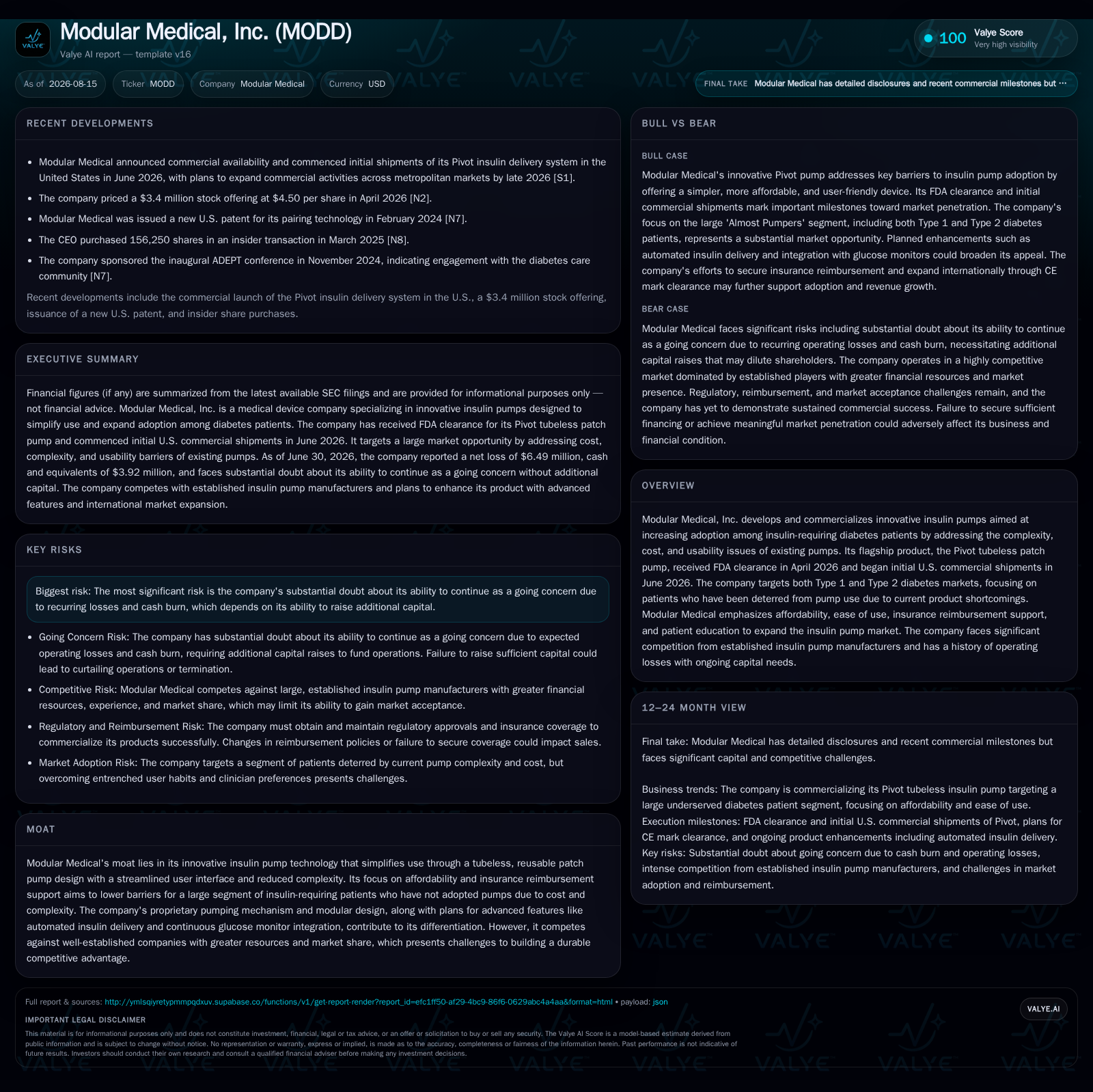
Modular Medical, Inc. initiated initial U.S. commercial shipments of its Pivot tubeless patch insulin pump in June 2026 following FDA clearance earlier that year. The company is targeting a broad patient segment, including both Type 1 and Type 2 diabetics, who have historically shunned insulin pumps due to cost and complexity. Its business model emphasizes affordability, insurance reimbursement facilitation, and streamlined patient education via a hybrid go-to-market approach combining distributors and a small direct sales team. Despite technological differentiation through its reusable tubeless design and a product roadmap that includes automated insulin delivery integration, Modular Medical confronts fierce competition from entrenched manufacturers like Medtronic and Insulet and must secure additional capital given continuing operating losses and limited cash runway. Monitoring early market adoption rates and reimbursement success will be critical to assessing the viability of its expansion strategy.
Recent Operating Update: Commercial Launch of Pivot Insulin Pump
Modular Medical’s latest quarterly filing confirms commercialization of its Pivot tubeless patch pump has commenced in the United States as of June 2026, shortly after receiving FDA clearance in April 2026 [S2][S1]. This marks the company’s first meaningful step into revenue generation after prior regulatory milestones including submission of its initial MODD1 pump (no longer commercialized), human use announcements in mid-2025, and conversion efforts toward Pivot manufacturing lines [S1]. While no revenue was reported as of mid-2026 reflecting very limited initial shipments or deferred revenue recognition dynamics typical in medtech launches [F1], these foundational developments establish Modular Medical’s entry into the competitive insulin pump market.
The filing also highlights that despite recent raises — net proceeds of about $3 million from an equity offering in April and ongoing ATM share sales — cash on hand stood at only $3.9 million at June-end [F1][S2]. With operating losses continuing near prior quarterly levels (operating loss approximately $27.6 million at March quarter-end) [F1], management acknowledges substantial doubt about their ability to continue as a going concern without further financing [S2]. Thus, raising sufficient capital remains an urgent priority to fund ongoing product development, commercial expansion, and market access activities.
Business Model: Affordable Insulin Delivery Focused on Ease-of-Use and Expanded Access
Modular Medical's core value proposition revolves around simplifying insulin pump therapy — a domain often hampered by device complexity, high costs, intricate training requirements, and reimbursement challenges that deter a broad swath of insulin-dependent diabetics from pump adoption [S1]. Their flagship Pivot system embodies this philosophy with a two-part patch pump design featuring a truly tubeless device that integrates the infusion set under the removable patch component to enhance usability and manufacturability efficiencies [S1].
The company directly targets both Type 1 diabetics — traditionally more familiar with intensive insulin delivery devices — as well as an expanding portion of Type 2 diabetic patients who require multiple daily insulin doses but have low historical penetration of pumps due to cost or complexity barriers [S1]. By emphasizing affordability alongside patient-friendly features such as simplified setups and phone-based control slated for future iterations, Modular Medical aims to grow the overall wearable insulin delivery market beyond "super users" toward mass market segments who currently rely on multiple daily injections.
In terms of monetization mechanics, revenue likely derives initially from device sales—the Pivot patch pumps—with expected follow-on consumable revenues coming from cartridge replacements or infusion sets. The filing does not detail consumables specifically but notes plans for broader platform enhancements including Automated Insulin Delivery (AID) capabilities integrated with continuous glucose monitors (CGMs), which would expand addressable markets among established pump users seeking automation [S1]. This extensible platform approach aligns with standard industry practices seen at peers like Medtronic or Insulet.
Industry Structure and Competitive Positioning
The medical devices sector servicing diabetes management is dominated by several mature incumbents with robust clinical evidence bases, extensive distribution networks, large installed user bases, optimized manufacturing scales, regulatory footprints spanning multiple geographies, and deeply entrenched payer relationships facilitating reimbursement. Companies such as Medtronic are leaders in integrated pump-CGM-AID systems whereas Insulet is notable for pioneering tubeless patch pumps similar in concept to Modular’s Pivot.
Modular Medical’s competitive moat arises chiefly from its proprietary tubeless reusable patch pump design aimed at lowering complexity and cost simultaneously—an uncommon pairing given typical trade-offs—alongside streamlined user interfaces designed to reduce training burdens [S1]. Unlike traditional pumps requiring tubing attachments prone to tangles or cumbersome handling, Pivot’s true integration of infusion sets under the patch is intended to enhance wearability and patient adherence.
Nonetheless, the firm faces considerable hurdles competing against established players enjoying scale advantages evident in R&D funding horsepower capable of iterating faster on AID technologies; larger direct sales forces; sizeable investments in healthcare provider engagement; entrenched payer formularies; robust post-market clinical datasets; and global regulatory clearances including lucrative European markets where Modular is still pursuing CE marking planned for Q2 2027 [S1]
Growth Drivers: Market Expansion through Simplification & Accessibility
The fundamental growth driver for Modular Medical rests on unlocking the remaining two-thirds plus segment of insulin-requiring diabetic patients currently not using pumps due primarily to cost barriers and device complexity—a large underserved opportunity supported by epidemiological trends showing rising diabetes prevalence globally especially among Type 2 populations requiring intensified therapies.
Key growth enablers include:
- FDA clearance enabling initial product launch,
- A differentiated portfolio roadmap that will integrate AID capabilities leveraging CGM partnerships,
- Insurance reimbursement facilitation programs embedded within Modular’s go-to-market strategy,
- Dual-channel sales approach targeting primary-care-managed patients via distributors plus more specialized engagements through a compact direct sales team aligned with diabetes educators for clinical support/training,
- Planned international expansion pending CE marking,
- Patient education initiatives lowering barriers for less motivated or “average” users compared with conventional “super user” pipelines.
Execution effectiveness on these fronts will drive KPIs such as units shipped, active user counts ramping beyond early adopters, reimbursement acceptance rates by payors, recurring consumable revenues scaling alongside installed base growth, customer retention metrics indicative of clinical satisfaction/adherence increases, and regulatory filings progress for geographic diversification.
Risks & Constraints: Capital Intensity Meets Steep Competition
Foremost among risks is Modular's precarious financial position reflected in persistently high operating losses (approximately $27.6 million loss preceding commercial launch), constrained cash reserves ($3.9 million as of June 30), combined with recurring negative cash flows that render the company dependent on accessing external financing under uncertain terms [F1][S2]. Failure to secure affordable capital could force curtailed R&D investment or even business cessation.
Regulatory risks remain material despite recent FDA approvals: future product modifications may trigger additional lengthy premarket reviews; international approvals such as CE marking still await; compliance with evolving FDA quality control inspections adds operational uncertainty; adverse post-market events could lead to recalls damaging brand trust [S4][S14][S20].
Reimbursement uncertainties also loom large since insurance coverage dictates patient affordability in this sector yet remains variable across plans/providers; suboptimal payor acceptance could stifle volume uptake regardless of technological merits [S12]. Patient adoption hinges not just on device features but also perceptions formed by clinician advocacy—ties with diabetes educators must translate into tangible training support amid general complaints that existing training reimbursements are inadequate industry-wide [S1]. Supply chain disruptions impacting components or manufacturing throughput could impede meeting demand spikes or maintaining gross margin targets [S7].
Competitive pressures are robust: incumbents benefit from deep intellectual property portfolios protecting pump mechanisms; branding/sales channel entrenchment leading to slow switching; accelerated innovation cycles particularly integrating next-gen AID systems making modular lag risky if delays arise.
What To Watch Next: Execution Milestones & Market Validation Signals
Investors should focus earliest on monitoring:
- shipment volumes beyond initial limited runs indicating expanding patient uptake;
- feedback loops from diabetes clinics regarding ease-of-use improvements versus legacy pumps;
- insurance reimbursement acceptance patterns which will heavily influence net accessible market size;
- development updates regarding timely delivery of planned software-enabled features including phone control and AID integration;
- successful scaling of dual-channel sales strategy demonstrating distributor reach combined with direct educator engagement effectiveness;
- CE mark approval advances enabling entry into European markets projected by mid-2027;
- capital raise announcements addressing short-term liquidity gaps critical for sustained operations.
Each milestone achieved reduces key execution risk layers inherent in early-stage medtech commercialization efforts.
Financial Profile Discussion
As of June 30, 2026, Modular held approximately $3.9 million in cash equivalents against current liabilities near $1.49 million representing a healthy current ratio near 3.25x reflective of short-term liquidity sufficiency but underscoring limited runway absent new inflows [F1]. Reported accumulated deficits exceed $119 million evidencing prolonged unprofitability reflective largely of substantial R&D investments required ahead of commercial validation along with fixed overheads intrinsic to medical device firms at commercialization inception stages [F1][S2].
Near-term financial survival hinges primarily upon accessing additional capital via equity or debt financings anticipated but uncertain in timing/terms per disclosed risk factors; proceeds thereof will directly underpin product development continuance including pipeline enhancements (AID/CGM integrations) plus marketing/sales expansion [S2][S5]. Investor dilution risks remain material given frequent issuance under ATM programs observed recently raising net proceeds modestly around $0.7 million post-Q2 close [S2]. The absence yet of meaningful revenues reflects nascent commercial phase typical for early-stage device firms launching new technologies needing time for scaled revenue ramps following clinical adoption cycles.
This analysis synthesizes publicly filed information from Modular Medical through mid-2026 to provide an informed industry-caliber perspective respecting the company’s market entry dynamics within diabetes medical devices. It highlights structural industry challenges such as technology complexity trade-offs versus affordability gains shaping addressable populations alongside operational complexities governing regulation-compliance-capital interplay typical in emerging medtech innovators.
Disclaimer: This report is provided solely for informational purposes without any research view or investment advice implied or expressed regarding Modular Medical or related securities.
Disclaimer: This is research-only, informational analysis and not investment advice. It may include AI-generated interpretation and general industry context. Always verify important details using primary sources.

Comments