
Patriot National Bancorp’s Strategic Reset Under Regulatory Pressure
Patriot National Bancorp is navigating a transformative phase focused on regulatory compliance, capital enhancement, and refocused lending amid competitive pressures.
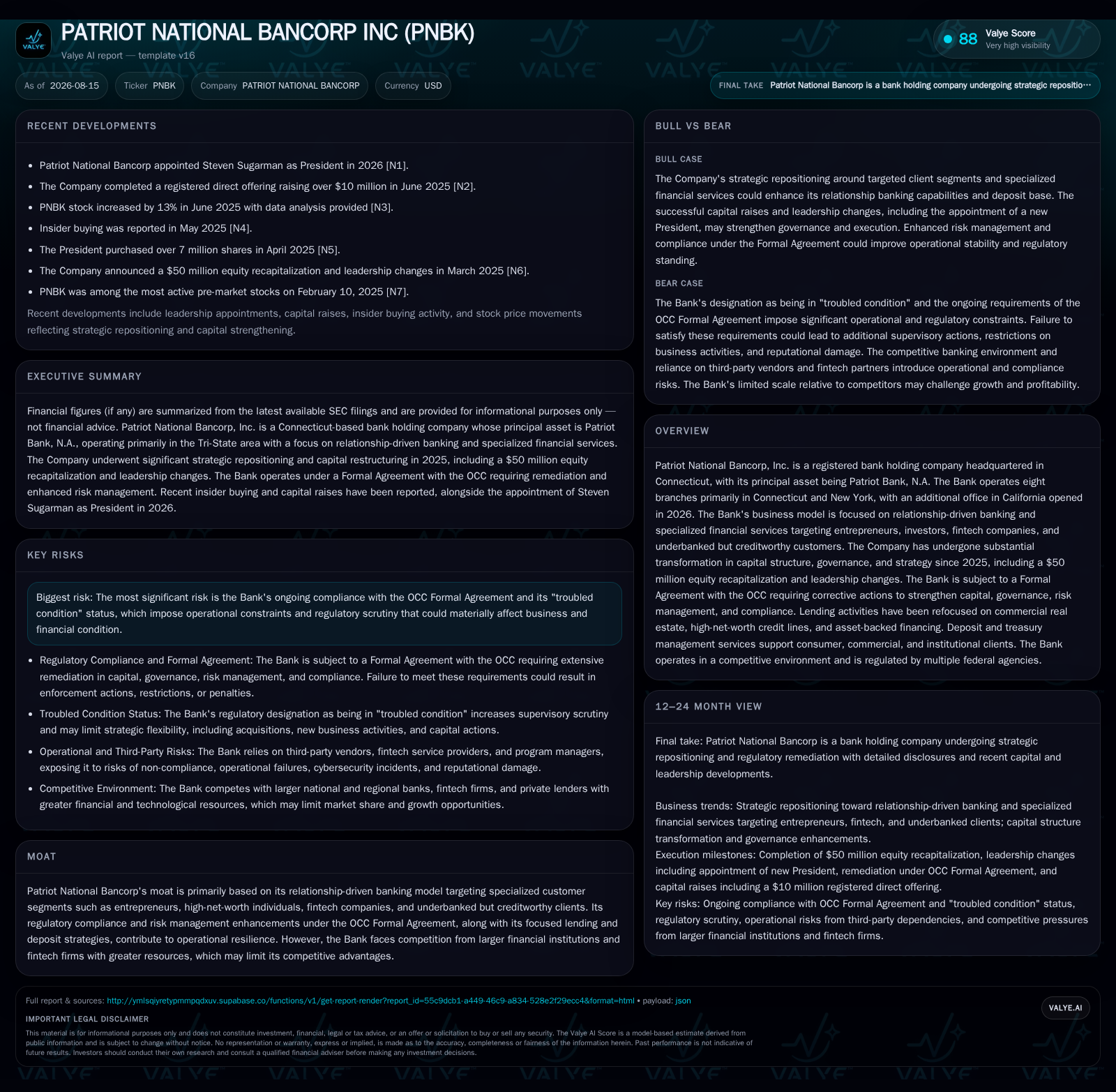
In its August 2026 quarterly filing, Patriot National Bancorp demonstrated ongoing efforts to comply with a stringent OCC Formal Agreement instituted in early 2025. The Bank has pivoted its lending strategy toward commercial real estate and high-net-worth clients while expanding fee income streams through treasury management and digital payments. Despite a strengthened capital base from recapitalization efforts, regulatory constraints tied to its "troubled condition" status continue to limit growth flexibility. The Bank operates in a competitive regional environment marked by peer banks and fintech challengers, balancing legacy portfolio wind-downs with niche relationship banking. Key milestones ahead focus on capital adequacy, remediation progress, and operational risk management.
Quarterly Operating Dynamics Reflect Ongoing Regulatory Remediation Impact
Patriot National Bancorp's August 2026 quarterly filing highlights sustained efforts to satisfy the OCC Formal Agreement entered into in January 2025. Management continues dedicating substantial resources to enhance governance structures, internal controls over credit administration, compliance frameworks, and reporting capabilities required by this agreement [S2]. Although these remediation activities increase non-interest expenses and weigh on near-term profitability, they are critical for rebuilding regulatory confidence. The bank remains under a "troubled condition" designation that restricts operational flexibility and subjects it to heightened supervisory scrutiny, indicating that remediation is an ongoing process rather than a near-term conclusion [S2][S3].
Lending Strategy Refocused on Relationship-Driven Commercial Real Estate and Wealth Segments
The Bank has strategically shifted its lending portfolio away from legacy or non-core products towards relationship-centric commercial real estate loans within its branch footprint. This approach aims to generate more stable risk-adjusted returns by leveraging deep client relationships rather than volume-driven lending [S1][S16]. Simultaneously, Patriot targets secured and unsecured credit lines for high-net-worth individuals, entrepreneurs, and related businesses—offering facilities backed by marketable securities or other collateral. This tailored credit approach supports margin improvement amid pressures from higher deposit costs and lower overall loan balances observed in recent quarters [S15].
Capital Structure Strengthened but Growth Remains Cautious Under Regulatory Constraints
Capital raising initiatives completed in 2025 injected approximately $50 million of equity into the Bank, lifting regulatory capital ratios above OCC-mandated minimums (CET1 at least 10%, Tier 1 at least 10%, total capital at least 11.5%) as of September 2025 [S11][S16]. Despite this progress, the Formal Agreement’s restrictions curtail dividend payments, acquisitions, new product launches, and limit branch expansion pace due to the "troubled condition" status [S1][S2][S19]. Governance enhancements including board committees and executive team restructuring support improved oversight; however, cautious capital deployment reflects ongoing remediation priorities pending full regulatory clearance.
Competitive Environment: Navigating Regional Banks and Fintech Disruption
While primarily serving Connecticut and New York with a new office opened in California targeting affluent Los Angeles clients in early 2026 [S13], Patriot faces competition from established multi-state banks such as Citizens Financial Group and specialized boutique banks like Signature Bank known for servicing high-net-worth customers. Additionally, fintech firms challenge Patriot’s underbanked customer focus by offering technology-driven convenience at lower costs. Patriot leverages its regulated bank status with insured deposits and personalized advisory services as key differentiators that create switching costs difficult for fintech competitors to overcome.
Diversification into Fee Income via Treasury Management & Digital Payments
Patriot is expanding non-interest income streams through treasury management offerings—such as ACH services, wire transfers, remote deposit capture—and digital payments tailored for fintech clients including program managers and payment processors [S1][S2]. This diversification strategy offsets margin pressures from elevated deposit funding costs by increasing stable fee-based revenue sources aligned with client demand for integrated cash management solutions.
Regulatory Constraints Limit Growth Options Amid Execution Risks
The ongoing Formal Agreement imposes significant operational constraints including restrictions on dividend distributions (which have been suspended since 2020), limits on acquisitions or strategic initiatives without OCC approval, controls over personnel changes critical for growth initiatives, and enhanced scrutiny of new products or market entries [S1][S2]. These restrictions compress financial returns during a period of elevated remediation spending. Successful execution hinges on eventual termination of the Formal Agreement and removal from "troubled condition" status to unlock broader strategic flexibility.
Operational Risk Focused on Third-Party Vendor Dependencies & Cybersecurity
The Bank’s reliance on multiple third-party vendors supporting its digital payments infrastructure and compliance monitoring elevates operational risk profiles [S2]. Vendor failures or cybersecurity breaches could result in costly remediation efforts or reputational harm. Although contractual indemnification offers some protection, regulators expect comprehensive risk management equivalent to internal operations. Vigilance around data privacy incidents remains critical given prior regulatory emphasis on BSA/AML control deficiencies.
Key Execution Milestones to Monitor
Looking ahead into late 2026 and beyond, performance indicators include sustaining or exceeding regulatory capital requirements (especially CET1 ratio), reducing non-performing assets within commercial real estate portfolios, growing fee income contributions demonstrating diversification success, strengthening governance effectiveness as evidenced by audits or regulator feedback, and mitigating third-party vendor risks including cybersecurity incidents without material impact [S2][S3]. Timely updates regarding the easing or termination of the OCC Formal Agreement will be pivotal markers validating strategic repositioning progress.
This analysis synthesizes information exclusively from Patriot National Bancorp Inc.'s latest SEC filings through August 14, 2026 ([S2], [S3], [S1]) augmented by validated financial snapshot data ([F1]) alongside contextual industry knowledge relevant to regional banking firms executing transformational remediation under regulatory enforcement frameworks. It aims to provide an informed perspective without extrapolating beyond disclosed facts or issuing any investment advice.
Disclaimer: This is research-only, informational analysis and not investment advice. It may include AI-generated interpretation and general industry context. Always verify important details using primary sources.

Comments