
VPR Brands Advances Patent Licensing Amid Regulatory and Competitive Challenges
Recent licensing deals bolster liquidity and revenue diversification, yet regulatory pressures and market fragmentation limit margin expansion and competitive moat.
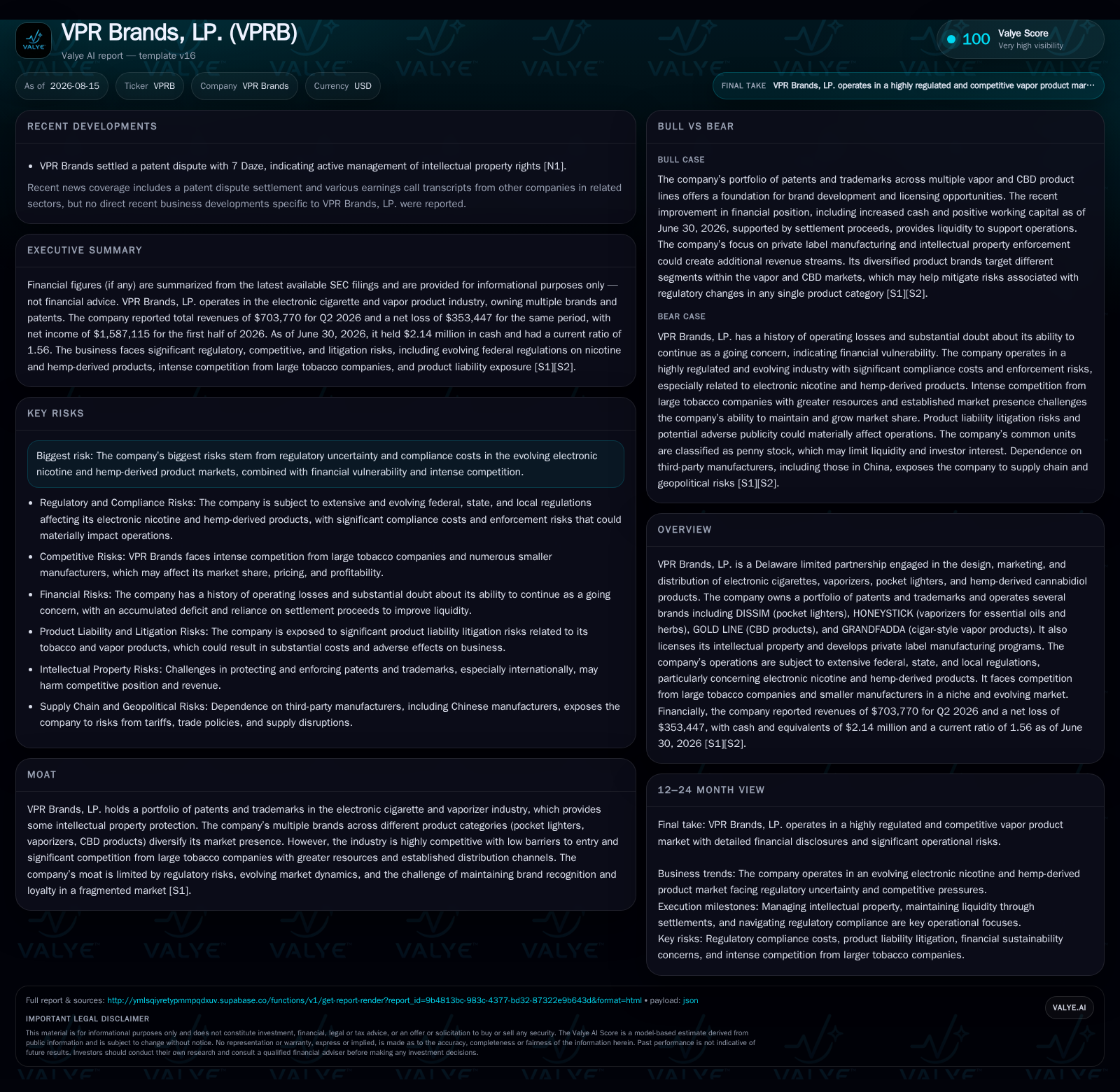
In Q2 2026, VPR Brands reported a net loss despite strong cash inflows driven by patent settlements and licensing income. Revenue of $703,770 reflects ongoing sales in electronic cigarettes, vaporizers, and CBD products amidst a challenging regulatory landscape marked by FDA premarket authorization hurdles. The company’s intellectual property portfolio and multi-brand strategy provide differentiation but face competitive pressure from large tobacco companies with scale advantages. Key growth drivers include royalty income from the JUUL licensing agreement, expanding CBD demand, and innovation aligned with evolving regulations. Risks remain elevated around regulatory compliance costs, supply chain dependencies, and product liability exposure.
Recent Operating Update
VPR Brands’ Q2 2026 results underscore both operational challenges within its core business lines and the strategic importance of its intellectual property monetization efforts. The company generated total revenue of $703,770 during the quarter ending June 30, 2026, alongside a net loss of $353,447. Despite this quarterly loss, net income for the first half of 2026 reached approximately $1.59 million due primarily to significant patent settlement proceeds recognized earlier in the year [S2]. This settlement income materially enhanced liquidity, increasing cash balances from roughly $125,000 at December 31, 2025 to over $2.13 million by mid-2026. Working capital improved correspondingly to about $1.15 million from a prior negative position [S2]. These figures highlight how patent enforcement and licensing revenues currently play a crucial role in bolstering financial stability relative to core product sales.
A key development was the July 22, 2026 License and Release Agreement with JUUL Labs granting non-exclusive worldwide rights under U.S. Patent No. 8,205,622 B2 for an aggregate consideration of $11 million payable in installments. An initial payment of $4 million was received shortly thereafter providing immediate cash inflows [S3], [S21]. This agreement exemplifies VPR Brands’ strategic emphasis on leveraging its intellectual property portfolio as a critical monetization lever during an increasingly difficult operating environment.
Business Model Overview
VPR Brands operates across several product categories including electronic nicotine delivery systems (ENDS), vaporizers for essential oils and herbal blends through brands like HONEYSTICK and GRANDFADDA cigar-style devices; pocket lighters via DISSIM; and hemp-derived cannabidiol (CBD) products under GOLD LINE [S1]. Its business model combines direct branded product sales with intellectual property licensing arrangements and private label manufacturing services.
The company’s IP portfolio—anchored by patents such as the ’622 patent licensed to JUUL—creates diversified revenue streams beyond retail sales but also exposes performance to successful patent enforcement outcomes. Manufacturing is largely outsourced overseas (primarily China), which reduces capital intensity but introduces margin volatility linked to currency fluctuations and tariffs that may not be fully passed onto consumers [S16]. Revenue growth depends heavily on both unit sales volume across categories and the ability to navigate evolving regulatory approvals impacting product availability.
Industry Structure and Competitive Positioning
The electronic cigarette and hemp-derived consumer products industry is highly fragmented yet dominated by large multinational tobacco companies such as Altria and British American Tobacco. These incumbents leverage scale advantages in manufacturing capacity, extensive retail distribution networks (particularly into convenience stores), robust regulatory compliance capabilities, established brand portfolios including ENDS products, and significant marketing budgets — advantages that smaller players like VPR lack.
VPR Brands differentiates itself through its moderate intellectual property portfolio protecting vaporizer technology designs mainly via patents like ’622 central to recent licensing deals. Its multi-brand approach spanning less regulated segments such as pocket lighters partially mitigates concentration risk. However, barriers to entry for manufacturing are relatively low which limits IP moat strength.
Regulatory compliance represents a major structural barrier: flavored ENDS products require rigorous FDA premarket tobacco authorization (PMTA) demonstrating adult user benefits while minimizing youth access risks through measures such as biometric age gating or geofencing technology — a high evidentiary bar that has led to widespread denials or delays across the industry [S23].
Competitive positioning thus depends on successfully navigating these regulations while innovating device features appealing to adult consumers without triggering increased enforcement or bans. Demand volatility persists amid shifting consumer preferences favoring non-nicotine CBD wellness formulations alongside traditional nicotine vaping.
Growth Drivers
Growth is propelled by rising consumer preference for alternatives to combustible cigarettes—especially flavored vaping products—and expanding legal acceptance of hemp-derived cannabinoids like CBD for wellness purposes. VPR’s GOLD LINE CBD offerings align well with this trend supported by state-level legalization advances.
Recurring royalty streams from legal settlements provide near-term revenue stability while funding R&D investments focused on developing new products compliant with tightening regulations yet differentiated through safety features or user experience enhancements [S21], [S24].
Strategic partnerships including private label manufacturing broaden revenue diversification beyond proprietary branded sales.
Technological innovation aimed at improving battery safety profiles and enhancing device access restrictions addresses FDA scrutiny requirements crucial for securing Marketing Granted Orders needed for sustained flavored ENDS sales growth.
Geographic expansion into states with favorable cannabis/hemp laws combined with targeted branding efforts seeks to build consumer loyalty within a fragmented retail environment characterized by frequent brand switching.
Risks and Watchpoints
Regulatory uncertainty remains the most significant risk: rapid shifts in FDA enforcement policies—particularly regarding flavored ENDS—and potential state-level restrictions could curtail permissible product offerings or impose costly compliance burdens that compress margins [S23], [S24]. Failure to secure or maintain required marketing authorizations would sharply reduce sales volumes.
Intense competition from well-capitalized tobacco multinationals possessing cost efficiencies due to scale presents ongoing challenges. Dependence on third-party overseas manufacturers introduces operational risks including supply chain disruptions or tariff escalations affecting input costs [S16].
Product liability litigation poses existential financial threats given historical precedents in tobacco-related industries; inadequate insurance coverage or adverse rulings could impose material expenses jeopardizing business continuity [S1], [S24]. Sustaining consistent brand recognition amid market fragmentation is challenging; quality issues or competitor innovations could swiftly erode consumer loyalty.
Financially, persistent accumulated deficits underscore ongoing profitability pressures despite intermittent settlement income boosts; prudent cash flow management remains critical given modest operating cash generation excluding litigation-related receipts.
What to Watch Next
Investors should closely monitor forthcoming royalty payments under the JUUL Labs license agreement installment schedule totaling $11 million overall along with related accounting recognition guidance announced post quarter-end [S3], [S21].
FDA Marketing Granted Order developments impacting existing flavored ENDS products held or under PMTA review will significantly influence future revenue trajectories beyond steady-state licensing income streams [S23]
Tracking unit sales volume trends across key categories—such as HONEYSTICK vaporizers versus emerging herbal formulations—and shifts between nicotine versus CBD segment revenues will provide insight into demand sustainability.
Expansion or renewal of private label manufacturing contracts will indicate success in diversifying revenue sources while margin trend analysis linked to procurement cost volatility amidst currency fluctuations will illuminate operational efficiency gains or pressures.
Management capability in recruiting personnel skilled in marketing expansion and financial sophistication will be important for executing growth strategies effectively [S1].
Financial Profile Discussion
As of June 30, 2026, VPR Brands held approximately $2.14 million in cash and equivalents against current liabilities of about $2.07 million, resulting in a current ratio near 1.56 — signaling adequate short-term liquidity cushions for operational needs [F1]. Total debt was approximately $388 thousand as of September 30, 2025, while net debt was negative by about $1.75 million after factoring liquid assets, indicating low leverage risk based on available data [F1].
Operating cash flow generation was robust at roughly $2.04 million over six months ended June 30 primarily reflecting collections tied to patent monetization rather than core operations alone [S7]. Although quarterly losses persisted ($353 thousand loss Q2), management concluded that substantial doubt regarding going concern status had been alleviated following receipt of significant non-recurring settlement cash inflows [S10].
Cost structure continues to bear typical small consumer brand burdens involving elevated selling general & administrative expenses necessary for marketing investment alongside R&D focused on regulatory-driven innovation efforts [S1]. Capital expenditures remain minimal consistent with reliance on outsourced manufacturing [S7].
Achieving sustained positive free cash flow beyond litigation-related inflows will be critical long term given historic trends of recurring operating losses [F1]
This analysis synthesizes publicly filed data through August 14, 2026 focusing on VPR Brands’ strategic positioning within electronic nicotine delivery systems and hemp-derived consumer segments while emphasizing critical regulatory context shaping its operating environment. It aims to provide an informed perspective on emerging opportunities alongside structural headwinds facing the company without constituting investment advice.
Disclaimer: This is research-only, informational analysis and not investment advice. It may include AI-generated interpretation and general industry context. Always verify important details using primary sources.

Comments