
INVO Fertility Confronts Liquidity Pressures While Advancing Proprietary Fertility Technologies
Recent quarterly results highlight financial strain amid efforts to expand INVOcell device adoption and telehealth fertility services.
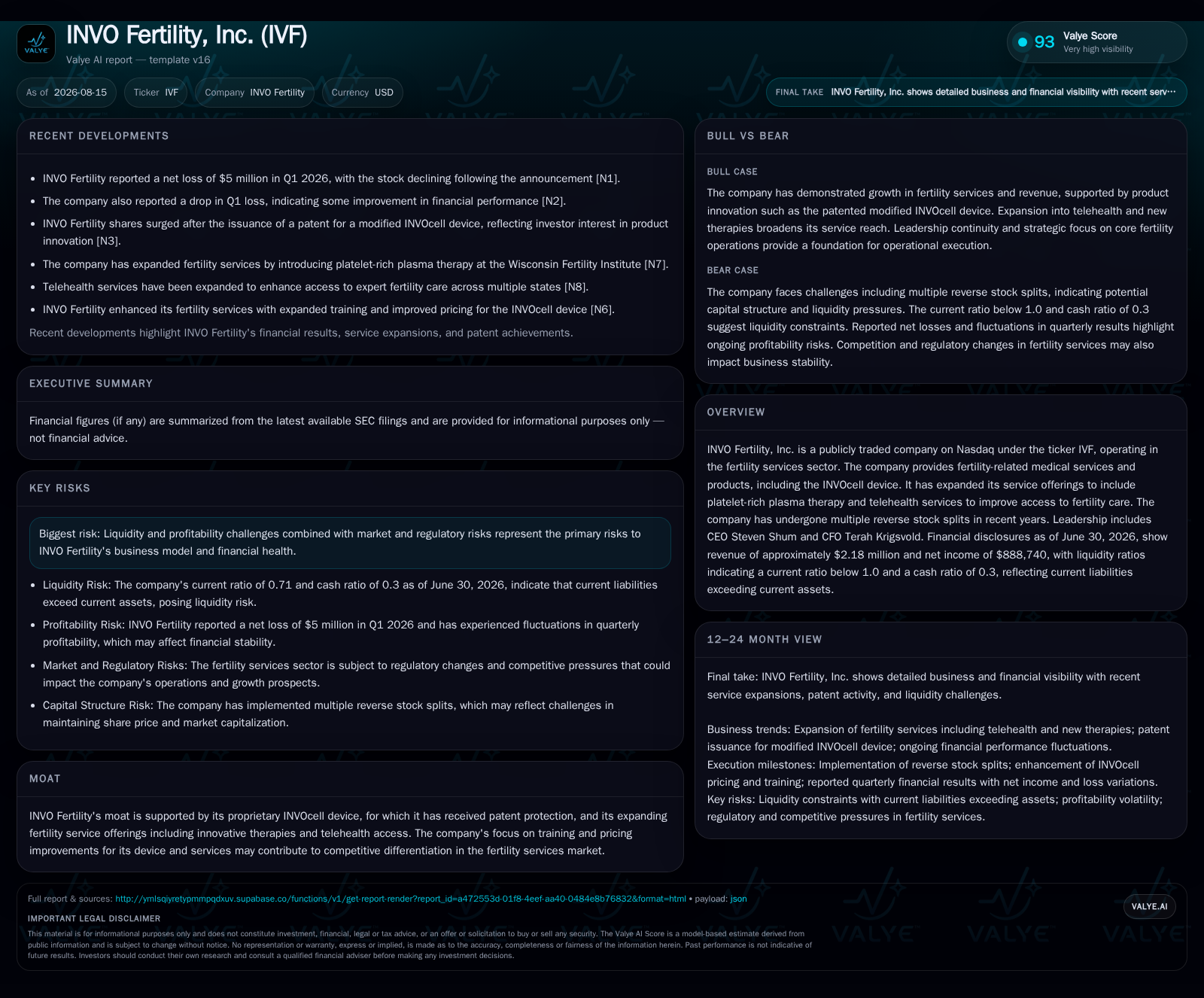
INVO Fertility, Inc. remains focused on leveraging its patented INVOcell fertility device and expanding service offerings such as platelet-rich plasma therapy and telehealth to differentiate itself in the assisted reproductive technology (ART) market. However, the latest quarterly filing reveals significant liquidity challenges, with current liabilities exceeding assets and a depressed current ratio of 0.71, underscoring financial constraints that could hamper growth execution. The company's new financing arrangement with Alumni Capital LP could provide needed capital flexibility, but profitability remains elusive. Continued progress depends on scaling treatment volume and improving pricing, alongside navigating regulatory and reimbursement dynamics.
Recent Operating Update
INVO Fertility's most recent quarterly filing dated August 14, 2026 reveals acute liquidity pressures despite operational initiatives aimed at expanding its fertility services footprint [S2]. The balance sheet shows current assets totaling roughly $4.6 million against current liabilities exceeding $6.5 million as of June 30, 2026, resulting in a current ratio of approximately 0.71 [F1]. This ratio signals that short-term obligations significantly outstrip readily available assets—a red flag for operational flexibility in a sector where timely funding is critical for R&D and clinical deployment. Furthermore, reported cash equivalents stand near $2 million as per the most recent data point from mid-2022 [F1], underscoring constrained cash runway relative to liabilities.
Amid these challenges, the company entered an Any Market Purchase Agreement with Alumni Capital LP in July 2026 granting it the right to sell up to $15 million worth of common stock—expandable to $50 million upon mutual agreement—to shore up liquidity [S3]. The deal's tiered purchase options provide some adaptability depending on market conditions and trading prices. This infusion opportunity is strategically relevant given the company’s limited revenue base (~$2.18 million as of mid-2026) and nascent profitability profile with net income under $1 million [S1]. How effectively INVO Fertility leverages this financing will be instrumental in sustaining operations and scaling.
Business Model: Proprietary Devices Complemented by Expanding Service Offerings
INVO Fertility operates at the apex of medical device manufacturing and fertility service provision. Its flagship product is the INVOcell—a proprietary intra-vaginal fertility device designed as a lower-cost alternative within assisted reproductive technologies (ART). This device has secured patent protection bolstering its competitive moat by limiting direct replication [S1]. Revenues derive primarily from sales of this device alongside fees for fertility treatments conducted by partner clinics that utilize INVOcell within their ART cycles.
Beyond hardware, INVO Fertility has strategically expanded into adjacent therapeutic domains including platelet-rich plasma (PRP) treatments intended to enhance reproductive outcomes and telehealth fertility consultations that improve patient access irrespective of geography [S1]. Telehealth especially stands out as a growth vector enabling broader patient acquisition while addressing barriers traditionally associated with clinic-based treatments such as scheduling constraints or location inconvenience.
The monetization model thus combines devices sold through medical providers with recurring service revenues related to treatment cycles—both physical and virtual. Pricing power is influenced by regional reimbursement policies for ART services plus clinic willingness to adopt innovative therapies balancing cost-effectiveness against clinical outcomes.
Industry Structure and Competitive Position
The fertility services industry encompasses a mix of specialized clinics offering ART procedures like IVF and IUI, manufacturers of fertility devices, telehealth platforms focusing on reproductive health, biotech firms developing adjunct therapies, diagnostic laboratories, and pharmaceutical providers. Within this diverse ecosystem, companies like INVO Fertility straddle product innovation (via patented devices) and service delivery enhancement (via extended therapies and telehealth).
Key industry participants include established fertility clinic operators such as Progyny known for comprehensive care networks; medical device firms like Cook Medical which benefit from scale and globally recognized clinical support infrastructure; and emerging telehealth platforms that tap into shifting patient preferences for convenience.
INVO Fertility differentiates itself through its patented INVOcell technology offering potential cost advantages in ART treatment cycles. Its growing incorporation of PRP therapies aims at improving clinical success rates—an essential factor influencing patient retention and referral rates in elective fertility treatments.
Growth Drivers
Demographics underpinning the sector are broadly favorable: rising infertility incidence globally driven by delayed childbearing trends stimulates demand structurally rather than cyclically. Rising societal acceptance of fertility treatments further enlarges addressable markets.
Technology advances also enable novel therapeutic approaches allowing differentiation beyond conventional IVF procedural volumes. Specifically:
- INVOcell utilization: Increasing adoption of the patented device can drive unit sales volume correlated directly to treatment cycle increases.
- Telehealth expansion: Higher volume of remote consultations supports patient funneling into ART cycles while reducing geographic care gaps.
- Adjunct therapies: Platelet-rich plasma therapy integration may enhance clinical outcomes boosting patient confidence and justifying premium pricing.
- Regulatory progress: Additional approvals or expanded indications for the INVOcell device reinforce competitive barriers.
Successfully increasing average revenue per treatment cycle through optimized pricing or bundled service offerings also contributes materially to top-line growth while improving operational margins if fixed costs dilute over higher volumes.
Risks and Watchpoints
Liquidity constraints remain the immediate operational risk due to current liabilities outstripping available liquid assets [F1], potentially restricting R&D investment pace or marketing activities vital for scaling device adoption.
Regulatory uncertainty looms large given evolving FDA guidelines affecting medical devices used in reproductive health—any delays or adverse rulings could impair product availability or uptake. Insurance reimbursement fluctuations similarly impact patient affordability thresholds directly influencing elective treatment volumes.
Competitive pressure is formidable both from entrenched multidisciplinary fertility centers offering comprehensive ART solutions including drugs and diagnostics—as well as innovative telehealth entrants simplifying access frameworks. Without demonstrable improvements in clinical success rates tied to their therapies or proprietary devices’ real-world effectiveness data disclosure, INVO may find it difficult to differentiate sufficiently.
Ongoing patent protection will be critical; any litigation or expiration could erode competitive advantage rapidly given low switching costs for clinics towards comparable alternatives.
Additionally, economic downturns commonly reduce demand for elective procedures such as fertility treatments making sustaining utilization rates during macroeconomic uncertainty challenging.
What To Watch Next
Monitoring quarterly progression in key operating metrics such as:
- Number of treatment cycles utilizing the INVOcell system,
- Telehealth consultation volume growth,
- Device sales velocity,
- Regulatory compliance developments related to ongoing patent status or new approval filings,
- Achievement milestones against financing drawdowns under the Alumni Capital LP agreement, will provide transparency on whether operational execution aligns with strategic aspirations amidst tight cash conditions.
Investor focus should also track any management commentary on updates to pricing strategies, patient acquisition initiatives via digital channels, or partnerships expanding clinical network reach as drivers of incremental revenue growth over time.
Financial Profile Discussion
As of June 30, 2026, INVO Fertility’s balance sheet portrays liquidity challenges with current liabilities at approximately $6.52 million outpacing current assets near $4.60 million resulting in a concerningly low current ratio of about 0.71 [F1]. This metric highlights short-term solvency risks warranting close attention particularly given typical gestation periods between capital deployment into R&D/marketing investments versus realized revenue inflows in healthcare services sectors.
The company’s cash position stands comparatively thin relative to overall indebtedness with total debt estimated around $892 thousand against restricted cash balances approximating $2 million based on past data points [F1]. Such leverage levels require careful capital management especially as ongoing losses reflect operational deficits common among smaller emerging fertility service entities investing heavily in innovation pathways.
Nonetheless, net income generation showed some improvement reaching nearly $889 thousand positive result amid constrained revenue base reported recently suggesting potential early-stage progress toward profitability [S1]. The new equity commitment via the Purchase Agreement provides essential flexibility but also introduces dilution considerations contingent on share issuance executions aligned with market conditions [S3].
Moving forward sustainable profitability will depend heavily on scaling revenue faster than fixed cost growth while managing working capital rigorously—typical challenges faced by companies transitioning from development-heavy phases to commercial maturity stages within fertility technology ecosystems.
This analysis synthesizes publicly available regulatory filings through August 14, 2026 alongside industry context relevant to assisted reproductive technology providers specializing in proprietary medical devices complemented by adjunct services such as plateletrich plasma therapy and telehealth-enabled accessibility enhancements. It does not constitute investment advice but aims at providing a grounded understanding of INVO Fertility’s business fundamentals relative to prevailing sector dynamics.
Disclaimer: This is research-only, informational analysis and not investment advice. It may include AI-generated interpretation and general industry context. Always verify important details using primary sources.

Comments