
Tivic Health Advances Biopharmaceutical Pivot with Entolimod Milestones Amid Nasdaq Compliance Pressure
The company progresses clinical and regulatory development of its TLR5 agonist therapies while managing liquidity and stock listing risks.
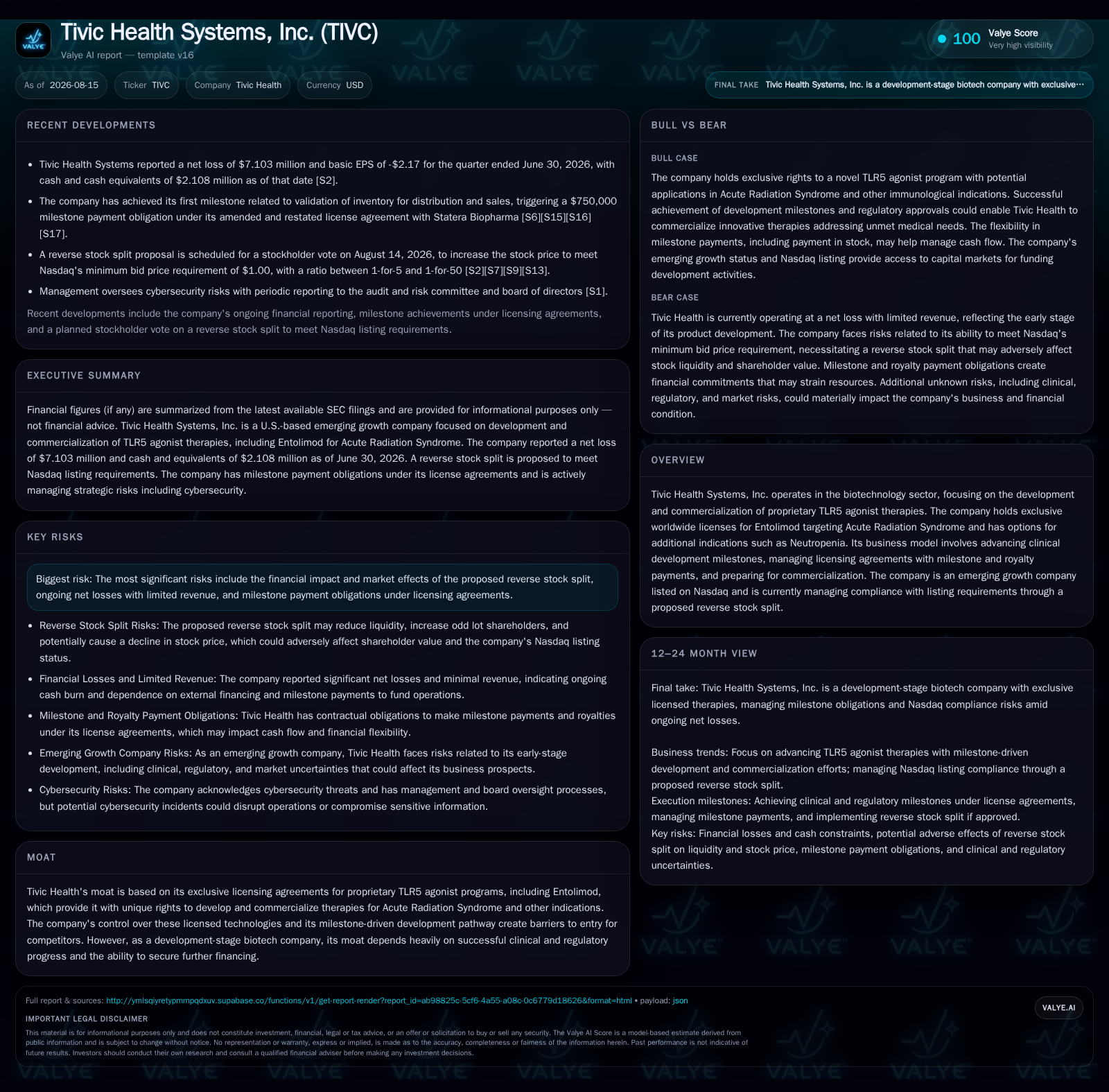
Tivic Health Systems, now Valion Bio, is executing its strategic shift from bioelectronic devices to a focused biopharmaceutical model centered on proprietary TLR5 agonists. In the latest quarter, it achieved a key milestone related to inventory validation for commercial distribution of Entolimod, triggering a $750,000 payment obligation under its exclusive license agreement. The company faces continued financial pressure with limited revenue and tight cash reserves, while seeking to maintain Nasdaq listing compliance through a proposed reverse stock split. Its business model depends on regulatory progress in Acute Radiation Syndrome and optional indications like Neutropenia, alongside milestone-driven licensing payment obligations and emerging manufacturing capabilities via its CDMO subsidiary.
Recent Operating Update
Tivic Health Systems (now also known as Valion Bio) has made tangible progress in executing its biopharmaceutical strategy during the second quarter of 2026 [S3,S18]. The company announced completion of a key milestone involving validation of inventory materials necessary for distributing and selling Entolimod, a proprietary TLR5 agonist therapy developed under exclusive worldwide license for Acute Radiation Syndrome (ARS). This milestone triggered an associated payment obligation of $750,000 under the Amended and Restated License Agreement (A&R License Agreement), payable either in cash or shares at the company's discretion
This step signals readiness toward commercialization logistics—a critical transition point for biotech companies advancing from clinical phases into market preparation. While not equivalent to regulatory approval or direct revenue generation, inventory validation reflects operational capability to satisfy distribution standards.
Importantly, Tivic remains on track with its broader licensing and clinical milestones dictated by its agreements with Statera Biopharma and Avenue Capital. These contracts provide control over Entolimod’s development pathway but impose structured financial obligations including milestone payments and royalties tied to net sales post-approval across ARS and potentially other indications if options are exercised [S9,S18]
Business Model Analysis
Tivic operates predominantly as a development-stage biotechnology company focused on immunomodulatory therapies based on Toll-like Receptor 5 (TLR5) agonism. Its core asset is Entolimod, which it licenses exclusively worldwide for ARS treatment—a niche but high-impact indication typically aimed at mitigating radiation sickness arising from nuclear incidents or emergencies.
Alongside ARS, Tivic holds options to expand into additional indications such as neutropenia—an immunosuppressive condition—offering scope for portfolio growth contingent upon successful regulatory filings and trial endpoints [S1,S18]. This dual-indication strategy balances concentrated focus with pipeline flexibility.
Revenue realization follows classical biotech licensing archetypes: pre-commercial phases rely heavily on milestone payments triggered by achievements in R&D (e.g., inventory validation, IND filing, Phase III completions), while post-approval revenue derives principally from royalties on net product sales or sublicensing fees.
Monetization involves checkpoint-triggered payments to licensors like Statera Biopharma; notably, Tivic retains latitude to pay these in cash or stock—an important flexibility amid constrained capital circumstances [S9]. These obligations affect cash flow forecast accuracy and require careful capital allocation.
Manufacturing strategy is supported by the December 2025 establishment of Velocity Bioworks™, a wholly owned contract development and manufacturing organization (CDMO) subsidiary [S1]. This creates internal capacity to manage drug substance production and process validation without entirely outsourcing—an operational advantage that may improve supply chain reliability relative to peers relying solely on third-party CDMOs
Industry Structure and Competitive Position
Within the specialized segment of ARS therapeutics targeting medical countermeasures against radiation exposure, Tivic faces limited direct competition but challenging incumbents. Approved standard-of-care biologics primarily comprise Granulocyte Colony-Stimulating Factor (G-CSF) agents such as filgrastim (Neupogen®) and pegfilgrastim (Neulasta®), which also enjoy established government stockpiles like the U.S. Strategic National Stockpile [S1].
These FDA-approved G-CSF drugs set a high bar for efficacy and safety expectations among military purchasers and disaster response entities—key payors for any ARS therapeutic—which could restrict market penetration for newer entrants until substantial clinical benefits are demonstrated.
Tivic’s competitive edge theoretically rests on leveraging novel TLR5 agonist biology offering differentiated mechanisms possibly yielding improved outcomes or administration profiles. However, success hinges decisively on favorable clinical trial results that meet stringent regulatory milestones.
Manufacturing capability via Velocity Bioworks positions Tivic ahead compared with some similarly sized peers who must outsource extensively at potentially higher costs or longer lead times. Nonetheless, scale limitations typical for emerging growth biotechs imply ongoing challenges achieving cost-effective commercial production until volumes increase substantially.
Growth Drivers
Key drivers will be landmark regulatory approvals anchored by positive Phase II/III data enabling submission of biologics license applications (BLAs) for both ARS and neutropenia indications [S18]. Achieving these approvals would unlock further milestone payments—from $1 million for BLA filing up to $1.5 million upon FDA approval in neutropenia cases—and initiate royalty revenue streams absent today.
Government procurement contracts represent an important growth lever given substantial public sector demand for medical countermeasures addressing national security concerns. However, demand can be erratic based on federal budget priorities and existing stockpiles that limit near-term purchase volume.
Strategic partnerships or licensing collaborations with larger pharmaceutical entities could accelerate commercialization reach or augment capital availability but remain unconfirmed at this stage.
Financial dynamics such as effective cash management balancing R&D burn against fundraising capacity will influence pace of clinical progression—a critical gating factor considering finite cash resources reported [F1]. Development expenses are principal investments underpinning long-term value creation here.
Risks and Constraints
Prominent risks include ongoing net losses contributing toward tightening liquidity—cash reserves stood at approximately $2.1 million versus current liabilities above $3 million as of June 2026—with a narrow current ratio (~1.11), underscoring limited short-term financial flexibility [F1]
The proposed reverse stock split intended to comply with Nasdaq’s minimum bid price test introduces dilution risk perceptions alongside potential share liquidity compression; historical precedent shows such corporate actions can negatively affect market confidence despite intended listing preservation benefits [S2,S25]
Clinical trial outcomes remain inherently uncertain; failure or delay can impair licensing revenue triggers while extending cash burn duration. Regulatory review timing adds unpredictability affecting launch trajectories.
Competition from entrenched G-CSF biologics stocked by governments poses adoption hurdles despite potential mechanistic advantages.
Milestone payment obligations cumulatively strain finances during commercial build-up phases where revenues are nascent or nonexistent if development stalls.
Dependency on licensors’ IP intensifies exposure if licensed patents encounter challenges or contractual disagreements arise.
What To Watch Next
Key upcoming indicators include timing and results of pivotal clinical trials supporting BLAs for ARS and neutropenia indications as well as successful completion of regulatory submissions—milestones intricately linked to subsequent material payments detailed in licensing agreements [S18].
Capital raising initiatives will bear watching given current cash runway tightness; securing funds is essential to sustain operations through these critical phases.
Monitoring Nasdaq compliance updates related to reverse stock split proposals offers insight into structural equity market risks potentially impacting investor interest.
Advances in manufacturing scale-up via Velocity Bioworks could surface as positive operational milestones lowering future cost barriers.
Additional government contract awards or extensions would validate commercial prospects within countermeasure markets historically influenced by geopolitical risk considerations.
Financial Profile Discussion
Tivic’s financial snapshot remains characteristic of an emerging growth biotech still firmly in clinical development stages without significant approved-product revenue streams. As of June 30, 2026, cash and equivalents were modest at $2.1 million against current liabilities slightly exceeding $3 million leading to constrained liquidity visible in a current ratio of approximately 1.11 [F1]. This liquidity level necessitates careful operational prioritization alongside active capital management strategies likely involving equity issuances or debt arrangements given typical R&D expense drag.
Historical revenues have been minimal ($780k reported at year-end 2024) with operating losses persisting (~$7.9 million operating loss FY 2025), reflecting heavy investment ahead of product commercialization capacity [F1]. The firm continues incurring milestone payments such as the recently triggered $750,000 entitlement tied to inventory validation while preparing regulatory filings that may trigger further sizable financial commitments payable either in stock equity or cash — terms providing some flexibility but complicating forecasting precision [S18].
Overall balance sheet trends suggest dependency on timely successful capital raises balanced against managing milestone liabilities amid nascent revenue generation expected only upon eventual product approvals.
Disclaimer: This analysis is based solely on publicly available information from SEC filings dated through August 14, 2026, supplemented by general biotechnology industry knowledge. It does not constitute investment advice or research views.
Disclaimer: This is research-only, informational analysis and not investment advice. It may include AI-generated interpretation and general industry context. Always verify important details using primary sources.

Comments