
Solaris Energy Infrastructure Boosts Revenues and Expands AI Data Center Footprint with Strategic Equipment Rentals
The company nearly doubled revenues in FY2025 driven by long-term equipment rental agreements, especially targeting AI data center power demand, while managing rising capital expenditures and maintaining liquidity.
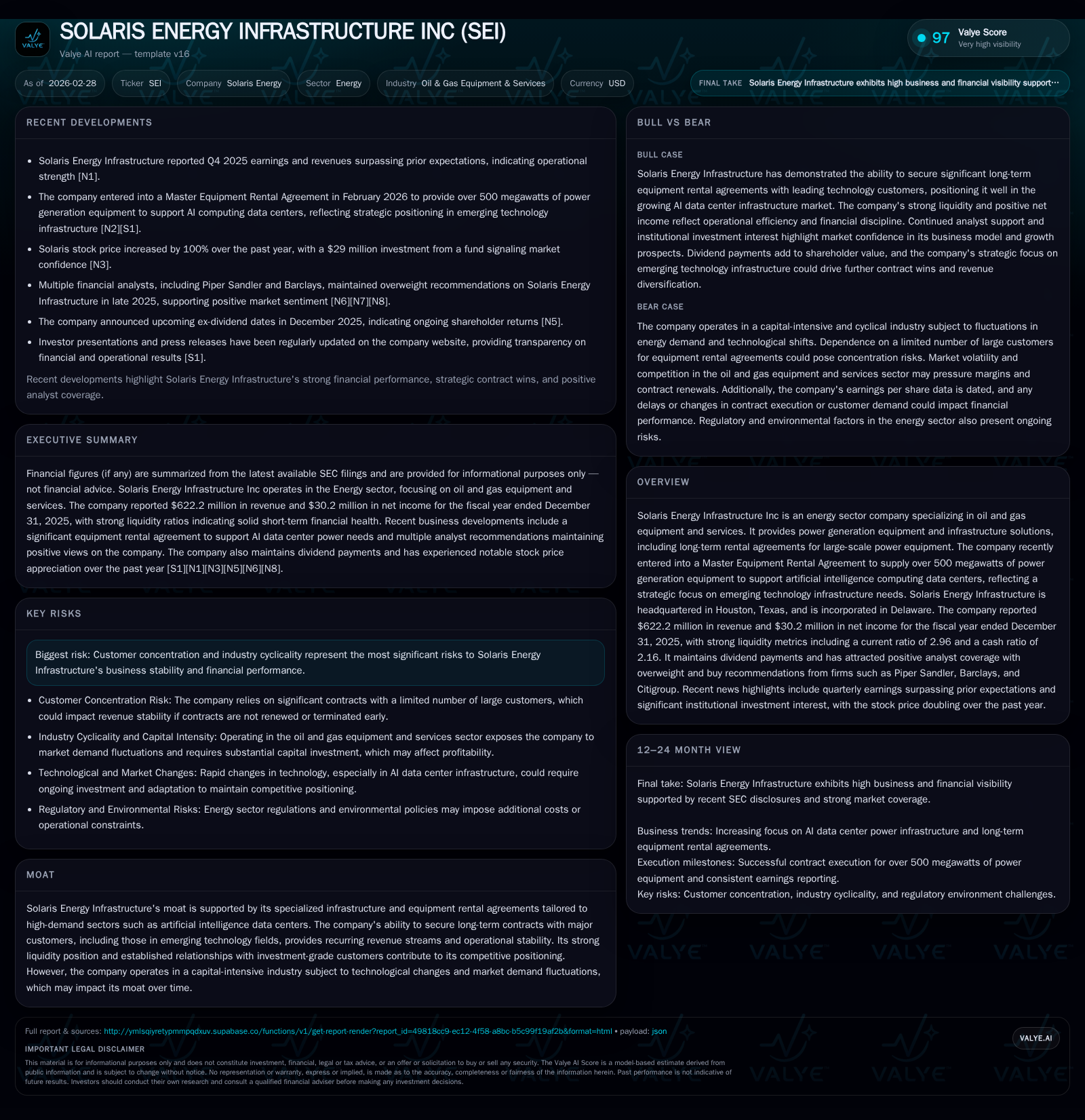
Solaris Energy Infrastructure Inc reported a striking 98.7% revenue increase to $622.2 million in fiscal year 2025, fueled largely by a strategic Master Equipment Rental Agreement supplying over 500 MW of power equipment for artificial intelligence data centers. Despite this surge in top-line and operating income growth (156.3%), heavy capital spending of $646.8 million pushed free cash flow negative, although the balance sheet remains robust with cash ratios above 2. The company sustained dividends but paused share buybacks as it invests heavily in specialized power infrastructure. Key risks include customer concentration and sector cyclicality, while upcoming milestones hinge on the development of additional lease income streams and rental contract realizations.
Tracking Solaris’s Revenue Acceleration: FY2025 in Context
Solaris Energy Infrastructure delivered an impressive financial performance in fiscal year 2025, nearly doubling its revenue to $622.2 million, up 98.7% compared to $313.1 million in the prior year [F1]. This dramatic top-line acceleration was accompanied by operating income growth of 156.3%, rising to $135.4 million from $52.8 million in fiscal 2024, indicating improving operational efficiency and scale benefits within its equipment rental services [F1]. Net income rose by just over 90%, reaching $30.2 million [F1].
Key drivers behind this surge include the expansion of long-term rental contracts, particularly involving large-scale power generation equipment tailored to emerging technology infrastructure demands such as data centers dedicated to artificial intelligence workloads [N1][S3]. This shift marks a departure from more traditional oilfield equipment services, enabling Solaris to capture higher-margin recurring revenues tied to specialized infrastructure.
While Solaris operates in the capital-intensive Oil & Gas Equipment & Services industry, its strategic pivot toward servicing AI computing facilities represents an attempt to harness evolving power needs through highly engineered equipment rentals under master agreements that lock customers in for multiple years.
Historical Financial Performance Summary (FY2022-FY2025)
Historical performance (annual)
| FY | Rev ($mm) | Net ($mm) | CFO ($mm) | OpInc ($mm) | Rev YoY | Net YoY |
|---|---|---|---|---|---|---|
| 2025 | 622 | 30 | 209 | 135 | +98.7% | +90.8% |
| 2024 | 313 | 16 | 59 | 53 | +6.9% | -35.0% |
| 2023 | 293 | 24 | 90 | 50 | -8.5% | +15.0% |
| 2022 | 320 | 21 | 68 | 42 |
Source: SEC companyfacts cache [F1].
Capital returns and efficiency (annual)
| FY | Div ($mm) | Buybacks ($mm) | FCF ($mm) |
|---|---|---|---|
| 2025 | 22 | 0 | -438 |
| 2024 | 15 | 8 | -129 |
| 2023 | 14 | 26 | 26 |
| 2022 | 14 | 27 | -13 |
Source: SEC companyfacts cache [F1].
Note: Operating income is impacted by expanding rental operations; capex escalated sharply starting FY2024.
Long-Term Rental Agreements: A Strategic Pivot Toward AI Data Center Demand
On February 12, 2026, Solaris entered into a Master Equipment Rental Agreement with Hatchbo, LLC, an affiliate of a global investment-grade technology leader specializing in artificial intelligence computing [S10]. Under this contract, Solaris will supply over 500 megawatts of power generation equipment dedicated to supporting the power demands of AI data centers.
This agreement has an initial ten-year term starting January 1, 2027, with an option for one five-year extension by the customer [S10]. Termination provisions are stringent—the customer can end early only with thirty days’ notice and must pay a termination fee equating to half the remaining rental fees owed through the contract term.
The arrangement includes obligations for Solaris or its subsidiary to own, install, operate, maintain, and provide necessary engineering and site work related to the equipment and supporting facilities [S10]. Importantly, such master rental agreements underpin recurring revenue streams—a fundamental moat element—by binding major customers in capital-intensive deployments shielding Solaris from short-term demand shocks.
This shift towards provisioning infrastructure tailored for AI computing reflects broader sector trends where energy equipment providers increasingly tap emerging power-hungry tech sectors beyond traditional upstream oilfield markets (analysis). Leasing models focused on turnkey deployment and ongoing maintenance enhance customer retention, enabling Solaris to differentiate through asset specialization.
Financial Position and Liquidity: Strengthening Balance Sheet Amid Growing Capex
Despite rapid top-line growth and cash flow expansion, Solaris faced significant pressure on free cash flow due to capital expenditure ballooning to $646.8 million in FY2025 from just $188.4 million the prior year—a near tripling aligned with asset buildout for its expanding rental fleet [F1].
Operating cash flow grew impressively by roughly 252% YoY reaching $209 million reflecting improving collections and earnings quality; however, free cash flow turned markedly negative by approximately $437.7 million due to aggressive investment activity [F1].
Notably though, Solaris maintains robust liquidity buffers: its current ratio stood at a healthy 2.96 derived from current assets of $483 million against current liabilities of $163 million at year-end [F1]. Similarly strong cash ratios (2.16) reflect significant cash reserves ($353 million) providing coverage during this capital expenditure ramp [F1][S7][S8][S9].
This profile typifies a capital-intensive leasing business scaling rapidly—commonplace across oilfield equipment but on an accelerated scale given the new technology-focused fleet deployments (analysis). The company’s ability to sustain current operational liquidity while investing heavily will be essential to preserve balance sheet strength.
Capital Allocation Trends: Dividends Maintained Amid No Recent Buybacks
Solaris continues paying dividends supported by steady earnings growth; dividend payouts rose modestly year-over-year to about $21.8 million or roughly a tenth of net income [F1][S15]. Meanwhile, share buybacks were suspended during FY2025 after repurchases totaling approximately $8 million in FY2024 [F1].
This decision signals management’s prioritization of reinvesting proceeds into expanding the asset base needed for new rental contracts rather than returning capital via buybacks amid aggressive growth efforts.
Calculating approximate return on equity yields 5.3% using net income over equity ($30M / $564M) [F1], consistent with an asset-heavy leasing model still maturing its profitability profile with substantial reinvestment diluting near-term returns.
Investors will want to monitor if dividend levels remain stable or grow as Solaris aims toward generating positive free cash flow in future periods when capex scales moderate.
Risks to Sustain Growth: Customer Concentration and Sector Cyclicality
Solaris flags customer concentration as a principal risk given revenue reliance on relatively few investment-grade counterparties like Hatchbo engaged via large equipment leasing agreements [S4][S6]. Should these relationships deteriorate or contracts terminate early despite penalties, revenues and cash flows could see meaningful disruption.
Furthermore, inherent cyclicality within oil & gas equipment servicing persists—demand fluctuates with commodity price cycles impacting traditional clientele even as newer technology sectors grow (analysis). Technological advancements or shifting energy policies may also alter infrastructure needs competitively challenging Solaris’s offerings.
While contracts are structured with protective termination fees and guarantees capped at fractional contract values mitigate some downside risk exposures, maintaining diversification across customers and verticals will be crucial going forward.
Outlook and Milestones: What Investors Should Watch Next
The company has not issued explicit forward guidance beyond disclosing recent contract wins [N3][S3], but market commentary indicates optimism tied to backlog conversion potential from the recently announced AI data center equipment agreement [N5].
Key events include upcoming quarterly earnings releases expected to provide updated revenue mix breakdowns showing lease income ramp-up alongside detailed capex trends — critical barometers for monitoring margin sustainability and liquidity management.
Other variables investors should track include any amendments or extensions related to the Master Equipment Rental Agreement that might indicate longer-term demand visibility or moves toward transitioning contracts into power purchase agreements (PPAs) as contemplated under terms [S10].
In sum, Solaris is actively rewriting its revenue base toward recurring infrastructure rentals keyed on adjacent tech markets whose steadfast growth may confer competitive advantage if well executed despite industry cyclicality challenges.
Disclaimer: This analysis is based solely on information sourced from public filings and news releases as cited; it does not constitute investment advice.
Disclaimer: This is research-only, informational analysis and not investment advice. It may include AI-generated interpretation and general industry context. Always verify important details using primary sources.

Comments