
Sweetgreen’s Struggle for Profitability Despite Healthy Growth Momentum
Strong unit expansion and brand positioning drive Sweetgreen’s growth, yet rising losses and negative cash flow highlight ongoing profitability challenges.
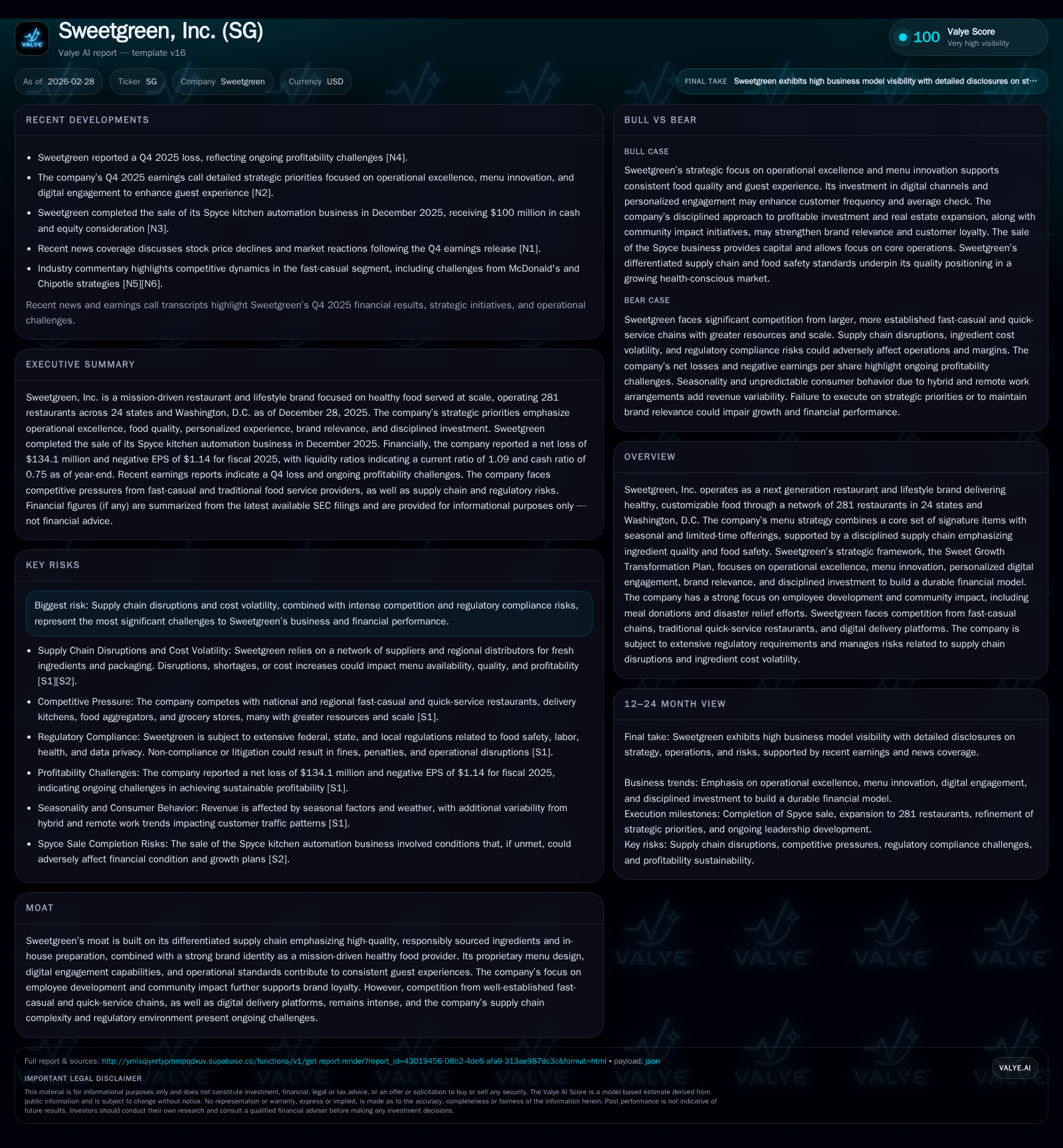
Sweetgreen, Inc. expanded to 281 restaurants across 24 states by the end of 2025, leveraging a differentiated menu and supply chain optimized for healthy fast-casual dining. Despite growth momentum, operating and net losses deepened significantly in fiscal 2025, reflecting cost pressures and investments outpacing revenue gains. Management’s Sweet Growth Transformation Plan targets operational excellence and personalized digital engagement to improve financial durability but faces headwinds from supply chain complexity, regulatory risks, and competition from delivery platforms and traditional incumbents. Key near-term catalysts include the pending Spyce sale completion and evidence of margin improvement at the restaurant level.
Evolution of Sweetgreen’s Growth Performance
Sweetgreen has pursued rapid unit expansion as a core driver of its top-line growth, growing its restaurant count to 281 establishments across 24 states plus Washington D.C. by the end of fiscal year 2025 [S1]. While the broader footprint generates higher revenues via greater market reach, the company’s operating income declined further into negative territory, reaching a loss of approximately $139 million in FY2025—a deterioration of 45.6% year-over-year from about -$95.7 million in FY2024 [F1]. The net income followed with an even steeper 48.3% decline to -$134 million [F1].
This widening loss profile occurred despite ongoing revenue momentum fueled by store openings (35 net new restaurants in FY2025 versus 25 in FY2024) [S26], signaling that incremental revenues were insufficient to offset elevated costs related both to expansion expenses and operational inefficiencies identified during earnings commentary [N1]. Moreover, operating cash flow swung sharply negative in FY2025 (-$12.7 million) from positive inflows of $43.4 million one year earlier—a decline of 129%—reflecting stress on working capital and margin compression amidst heavy investments largely concentrated on growth initiatives [F1]. Capital expenditures surged by over a quarter (26.1%) reaching $106.5 million in the recent year while equity declined roughly 20% from peak levels recorded in FY2022 at $541 million down to $356 million at the end of FY2025 [F1].
Historical performance (annual)
| FY | Net ($mm) | CFO ($mm) | OpInc ($mm) | Capex ($mm) | Net YoY |
|---|---|---|---|---|---|
| 2025 | -134 | -13 | -139 | 106 | -48.3% |
| 2024 | -90 | 43 | -96 | 84 | +20.3% |
| 2023 | -113 | 26 | -122 | 90 | +40.5% |
| 2022 | -190 | -43 | -193 | 97 |
Source: SEC companyfacts cache [F1].
Capital returns and efficiency (annual)
| FY | FCF ($mm) | ROE% |
|---|---|---|
| 2025 | -119 | -37.6 |
| 2024 | -41 | -20.3 |
| 2023 | -63 | -23.5 |
| 2022 | -140 | -35.2 |
Source: SEC companyfacts cache [F1].
Table notes: Operating Income shows increasing losses despite rising store count; negative cash flow in FY2025 driven by capex outpacing cash inflows contributes to deteriorated equity and ROE.
The Sweet Growth Transformation Plan: Strategy in Action
In response to escalating operating deficits amid ambitious expansion plans, Sweetgreen's leadership articulated the 'Sweet Growth Transformation Plan' aimed at building a more durable financial model through five strategic priorities documented in the latest Form 10-K [S1]:
- Operational Excellence: Improving consistency at store-level execution for better guest experiences.
- Food Quality & Menu Innovation: Sustaining differentiation based on high-quality ingredients sourced responsibly with an emphasis on scratch cooking.
- Personalized Experience: Leveraging digital tools to increase frequency and basket size via targeted offers.
- Brand Relevance: Amplifying cultural resonance of Sweetgreen’s mission-driven ethos.
- Disciplined Profitable Investment: Enhancing capital allocation rigor focusing on returns and cost discipline.
Recent earnings call remarks acknowledged progress in operational improvements but underscored ongoing challenges related to costs expanding faster than revenues [N1]. Management emphasized optimizing labor scheduling systems alongside streamlining supply procurement processes as practical steps toward improving profitability.
Menu Innovation and Supply Chain: Core Competitive Differentiators
Sweetgreen's moat relies heavily on its differentiated supply chain philosophy dubbed "The Sweetgreen Way," which entails strict sourcing standards emphasizing ingredient quality and responsible practices coupled with extensive in-house preparation protocols [S1]. This supports fresh meal customization within a standardized ingredient framework facilitating consistent guest satisfaction across locations.
The menu blends a core set of signature items offered year-round with seasonal launches designed for innovation while maintaining operational consistency [S14]. Proprietary digital-only menu options supplement physical offerings enhancing customer discovery experiences.
However, this scrupulous sourcing plus complex regional distribution networks carry inherent risks: supplier concentration increases vulnerability; rising tariffs—particularly on packaging components mostly imported—and shifts in trade policies elevate cost structures; all contributing margin pressures noted as significant operational challenges [S7][S10]. Managing these complexities demands stringent inventory forecasting accuracy alongside active supplier relationship governance.
Digital Engagement as a Lever for Customer Personalization
Targeted digital engagement forms a cornerstone of Sweetgreen’s strategy aiming to boost customer frequency and average order value (AOV). Their platform features app-exclusive items alongside curated collections tailored through CRM segmentation enabling granular messaging calibrated by purchase behaviors [S1][N8].
Such sophistication allows funnel optimization converting casual diners into loyal patrons through personalized offers timed strategically around historical visit patterns enhancing lifetime value metrics typical of digitally mature restaurant operators.
Sector benchmarks suggest strong digital penetration is necessary not only for guest retention but also as defense against third-party delivery aggregators dominating ordering channels [N8]. Continued investment into app UI/UX enhancements plus data analytics capabilities remains pivotal.
Competitive Pressures from Delivery Platforms and Fast Casual Incumbents
Sweetgreen faces intense competition beyond traditional fast casual brands—it must contend with aggregators such as DoorDash, Uber Eats, or Grubhub which scale third-party ordering options capturing valuable customer data outside Sweetgreen’s direct control [S5][N11]. This creates margin pressures: fees paid erode profitability while limited direct consumer insight constrains personalized marketing effectiveness.
Established chains leverage deeper financial resources, superior locations, automation advances, or more efficient operations intensifying competitive threat vectors facing Sweetgreen’s scaling ambitions [S5]. Ongoing intellectual property protection efforts underpin brand defense amidst contested fast-casual space [S6].
Stock price pressure reported during Q4 fiscal reports partly reflects market skepticism related to sector headwinds including inflation impacting discretionary spending patterns harming traffic projections [N11].
Risk Landscape: Supply Volatility and Regulatory Factors
Material risks include supply chain volatility where shortages or quality lapses threaten consistent product delivery—as experienced recently with key produce disruptions linked to adverse weather causing temporary menu removals impacting sales volumes [S19][S25]. Domestic tariffs on packaging imports add incremental cost burdens exacerbated by trade policy uncertainty affecting capital expenditures essential for new stores [S10][S17].
Regulatory complexity extends across worker health & safety laws such as OSHA mandates, wage & hour regulations including minimum wage changes under the Fair Labor Standards Act impacting labor costs [S15]. Data privacy rules spanning CCPA plus emergent state frameworks along with cybersecurity mandates place additional compliance responsibilities overseen by senior executives including CTO authority embedded within board audit committee reporting lines focused on cyber risk governance [S1][S18][S16].
Lawsuits pertaining to ADA compliance require accommodations adjustments across physical locations and digital assets adding potential remediation costs; routine employment-related litigation presents contingent liabilities managed under current insurance frameworks without expected material effect pending resolution [S4][S15].
Capital Allocation Trends and Return Profiles
Capital deployment remains heavily weighted toward growth investments manifested through increased capex totaling approximately $106 million in fiscal year ending December 2025; this reflects aggressive expansion plus technology spend supporting digital initiatives [F1]. However, free cash flow is deeply negative near $119 million post-capex given operating cash drain turning negative; this highlights significant capital intensity amid ongoing unprofitability constraining internal funds availability for dividends or buybacks which remain absent typical of early-stage growth companies [F1][S27][N2].
Equity base erosion caused by cumulative losses yields an approximate negative ROE of -37.6%, signaling continued capital destruction though partly offset by planned divestiture proceeds discussed below [F1]. Monitoring management’s ability to invert this trend will be critical given investor scrutiny on disciplined profitable growth claims embedded within the transformation plan.
What’s Next? Key Milestones and Market Signals to Watch
Near-term corporate catalysts center around completion of the Spyce kitchen automation asset sale finalized late December 2025 but contingent upon regulatory clearances; full realization entails reduced operating expenses plus strengthened balance sheet conditions potentially alleviating financial strain if closing conditions are satisfied without adverse events impacting stock valuation or growth plans [S2][N3][N14].
Additional focus areas for stakeholders include upcoming quarterly results revealing same-store sales performance serving as proxy for brand health amid inflationary pressures; digital channel penetration rates reflecting progress toward personalized engagement objectives; restaurant-level margin improvements indicating operational excellence execution fidelity; plus moderated pace of new store openings per strategic guidance helping temper capex load going forward [N1][N14]. These indicators collectively inform whether Sweetgreen can transition toward sustainable profitability while maintaining its unique healthy fast-casual niche under competitive duress.
This analysis synthesizes public financial disclosures along with recent earnings commentary to provide an informed perspective on Sweetgreen’s business trajectory without offering investment advice or price forecasts.
Disclaimer: This is research-only, informational analysis and not investment advice. It may include AI-generated interpretation and general industry context. Always verify important details using primary sources.

Comments