
iShares Silver Trust Performance and Outlook: Physical Bullion Backing Under Pressure
SLV's growth and accounting profits reflect silver price swings, while recent redemptions expose structural and market vulnerabilities.
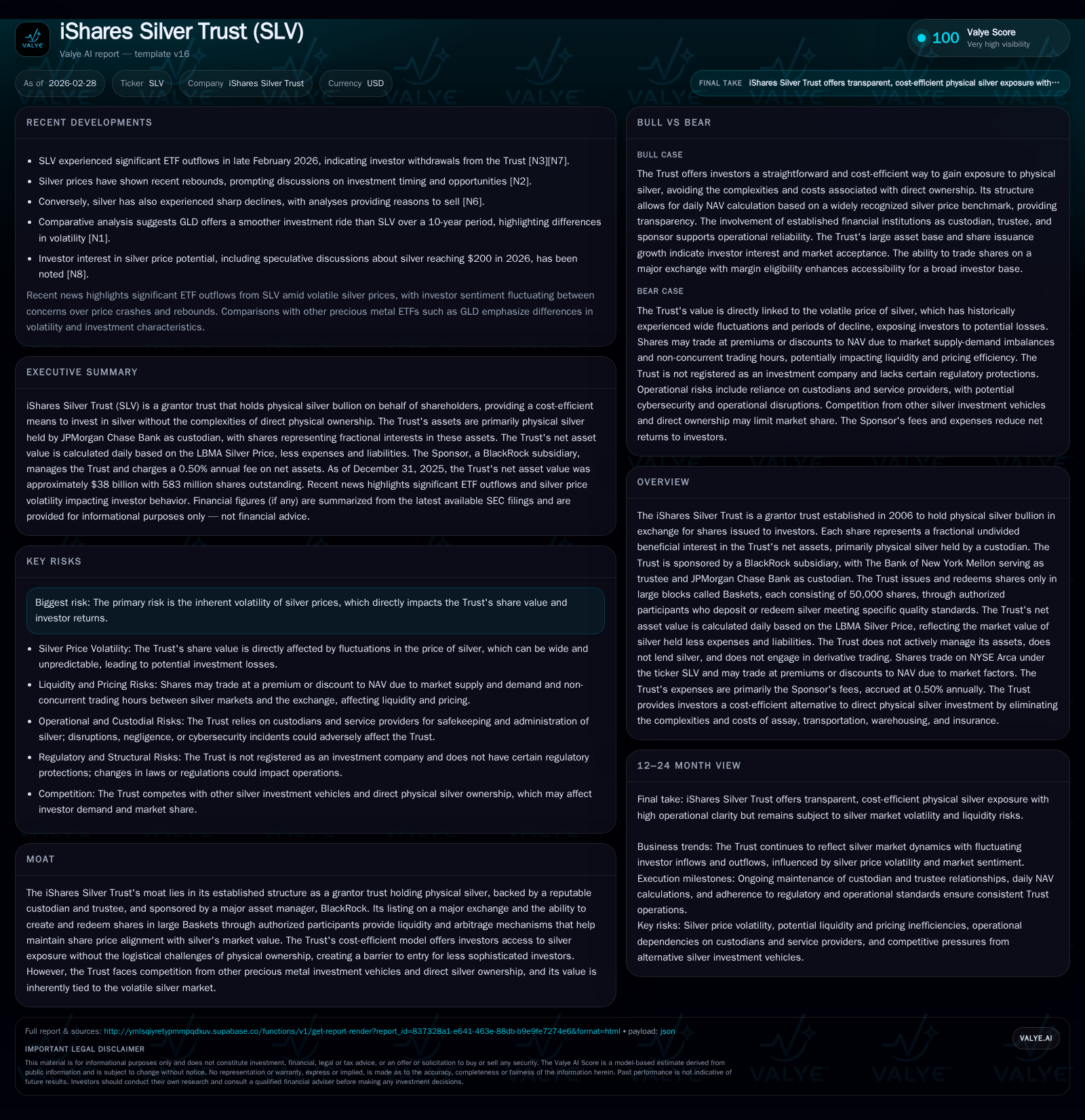
Established in 2006, the iShares Silver Trust (SLV) holds physical silver bullion to provide investors exposed to silver price movements without direct ownership hurdles. The Trust’s net assets surged from roughly $13.4 billion in 2024 to over $38 billion in 2025, propelled by a strong silver market that influenced both share creation and mark-to-market gains. However, SLV’s operating model reveals persistent operating losses due to fees funded by silver sales, contrasting with significant net income driven by asset revaluation. Recent months have seen notable ETF share outflows tied closely to silver price volatility, challenging liquidity and pricing alignment. Ongoing dependency on the LBMA Silver Price benchmark introduces regulatory and operational risks that could affect valuation fidelity and investor confidence in the near term.
Foundation of the Trust and Historical Growth Trajectory
Historical performance (annual)
| FY | Net ($bn) | CFO | OpInc ($mm) | Net YoY |
|---|---|---|---|---|
| 2025 | 21.3 | 0 | -96 | +883.9% |
| 2024 | 2.2 | 0 | -63 | +1778.9% |
| 2023 | -0.1 | 0 | -54 | -615.9% |
| 2022 | -0.0 | 0 | -56 |
Source: SEC companyfacts cache [F1].
The iShares Silver Trust was founded in April 2006 as a grantor trust with the primary purpose of holding physical silver bullion on behalf of investors seeking exposure to silver prices without owning or managing physical metal themselves [S1]. Each share represents a fractional interest backed primarily by allocated silver held by JPMorgan Chase Bank as custodian under English law. The Bank of New York Mellon functions as trustee, while BlackRock’s Delaware subsidiary sponsors the Trust [S1].
Historically, SLV has been designed as a passive vehicle with no active trading or lending of its silver holdings [S1]. The Trust issues shares exclusively via creation units called Baskets—large blocks consisting of 50,000 shares—which can only be transacted by authorized participants who deposit or redeem specified quantities of physical silver meeting strict quality standards [S1]. This mechanism ensures that new share issuance corresponds exactly with added physical bullion.
The Trust's scale expanded notably through recent years. As of December 31, 2024, SLV held roughly $13.4 billion in net assets with approximately 509 million shares outstanding. By the end of fiscal year 2025, net assets more than doubled to $38 billion alongside an increase to nearly 583 million shares outstanding [F1][S1]. This growth reflects robust investor demand correlated strongly with an appreciating silver price environment [F1].
Unlike actively managed funds or commodity pools, SLV does not employ derivatives or hedging strategies; it tracks silver’s market value passively via ownership of physical metal only [S1]. This structure appeals particularly to investors prioritizing cost efficiency and simplicity over speculative exposure.
Drivers Behind the Fiscal Year 2025 Expansion and Profit Surge
Fiscal year 2025 saw a marked divergence between operating income and net income. Operating income remained negative at approximately -$95.5 million, reflecting costs such as sponsor fees paid through sales of bullion. In contrast, net income surged dramatically to over $21.3 billion from roughly $2.2 billion in fiscal 2024—a nearly ninefold increase [F1].
This divergence arises because net income is heavily influenced by mark-to-market accounting gains from increasing valuations of held physical silver. Since SLV's revenue streams do not originate from selling investment products or services but solely from changes in asset value minus expenses (primarily fees paid out via sale of bullion), traditional profitability measures are distorted [F1][S22]. Operating losses largely reflect administrative fees owed to BlackRock and custodian expenses deducted directly against assets rather than offsetting earned revenue.
Cash flows from operations remain zero consistently since all earnings relate directly to unrealized asset appreciation, not actual cash inflows [F1]. Therefore, investors should interpret net income figures cautiously as indication of growing market value more than cash generation or distributable profit.
Silver Price Volatility and Its Impact on Share Valuation Dynamics
SLV’s sole driver is the LBMA Silver Price benchmark administered by IBA under London Metal Exchange auspices and regulated by the UK Financial Conduct Authority (FCA) [S1][S8][S10]. This electronic auction-based benchmark disseminates once daily during UK business hours reflecting prevailing supply-demand balances for spot silver.
Fluctuations in this benchmark directly influence SLV’s Net Asset Value (NAV) since each share claims proportional rights against physically held silver valued at daily LBMA prices less expenses [S1][S8]. The Trust explicitly states that any disruptions—including technological failures or perceptions of manipulation—could distort valuations materially, potentially leading to investment losses beyond intrinsic market movements [S8][S10].
Investor confidence hinges on maintaining integrity and uninterrupted operation of this pricing mechanism. The risk is amplified given electronic markets’ susceptibility to outages or fraud attempts witnessed historically elsewhere [S1][S24]. Regulatory scrutiny through the FCA seeks to mitigate such risks but does not eliminate systemic vulnerabilities entirely.
Recent Redemptions: Analyzing Outflows and Market Sentiment
Recent news reports highlight substantial outflows from SLV over early 2026 months coinciding with a downturn in silver prices [N3][N7][N5][N12]. Investor behavior appears reactive to short-term volatility with episodes described as tactical selling amid broader market uncertainty.
Large redemption volumes pose challenges for liquidity since creation/redemption processes must match physical supply constraints tightly tied to bullion availability meeting quality specifications [S11]. When demand for redemptions surges simultaneously while acceptable bullion supply contracts — potentially due to refiners’ sanctions or geopolitical events — arbitrageurs face greater risks executing trades between secondary markets and physical deliveries.
This scenario can generate dislocations where SLV shares trade at premiums or discounts relative to NAV depending on timing disparities between physical transfers and market pricing dynamics [S11][S19]. Sustained redemption pressure may erode trading spreads, reduce market makers' incentives, and widen premiums/discounts affecting investor returns negatively.
Regulatory Environment and LBMA Silver Price Benchmark Reliability
SLV’s heavy reliance on the LBMA Silver Price subjects it intrinsically to associated regulatory frameworks overseen chiefly by the FCA [S10][S24]. FCA regulations impose standards ensuring transparency, fairness, and resilience of the underlying auction process determining benchmark prices.
However, inherent operational risk remains given dependence on electronic platforms vulnerable to outages or manipulation allegations—as well as political factors influencing global silver supply/demand fundamentals such as executive orders historically affecting metal custody or trade flows within major jurisdictions including the U.S. [S8][S10][N14].
While no past litigation materially threatens this mechanism currently, theoretical scenarios involving benchmark failure could result in incorrect NAV calculations for SLV shares thereby adversely impacting fees assessed against mispriced valuations plus distorting investor returns [S8]. Future shifts in regulatory policy may necessitate transition towards alternative pricing references if existing benchmarks fail perceived reliability tests [S8].
Structural Mechanics of Creation/Redemption and Liquidity Implications
SLV issues new Shares solely through creation units requiring delivery of specified quantities of refined physical silver conforming to standards defined by LBMA Good Delivery List criteria enforced by custodians under contract law primarily governed by English jurisdiction [S1][S9]. form essential intermediaries performing these large-block exchanges—commonly effectuated as Baskets containing exactly 50,000 shares per transaction.
Restrictions exist where qualified physical silver supply lags demand induced by speculative buying or institutional reallocations; such bottlenecks inhibit seamless arbitrage opportunities typically constraining premium expansions on exchange-traded Shares versus underlying NAV values [S11].
Market makers must navigate delays stemming from vault inventory limitations or certification delays delaying asset movement thus increasing bid-ask spreads during stress periods leading to wider deviations between traded prices and intrinsic values. could suffer if participation shrinks due to these structural frictions exacerbating volatility further especially during downward price phases when costs pressure redemptions increasingly replace creations. given difficulty replicating functional access but exposes SLV to discontinuities responsive mainly to logistical efficiencies around bullions rather than pure capital flows alone.[Detailed understanding necessary for professional investors familiar with precious metals ETF microstructure]
Capital Allocation Overview: Fee Structure, Expenses, and Returns Metrics
SLV operates under a fee structure deducting sponsor payments plus custodian/trustee expenses allocated through periodic sales of physical silver held inside the Trust rather than collecting cash fees directly [S22][F1]. Consequently, this dynamic results in a slow attrition of ounces represented per Share over time absent offsetting incremental creations driven by demand or sustained price appreciation compensating for principal depletion.
Expense burden manifests as persistent operating losses annually ranging around -$63 million (2024) expanding near -$95 million (2025) driven by growing asset size but flat fee accrual framework consistent across years due principally to service fee agreements rather than operational scaling inefficiencies [F1]. remains nil confirming no cash generation apart from bullion sales covering costs with no dividends or share repurchase programs disclosed highlighting an absence of traditional capital return policies common amongst corporate entities.[Reported ROE calculated via ratio approximates over 480% for FY25 reflecting leveraged accounting gains rather than normalized financial performance] given underlying net income driven overwhelmingly by revaluation surges rather than distributable profits equitable for ongoing shareholder returns analysis [F1].[Investors should appraise such figures cautiously recognizing non-cash nature]
Outlook: Catalysts, Risks, and Factors to Monitor for SLV’s Next Phases
Looking forward into calendar year 2026 and beyond, several key factors will shape SLV's trajectory. Crucial considerations include continuing fluctuations in global silver supply-demand dynamics influenced notably by geopolitical tensions (e.g., Russia-related sanctions limiting refinery participation), industrial demand trends especially from technology sectors requiring silver components, plus speculative investor sentiment shaped partially by broader macroeconomic factors like inflation expectations impacting safe-haven asset appetite [N8][N14][S1].
Given no formal guidance issued regarding expected issuance/redemption volume trends or fee adjustments within filings up-to-date there is limited forward visibility offered formally; instead monitoring proxy signals such as Authorized Participant engagement levels announced periodically combined with independent reports tracking large ETF flow volume changes provides actionable insight [N3][N7].
Regulatory developments concerning the LBMA benchmark remain pivotal—any announced modifications prompted either internally via IBA governance structures or externally through FCA policy shifts could necessitate recalibrations within SLV affecting NAV estimations along with market pricing frameworks potentially exerting short-term dislocation pressures creating volatility clusters around transition periods noted previously only hypothetically but plausible given increasing global scrutiny surrounding commodities benchmarks today [S8][N14].
Emerging structural risks include evolving cybersecurity threats imperiling transactional integrity related systems maintained across Sponsor/Custodian/Trustee platforms flagged recurrently underscoring further need for rigorous IT disaster recovery preparedness aiming at ensuring uninterrupted service continuity critical given thin margin environment underpinning efficient creation/redemption cycles central across operation pillars supporting liquidity function effectively underpinning secondary market trading floors globally for this specific asset class vehicle provenance documented extensively across regulatory risk disclosures emphasizing harm severity potentials inherent especially amidst geopolitical concerns expanding attack surfaces presently observed broadly across financial services industries worldwide [S17].[Investors will find added value analyzing contemporaneous cybersecurity incident reports affecting related trust service providers alongside noted standard industry best practices summoned periodically]
Platforms continuing premium/discount spread convergence through tighter integration between authorized participant activities versus fluctuating availability/quality constraints among transferable bullion supplies represent key internal arbitrage efficiency levers awaiting improvement particularly during volatile trading windows where secondary market intermittency often generates widened spreads negatively impacting achievable exit points found among retail holders keenly sensitive toward execution costs relative safety margins set conservatively within portfolio limits today substantiating additional risk buffers considered prudent whilst investment thesis continues maturing amid cyclical commodity pricing environments dominated currently by macroeconomic uncertainties complicated additionally by monetary policy trajectories extending quarters ahead uncertain eventual outcomes derived thereof remain subject empirical refinement evolving dynamically aligned closely across latter half decade horizon aligned closely herewith insofar available public disclosures provided explicitly framed context above suggest accordingly.
Disclaimer: This report is intended solely for informational purposes regarding iShares Silver Trust (SLV) based on publicly available filings as of February 28, 2026. It does not constitute investment advice nor an offer or solicitation to buy or sell securities. Readers should perform their own due diligence before making any investment decisions.
Disclaimer: This is research-only, informational analysis and not investment advice. It may include AI-generated interpretation and general industry context. Always verify important details using primary sources.

Comments