
Sentinel Holdings Ltd. Q2 2026 Update: Divestiture of USS and Persistent Financial Pressures
Sentinel Holdings reports ongoing net losses and severe liquidity constraints in Q2 2026 following the divestiture of United Security Specialists Inc., raising questions about its financial sustainability.
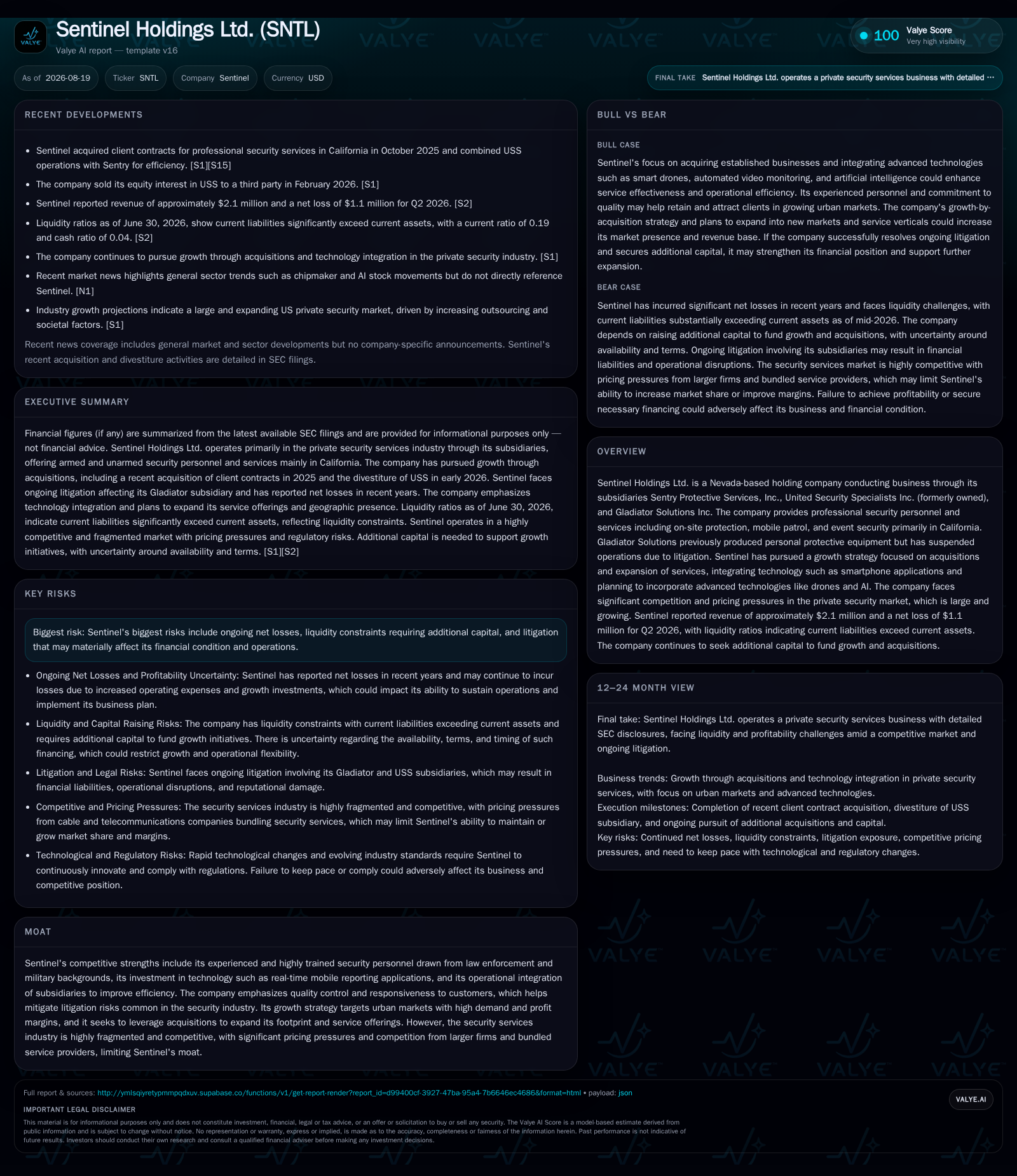
Sentinel Holdings Ltd. disclosed continued net losses and a critically weak liquidity position as of June 30, 2026, with a current ratio of 0.19 indicating current liabilities far exceed current assets. The company completed the divestiture of its wholly owned subsidiary United Security Specialists Inc. (USS) in February 2026, materially reducing its operational scale and revenue base. Despite investments in technology and integration efforts, ongoing litigation and competitive pressures contribute to financial strain. Sentinel’s ability to achieve sustainable profitability and improve liquidity depends on securing additional capital and managing operational risks.
Recent Operating and Strategic Developments
In the second quarter of 2026, Sentinel Holdings Ltd. completed the divestiture of its wholly owned subsidiary United Security Specialists Inc. (USS) effective February 28, 2026 [S1][S2]. USS had been a significant contributor to the company's revenue and operational complexity, providing professional security personnel and services primarily in California. The sale of USS materially changes Sentinel’s operational footprint and reduces its revenue base, potentially limiting near-term growth prospects. Prior to the divestiture, Sentinel had integrated the day-to-day activities of USS with its other security subsidiary, Sentry Protective Services, to streamline logistics and operations. This divestiture may help reduce overhead and simplify operations but also removes a key revenue-generating unit from the company’s portfolio.
Alongside the divestiture, Sentinel continues to invest in technology to enhance its service offerings. The company utilizes the SilverTrac mobile application, enabling security personnel to perform real-time reporting and patrol check-ins. Sentinel also plans to incorporate artificial intelligence and drone technology to improve operational effectiveness and efficiency. However, these technology investments remain long-term initiatives with uncertain near-term impact on profitability [S1].
Liquidity and Financial Condition Analysis
Sentinel Holdings faces severe liquidity challenges as of June 30, 2026 [F1]. This ratio indicates a substantial shortfall in liquid resources to cover short-term obligations, raising concerns about the company’s ability to sustain operations without additional capital infusion or restructuring.
The company’s financial statements and filings reveal ongoing net losses, with a net loss of $4.46 million reported for the year ended December 31, 2025 [S1]. Negative working capital and operating cash flow deficits suggest that Sentinel is burning cash and may require external financing or asset sales to meet its obligations and fund operations.
No capital raises or refinancing activities were disclosed in the latest quarter, underscoring the urgency of Sentinel’s liquidity predicament [S2][F1]. The company’s ability to secure additional financing on commercially reasonable terms remains uncertain, which could restrict growth initiatives and jeopardize operational continuity.
Business Model and Competitive Position
Sentinel Holdings operates primarily through its subsidiaries providing professional security personnel and related services to clients in California, including schools, houses of worship, public venues, and other entities requiring on-site protection, mobile patrol, and event security [S1]. Revenue is generated from contracts for security personnel services, with margins pressured by competitive pricing and litigation risks inherent in the industry.
The company’s competitive advantages include access to a pipeline of highly professional, military-trained personnel and the integration of technology such as mobile applications for real-time guard reporting. These factors contribute to quality control and operational oversight, which are critical in the fragmented and competitive private security market.
However, the market is characterized by intense competition, pricing pressure, and fragmentation, which constrain margins and cash conversion. Sentinel’s suspension of Gladiator Solutions Inc.’s operations due to ongoing litigation further reduces revenue diversification and increases operational risk [S1]. Gladiator Solutions, which focused on personal protective equipment sales, has been limited in its contribution due to legal disputes, compounding Sentinel’s financial challenges.
Risks and Litigation Impact
Litigation remains a significant risk factor for Sentinel Holdings. Gladiator Solutions Inc., a majority-owned subsidiary, has suspended operations amid ongoing legal disputes, including a notable case involving Strategic Funding Source, Inc. alleging breach of a loan agreement and related claims [S1]. These litigation issues not only reduce revenue diversification but also impose legal costs and operational uncertainty.
Sentinel records litigation accruals for probable and estimable claims, but ongoing legal proceedings could increase liabilities and expenses, further straining financial resources [S1][S2]. The company’s risk disclosures emphasize that litigation costs and outcomes could materially and adversely affect business operations, financial condition, and cash flows.
The combination of litigation risk and competitive pressures in the security services industry complicates Sentinel’s path to profitability and liquidity improvement. These factors contribute to operational volatility and may deter potential investors or lenders, exacerbating capital access challenges.
Outlook and Scenarios
Sentinel’s near-term outlook hinges on its ability to address liquidity constraints and stabilize operating losses [S1][S2][F1]. Under this base scenario, Sentinel continues to operate at a loss with constrained liquidity, requiring additional capital raises or asset sales to maintain operations while pursuing modest growth through technology integration. Successful financing and effective integration of technology could help stabilize operations and modestly improve margins. The company’s investments in AI and drone technology, alongside the SilverTrac mobile application, may enhance operational efficiency over time, supporting gradual recovery if capital is secured and litigation risks are managed.
Bear Scenario: Sentinel fails to improve liquidity or profitability, leading to insolvency risk or forced restructuring [S2][F1]. Adverse litigation outcomes or inability to raise capital could accelerate this trajectory, potentially resulting in missed debt payments, covenant breaches, or bankruptcy proceedings.
Bull Scenario: Sentinel successfully raises capital, integrates new technologies effectively, and manages litigation risks, leading to improved liquidity, reduced losses, and gradual return to profitability [S1][S2][F1]. Operational efficiencies and contract wins could drive positive momentum and investor confidence.
Future SEC filings will be critical to monitor for signs of improved liquidity, capital raises, litigation outcomes, and operational KPIs such as contract wins and technology adoption progress. These developments will help clarify whether Sentinel can transition toward sustainable profitability or faces heightened financial distress.
Conclusion
Sentinel Holdings Ltd.’s Q2 2026 results reflect persistent financial and operational challenges despite strategic actions such as the divestiture of USS. The sale reduces operational complexity but also limits revenue potential. The company’s severely constrained liquidity position and ongoing net losses raise significant concerns about its ability to sustain operations without additional capital. While investments in technology offer potential long-term benefits, near-term financial pressures and litigation risks remain substantial.
The divestiture of USS, while streamlining operations, removes a key revenue source, potentially limiting growth but possibly reducing overhead and integration challenges [S1][S2]. The critical liquidity shortfall, evidenced by a current ratio of 0.19 as of June 30, 2026, underscores the urgency of securing additional capital or restructuring to avoid insolvency [S2][F1].
Investors should closely watch future capital raising efforts, litigation developments, and operational performance indicators to assess Sentinel’s prospects for financial recovery and growth. The company’s ability to navigate these challenges will determine its sustainability in a highly competitive and litigious industry environment.

Comments