
Summit Networks Pursues Asian Logistics Platform Amid Liquidity and Execution Challenges
Summit Networks transitions to an acquisition-driven logistics platform strategy primarily targeting Asian markets, navigating capital constraints and competitive fragmentation.
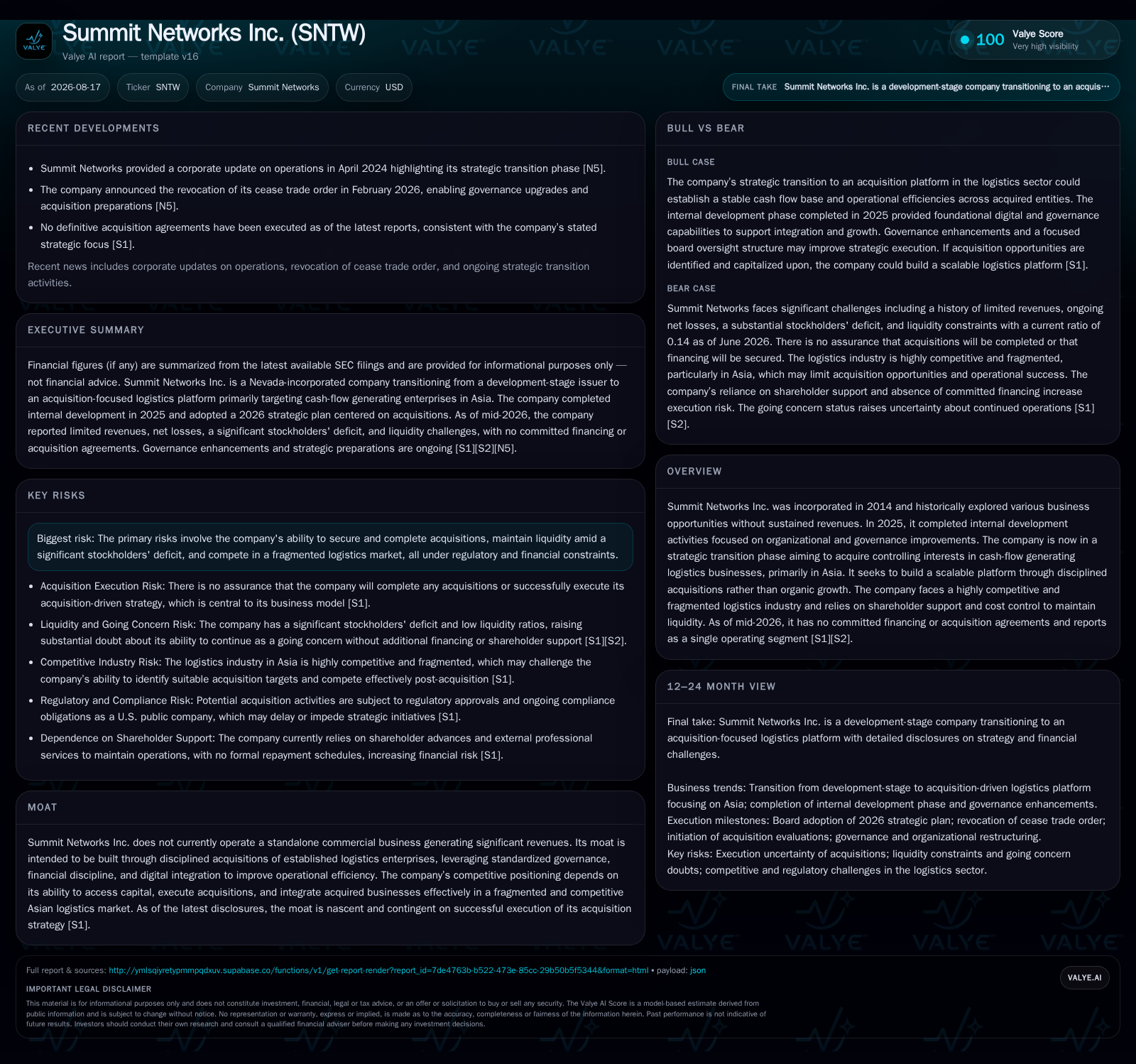
Summit Networks Inc. has completed an internal preparatory phase focused on governance and digital system readiness, now advancing a disciplined acquisition strategy to build a scalable logistics platform focused on cash-flow generating enterprises, primarily in Asia. The company currently operates without significant revenue-generating businesses and relies on shareholder financial support while facing liquidity challenges reflected in its large stockholders’ deficit and low current ratio. Summit's success hinges on its ability to secure financing, complete acquisitions, and integrate operations within a highly fragmented and competitive logistics landscape that demands operational efficiency and regulatory compliance.
Recent Operating Update
Summit Networks Inc. filed its latest quarterly report covering the period ending June 30, 2026. The filing confirms that the company remains a single-segment entity with no operating revenues deriving from logistics businesses as yet. Operationally, it is executing on a Board-approved strategy adopted at the end of 2025 focused on building a logistics services platform through disciplined acquisition of cash-flow positive enterprises primarily in Asia [S1][S2]. The company completed foundational internal development activities — notably governance improvements and digital workflow implementations — in 2025 to create a framework for integrating acquisitions efficiently. However, as of mid-2026, it has not closed any transactions nor secured committed financing lines for acquisition activity [S1][S2].
From a financial standpoint, Summit Networks reported total revenues of just $11,797 for fiscal year 2025 with operating losses reflecting administrative overhead exceeding $320K driven mainly by professional fees related to governance and strategic planning functions [F1][S1][S2][S5]. The net loss was approximately $331K for that year. Cash reserves improved modestly from roughly $95K at the end of 2025 to about $145K at mid-2026.
Business Model Overview
Summit Networks' business model is still nascent. Unlike traditional logistics providers generating revenue via transportation services contracts, warehousing fees, or freight volume charges, Summit currently derives no significant commercial revenues from such operations. Instead, its business is architected as an acquisition-driven holding platform targeting established logistics companies that already produce stable cash flows.
The company’s approach entails identifying suitable Asian logistics firms where it can gain controlling interests, then layering standardized governance protocols and financial discipline to drive operational efficiencies post-acquisition. It plans to utilize previously developed digital frameworks to accelerate integration across disparate enterprises.
Monetization will ultimately hinge on aggregated revenues from these acquired entities' transportation services—such as goods distribution across regional supply chains—and related value-added services like warehousing management or third-party logistics (3PL) solutions. Revenue changes would track volume shifts (e.g., shipments or tonnage), contract renewals with manufacturers or retailers outsourcing logistics functions, operational margins improved through scale and technology adoption, and asset utilization rates underpinned by efficient freight routing.
This platform model contrasts with organic-growth-focused operators by emphasizing capital allocation toward consolidation deals rather than expanding standalone service footprints organically—a distinguishing feature that requires strong access to capital markets and execution capability [S1].
Industry Structure and Competitive Position
The logistics sector targeted by Summit Networks—particularly in Asia—is characterized by pronounced fragmentation comprised of numerous regional operators often family-owned or specialized niche service providers. This fragmentation creates both opportunity for consolidation via acquisitions and substantial competitive challenges since many incumbents have established local networks and customer relationships.
Peer groups include integrated supply chain platforms like Kuehne + Nagel or Nippon Express which combine international reach with localized expertise; third-party logistics providers such as C.H. Robinson focusing on service contracts; as well as asset-heavy transportation firms managing fleets across multiple regions.
Summit's competitive edge depends heavily on securing timely regulatory approvals for cross-border acquisitions—a known challenge given differing local rules—and assembling sufficient financial firepower underpinned by stringent governance controls necessary for disciplined deal-making.
Operationally, the company must demonstrate superior capability integrating acquired entities through unified management systems leveraging digital tools for real-time supply chain visibility, cost control per shipment mile metrics, streamlined warehouse occupancy management, and enhanced customer retention through reliable on-time delivery performance.
These factors create a favorable backdrop if Summit can successfully access capital markets to fund transactions timely and integrate operationally. Key performance indicators relevant here include pipeline visibility into acquisition targets evaluated; management’s ability to move deals beyond non-binding discussions; subsequent improvement in operating margin post-integration; plus metrics such as average contract length among acquired customers signaling retention durability.
Risks and Watchpoints
Summit Networks confronts several critical risks:
- Acquisition Execution Risk: The absence of completed deals signals vulnerability around deal sourcing, due diligence rigor amid multi-jurisdiction complexities, financing availability amid constrained liquidity, or valuation discipline leading to missed opportunities.
- Liquidity Constraints: A sustained working-capital deficit combined with lack of committed financing elevates risk around meeting general corporate expenses without dilutive shareholder funding inflows.
- Integration Challenges: Successfully unifying diverse acquired operations calls for robust managerial capacity; failure here could erode expected operational synergies reflected in cost savings or margin expansions.
- Competitive Pressure: Established local logistics providers may resist consolidation moves either through competing offers or customer retention tactics limiting Summit’s addressable market share.
- Regulatory Approvals: Delays or refusals from regional authorities could stall transactions impacting strategic timelines.
- Financial Reporting Burden: As a U.S-listed public entity without significant commercial revenues yet incurs reporting costs that deepen losses limiting runway.
- Market Volatility: Vulnerability to macroeconomic downturns affecting freight volumes or escalating input costs (fuel/labor).
Monitoring progress against these watchpoints involves tracking disclosures around new acquisition announcements; financing commitments secured; changes in operating expenses signaling preparation capacity increases; updates on regulatory clearances; developments around governance strengthening initiatives including appointment of permanent CFO after interim arrangements; plus shareholder equity infusion trends enhancing working capital buffers [S1][S2]
What To Watch Next
Upcoming milestones critical for validating Summit Networks’ transformation narrative include:
- Public announcement of definitive acquisition agreements coupled with details on target profiles including size (revenue/EBITDA), location focus within Asia, service offerings (transportation/warehousing/3PL).
- Securing committed acquisition financing facilities—debt or equity—that demonstrate investor confidence into the buy-and-build thesis.
- Quarterly filings showing progress toward integration frameworks applied post-acquisition framed through operational KPIs like improving cash flow from operations or contract renewal rates among acquired entities.
- Continuation of governance enhancements possibly evidenced by hiring of permanent senior management (including CFO) strengthening stewardship credibility.
- Regulatory update disclosures signaling reduced barriers for inbound investments solicited under the new corporate strategy.
Successful visible progress along these vectors will underpin confidence that Summit is transitioning out of development-stage uncertainty into an operationally active platform poised to capture growth amid Asia's evolving logistics landscape [S2][S9].
Financial Profile Discussion
As of June 30, 2026, Summit Networks’ balance sheet presents notable liquidity challenges essential for context around its strategic runway. Cash & equivalents stood at approximately $145K while current liabilities hovered near $1.22 million producing an extremely low current ratio (~0.14) indicative of strained working capital conditions [F1]. Total debt data is less recent but last recorded near $579K mid-2022 suggesting gross leverage alongside other liabilities contributes to negative net working capital dynamics.
Management acknowledges reliance on shareholder funding ongoingly while enforcing conservative cost controls focused on expense reduction principally in professional fees linked to audit/compliance/governance functions rather than revenue drivers [S1][S5]. The company's history reveals operating losses driven purely by overhead absent substantive commercial cash inflows underscoring high break-even hurdles prior to scaling any acquired operations.
Capital allocation currently reflects preservation priorities rather than expansion until acquisition visibility improves. Future financing plans emphasize targeted capital raises aligned tightly with specific deal opportunities rather than general corporate funding injections—a prudent discipline given historical deficit realities but increasing pressure if acquisition pipelines stall longer term [S1].
Absent committed external financing agreements as of mid-2026 amplifies execution risk though balanced somewhat by emerging governance reforms designed to strengthen financial controls and attract institutional investor confidence subject to successful transaction execution [S9][S23]. Given these constraints the pathway toward sustainable profitability is likely protracted contingent on closing accretive acquisitions promptly while avoiding dilution traps amid tight liquidity conditions.
Disclaimer: This analysis reflects publicly available information as of August 2026 without any investment research view or forecast regarding Summit Networks Inc.’s securities performance.
Disclaimer: This is research-only, informational analysis and not investment advice. It may include AI-generated interpretation and general industry context. Always verify important details using primary sources.

Comments