
Sonoco's Integration and Sustainability Focus Drive Mixed Q2 with Margin Resilience
Q2 results reflect operational gains amid sales pressure, backed by vertical integration and strategic acquisitions.
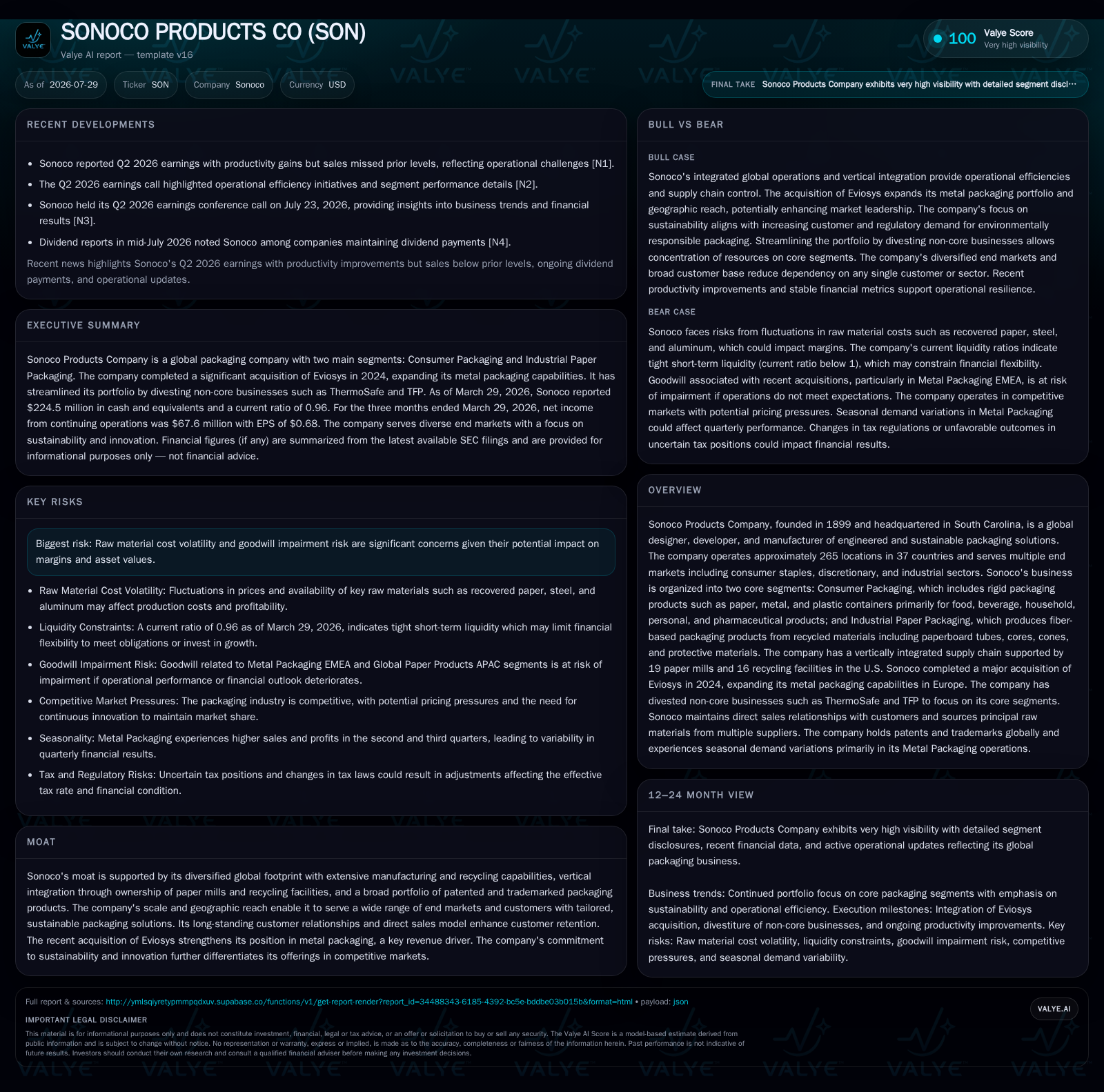
Sonoco Products Company's latest quarterly filing reveals a nuanced operating environment where productivity improvements outpaced top-line growth challenges. The business leverages its vertical integration through owned paper mills and recycling facilities to manage raw material cost volatility and sustain margins. Its transformation via the Eviosys acquisition reinforces metal packaging leadership, while sustainability initiatives and customer-tailored solutions underpin competitive differentiation. Key risks include raw material inputs and goodwill impairment sensitivity in specific reporting units. Monitoring capacity utilization, order backlog, and environmental credit disclosures will clarify future momentum.
Recent Operating Update: Productivity Gains Amid Sales Challenges
Sonoco Products Company's ("Sonoco") second quarter 2026 results reveal a complex operating picture that underscores both resilience in operational execution and challenges in revenue growth. Despite a top-line miss relative to analyst expectations, the company reported strong productivity gains that helped sustain profitability metrics [S2][N1]. Notably, operational efficiencies emerged from better manufacturing yields and streamlined processes across segments, partially mitigating volume pressures.
This dynamic is occurring within the context of ongoing macroeconomic headwinds affecting consumer discretionary spending and industrial production—two key demand drivers for packaging solutions [S2][S1]. While Sonoco’s Consumer Packaging segment benefits from stable demand in food, beverage, household, pharmaceutical sectors, these markets exhibit mixed volume growth trends given current economic indicators. The Industrial Paper Packaging segment continues leveraging its fiber-based product line but faces excess capacity risks amid global recycled fiber market fluctuations
The company’s recent sale of a recycling facility in Savannah, Georgia for $4 million reflects a deliberate move to optimize asset footprint favoring higher-return operations [S2]. Continued portfolio rationalization signals management’s focus on capital efficiency post its transformative acquisition of Eviosys in late 2024.
Business Model: Vertical Integration Fuels Sustainability-Focused Packaging
Sonoco operates two strategically significant business segments: Consumer Packaging, which delivers engineered rigid packaging products including diverse materials such as paperboard, metals, plastics; and Industrial Paper Packaging producing fiber-based packaging like paperboard tubes, cores, cones derived largely from recycled inputs [S1]. Both segments are tightly integrated into global value chains serving brand owners in food & beverage, personal care, household products, pharmaceuticals, and industrial applications.
Revenue generation depends primarily on large-volume contracts with consumer goods companies requiring dependable supply of customized packaging formats enhancing brand identity and shelf presence. Sonoco emphasizes differentiated custom packaging solutions using patented technologies coupled with sustainability credentials—a growing priority among its blue-chip customer base. The monetization engine is unit volume multiplied by average selling price per unit plus value-added service fees.
Operationally critical is the company's vertical integration: ownership of 19 paper mills plus 16 recycling centers in North America provides substantive control over raw material flows—a crucial buffer against input cost volatility known to plague the packaging sector [S1]. This vertical control not only reduces procurement risks but supports Sonoco's sustainability initiatives by enabling high recycling rates internally.
The December 2024 acquisition of Eviosys—Europe’s leading manufacturer of metal food cans—marked an inflection point expanding Sonoco's footprint in the highly competitive rigid metal packaging industry across EMEA regions [S1]. This acquisition complements existing capabilities enabling integrated multi-material offerings favored by global customers seeking innovation alongside environmental compliance.
Industry Structure and Competitive Position
The packaging manufacturing industry is fragmented but characterized by consolidation among scale players competing intensely on innovation, cost structure, sustainability attributes, and service breadth. Sonoco straddles several peer categories including rigid packaging manufacturers (Amcor), industrial paper producers (Packaging Corporation of America), metal packagers (Ball Corporation), manifesting a hybrid profile that adds complexity but also cross-material advantage.
Competition focuses heavily on winning customer mandates that integrate proprietary design elements with stringent recyclability standards—a segment increasingly regulated at national and supranational levels. Sonoco’s extensive patent portfolio alongside investment in new product introductions helps maintain barriers against substitutes such as flexible plastic films or alternative materials.
Margins depend on balancing production volume growth with commodity cost containment. Capacity utilization rates particularly within fiber-based packaging plants are key determinants for profitability. Fluctuations in recycled fiber availability influence pricing power for industrial paper products. Similarly, global metal price cycles affect the rigid metal container segment.
Growth Drivers
Sonoco’s growth trajectory is anchored on several structural industry tailwinds:
- Sustainability Shift: Increasing regulatory mandates restricting plastic use propel demand for recyclable fiber-based tubes/cores and metal cans supported by Sonoco's recycling network.
- Portfolio Optimization: Post-Eviosys acquisition alignment under geographically integrated Consumer Packaging segments creates scale efficiencies fostering faster innovation cycles [S1].
- Customization Demand: Brand owners increasingly seek unique packaging formats enhancing consumer engagement creating cross-selling opportunities across rigid materials.
- Emerging Market Expansion: Penetration into Asia-Pacific via APAC segment leverages rising consumption trends for packaged goods.
- E-commerce Impact: Surge in online retail drives demand for protective packaging solutions where Sonoco's fiber-based protective materials gain relevance.
Tracking KPIs like order backlog growth rates indicator early sales momentum; new product introductions signal innovation pipeline health; while margin progression reflects supply chain optimization effectiveness.
Risks and Watchpoints
Raw material cost volatility remains the most immediate risk given exposure to fluctuating prices for pulp, recycled fibers, metals used in cans—all impacting gross margins [S1]. Though vertical integration tempers some procurement variability, limited control over external commodity markets persists.
Goodwill impairment poses another notable vulnerability concentrated mainly at Metal Packaging EMEA ($1.4 billion goodwill balance) and Global Paper Products APAC ($27 million) units [S1]. Fair value assessments show narrow valuation cushions sensitive to modest EBITDA declines or increasing discount rates—potentially necessitating near-term write-downs if operating performance deviates near-term from projections.
Environmental credit accounting changes effective after December 2027 introduce added disclosure complexity related to assets/liabilities arising from sustainability compliance programs [S2]. This new guidance requires monitoring how environmental initiatives translate financially.
Additional headwinds include geopolitical trade disruptions affecting cross-border supply chains; capacity underutilization during demand downturns; competitive pressures from emerging alternative materials; rapidly evolving consumer preferences requiring agile innovation responses; currency fluctuation impacts due to significant international operations.
What to Watch Next
Key milestones over the coming quarters include:
- Segment-level revenue trend updates especially relating to volume recovery or contraction in Consumer Packaging across Americas vs EMEA regions;
- Operating margin stability tracking reflecting successful raw material cost pass-through or productivity enhancements;
- Backlog data as a demand-leading indicator useful in assessing macro end-market strength;
- Adoption progress of new environmental credit accounting rules providing transparency into sustainability program economics;
- Goodwill impairment testing outcomes following quarterly earnings releases revealing management’s forward-looking assumptions;
- Any further divestiture actions signaling tightening focus on high-margin core businesses;
- Capital expenditure cadence supporting innovation versus maintenance to gauge investment intensity;
- Debt refinancing moves or liquidity position updates illustrating financial flexibility post major acquisitions.
Financial Profile Discussion
As of June 28, 2026, Sonoco reported cash and cash equivalents of approximately $169 million with total current assets of about $2.79 billion against current liabilities near $2.85 billion—yielding a current ratio slightly below parity at about 0.98 [S2]. This modest shortfall underscores the importance of efficient working capital management given sizeable receivables totaling over $1 billion [S2].
Total debt was approximately $3.49 billion as of March 29, 2026, with net debt around $3.26 billion after accounting for cash balances [F1]. This indebtedness primarily reflects financing related to the Eviosys acquisition finalized in late 2024 [S17].
Operating cash flow generation remains robust enough to cover capital expenditures focused on process improvements rather than expansionary spending currently [S19]. Liquidity access is supplemented by a revolving credit facility with commitments up to $1.25 billion maturing in 2029, offering financial flexibility amid economic uncertainties [S10].
Continued focus on margin improvement through productivity gains combined with selective capital allocation toward high-return innovations aligns with sustaining free cash flow generation critical for eventual deleveraging efforts.
This analysis synthesizes recent SEC filings from Sonoco Products Company along with industry context applicable to global industrial packaging manufacturers emphasizing vertical integration and sustainability-driven competition. No investment advice is provided herein.
Financial position in context
As of 2026-03-29, companyfacts shows $224 million in cash and equivalents and $3.49 billion of total debt [F1]. The same snapshot implies net debt of roughly $3.26 billion, keeping balance-sheet context relevant but secondary to the operating story [F1]. Current assets of $2.7 billion and current liabilities of $2.8 billion imply a current ratio near 0.96x for 2026-03-29 [F1].
Disclaimer: This is research-only, informational analysis and not investment advice. It may include AI-generated interpretation and general industry context. Always verify important details using primary sources.

Comments