
American Tower’s Q2 Growth Affirms Resilience in Communications Infrastructure Leasing
Q2 2026 results demonstrate American Tower’s steady revenue expansion and lease portfolio stability amid accelerating 5G-driven site utilization and capital demands.
American Tower Corp’s latest quarterly filing reveals continued resilience in its core leasing business, supported by robust tenant stability and rising site utilization as network densification accelerates. Long-term lease agreements underpin steady recurring revenues, while expanding colocation demand drives tenancy growth per site. Despite persistent capital intensity and regulatory challenges common in communications infrastructure REITs, the company maintains solid leverage management and liquidity to support strategic investment. Near-term focus remains on lease renewal execution, tenancy ratio improvements, and disciplined capex allocation as wireless carriers deepen 5G deployments.
Q2 2026 Operating Update Highlights Resilient Revenue Growth Amid Accelerating 5G Network Densification
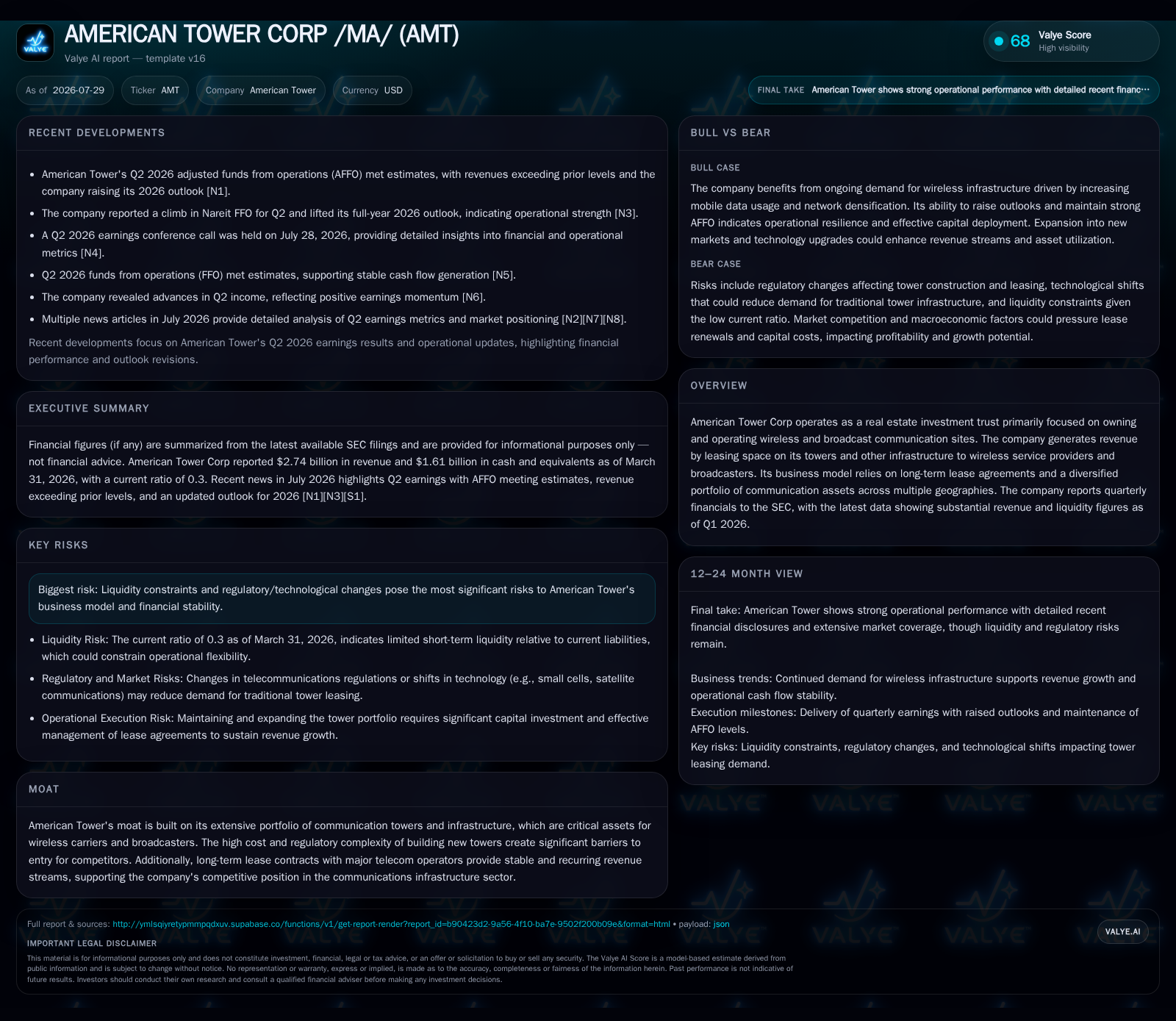
American Tower Corporation reported strong operational momentum in its Q2 2026 results, driven by sustained growth in site leasing revenue and expanding tenancy ratios as wireless carriers intensify 5G deployments [S2]. The company’s long-term lease portfolio demonstrated stability with steady renewal rates, while colocation demand on existing communication towers increased, enhancing site utilization and revenue per asset. This dynamic supports American Tower’s recurring revenue base despite ongoing capital expenditure requirements and regulatory challenges typical of the communications infrastructure REIT sector.
Business Model and Revenue Mechanics: Leasing Physical Infrastructure to Wireless Carriers
American Tower operates as a real estate investment trust (REIT) owning and managing a global portfolio of communication towers and related infrastructure. Its primary revenue source is rental income from long-term lease agreements with wireless carriers and broadcasters who deploy antennas and equipment on these sites to provide wireless connectivity to end users [S2]. These leases typically span multiple years and include contractual rent escalators indexed to inflation or fixed increases, providing predictable annual recurring revenue (ARR) streams and reducing tenant churn risk.
Revenue generation depends on two key operational levers: the number of communication sites leased and the tenancy ratio, defined as the average number of tenants per site. Wireless carriers increasingly colocate additional equipment on existing towers to densify networks, spreading fixed site costs over multiple tenants and improving margin profiles [N1]. This colocation trend drives incremental revenue growth without proportional capital expenditure (CapEx) on new tower construction, which faces lengthy regulatory approval and zoning hurdles.
Q2 2026 Performance: Revenue Growth and Tenancy Ratio Expansion
In Q2 2026, American Tower’s revenue growth outpaced expectations, supported by stable lease renewals and increased colocation activity that boosted tenancy ratios [S2][N6]. The company reported continued expansion in site utilization rates, reflecting carriers’ network densification strategies amid accelerated 5G rollout and growing Internet of Things (IoT) connectivity demands. These factors contribute to higher capital intensity focused on small cell deployments and backhaul integration, essential for supporting dense urban coverage and enhanced data throughput [S2].
Lease renewal execution remains a critical metric, with American Tower maintaining high tenant retention rates despite some churn, notably the termination of DISH Wireless agreements effective June 2026 [S28]. Replacement demand from other carriers and expansion of existing tenants partially offset this churn, preserving ARR stability.
Competitive Landscape: Tower REIT Peers and Alternative Infrastructure Solutions
American Tower competes with other major communications infrastructure REITs such as Crown Castle International Corp and SBA Communications Corporation, which operate similar business models focused on leasing tower and small cell infrastructure to wireless carriers. While these peers vary in geographic concentration and scale, all face comparable industry dynamics including regulatory complexity, capital intensity, and tenant concentration risks.
Alternative infrastructure solutions like small cell networks and fiber-based backhaul providers introduce competitive nuances but largely complement rather than substitute macro tower leasing at scale. Macro towers remain indispensable for broad geographic coverage, underpinning American Tower’s pricing power derived from site scarcity and regulatory barriers to new tower construction.
Growth Drivers: 5G Rollout, IoT Expansion, and Network Densification
The primary growth drivers for American Tower’s leasing business include accelerated 5G deployment requiring denser antenna placements and the expanding IoT ecosystem increasing demand for wireless connectivity. These trends necessitate both new tower developments where feasible and extensive upgrades to existing sites, including small cell installations linked via backhaul connectivity [S2].
Emerging market broadband expansion further supports long-term demand for communication infrastructure. However, telecom capital expenditure cycles introduce timing variability, requiring disciplined capital allocation to balance organic development and acquisition opportunities.
Risks and Challenges: Regulatory, Technological, and Financial Considerations
Regulatory and zoning restrictions pose ongoing risks by delaying tower construction and increasing permitting costs. Environmental and community opposition in certain regions add to development uncertainties [S10].
Technological shifts, such as accelerated adoption of small cells and distributed antenna systems (DAS), could reduce reliance on traditional macro towers if these alternatives scale faster than anticipated. Tenant concentration risk remains significant given dependence on a limited number of major wireless carriers whose strategic network decisions directly affect lease renewals and tenancy volumes.
The recent termination of DISH Wireless contracts illustrates tenant churn risk and ongoing litigation exposure [S28]. Capital intensity inherent in tower acquisition and development results in elevated leverage levels typical of the sector. Interest rate fluctuations impacting debt servicing costs require active balance sheet management to maintain investment-grade credit profiles [S6].
Key Operating and Financial Metrics to Monitor
Critical metrics for assessing American Tower’s operational health include:
- Lease renewal rates and tenant retention, especially with major national carriers, which influence multi-year revenue visibility [N9][S2]
- Leased tenancy ratio trends, indicating success in colocation and incremental revenue generation without proportional CapEx increases
- Adjusted funds from operations (AFFO), reflecting cash flow after sustaining capital expenditures
- Capital expenditure to revenue ratio, measuring capital allocation efficiency amid network densification demands
- Leverage ratios and interest coverage, ensuring prudent debt management in a capital-intensive REIT model
Financial Position and Capital Structure
American Tower has proactively amended its credit facilities, extending maturities to 2029–2031 and adjusting covenants to allow strategic borrowing flexibility up to defined senior secured debt multiples relative to adjusted EBITDA [S6]. This flexibility supports ongoing buy-and-build strategies and capital expenditure programs essential for sustaining growth amid evolving wireless carrier network plans.
Maintaining strong interest coverage ratios and disciplined capital allocation will be vital to preserving investment-grade credit ratings and access to affordable capital in a rising interest rate environment.
Summary
American Tower’s Q2 2026 results reinforce the resilience of its communications infrastructure leasing business, anchored by long-term lease agreements with major wireless carriers and supported by network densification trends driven by 5G and IoT expansion. Stable tenant retention and rising colocation activity underpin expanding ARR despite isolated churn events such as DISH Wireless contract terminations.
The company faces ongoing risks from regulatory constraints, technological shifts, and capital intensity but benefits from geographic diversification and proactive leverage management. Monitoring lease renewal execution, tenancy ratio progression, and capital expenditure discipline will provide key insights into the sustainability of American Tower’s infrastructure platform amid dynamic industry conditions.
This analysis is based entirely on publicly filed SEC documents dated through July 28, 2026 ([S2],[S3],[F1]) supplemented by recent news articles covering Q2 earnings commentary ([N1],[N6],[N9]). It aims solely to inform understanding of American Tower Corp's operational dynamics within communications infrastructure industry context without offering investment advice.
Disclaimer: This is research-only, informational analysis and not investment advice. It may include AI-generated interpretation and general industry context. Always verify important details using primary sources.

Comments