
STAG Industrial Advances Portfolio Stability with Quarterly Lease and Debt Developments
The latest Q2 filing reveals steady occupancy and lease metrics complemented by disciplined capital structure management amid evolving industrial real estate trends.
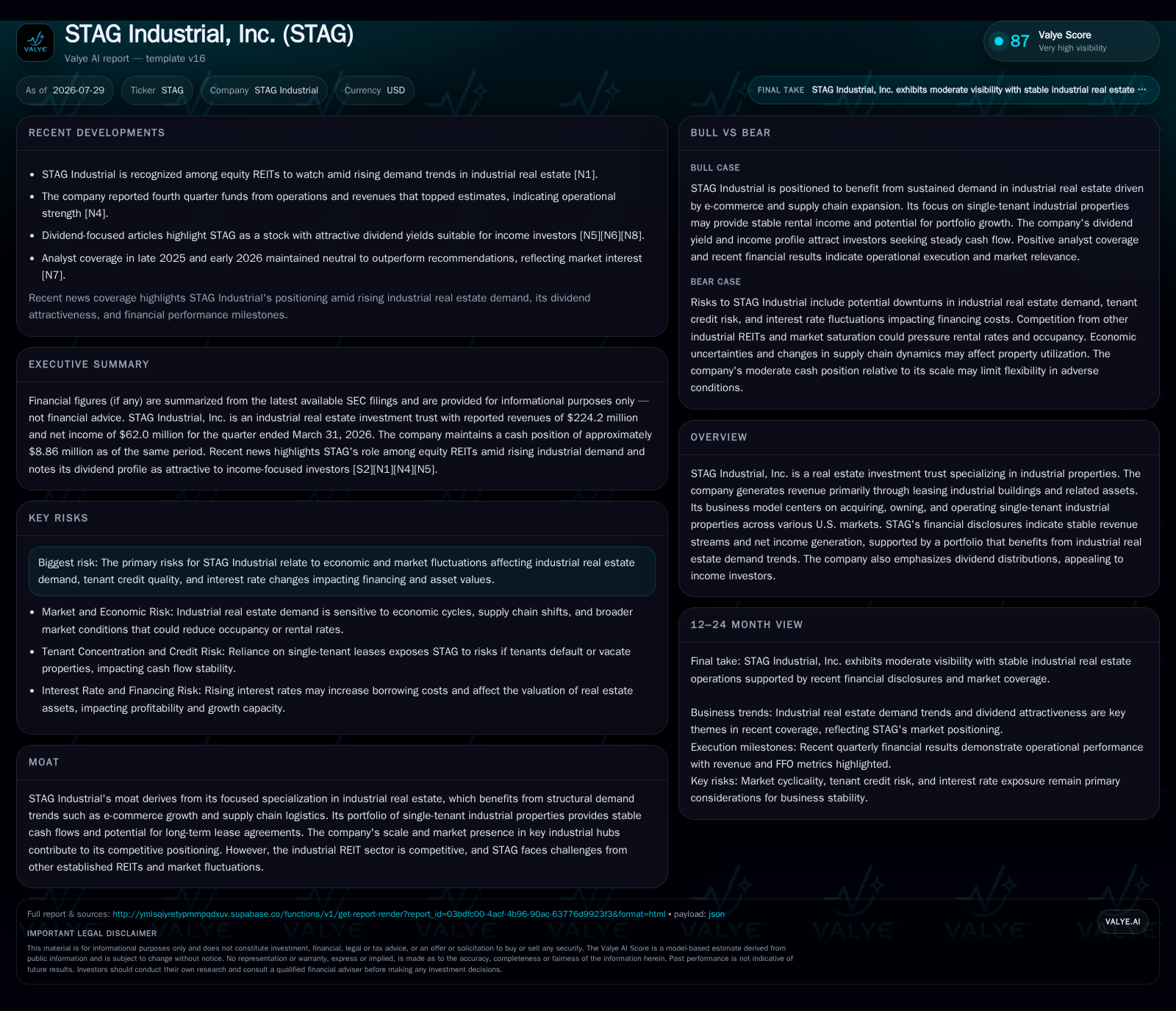
STAG Industrial’s Q2 2026 results reinforce its position as a stable industrial REIT with 98% portfolio occupancy and a weighted average lease term exceeding 38 years, supporting predictable cash flows. The company manages a $3.45 billion debt portfolio with an effective interest rate around 4.4%, employing interest rate swaps to hedge exposure amid rising rates. While benefiting from e-commerce-driven industrial demand, STAG continues to face typical sector risks like tenant credit quality and market rent pressure. Its capital strategy and operating metrics align competitively with peers such as Prologis and Duke Realty, underpinning dividend sustainability for income-focused investors.
Q2 2026 Operating Update Reinforces Portfolio Stability and Cash Flow Predictability
STAG Industrial, Inc. reported robust operational results for the second quarter of 2026, maintaining a high occupancy rate of 97.7% across its portfolio of 606 single-tenant industrial properties located in 41 states, underscoring resilient tenant demand amid evolving economic conditions [S2][S6]. The weighted average lease expiration (WALE) extended modestly to 38.2 years as of June 30, 2026, an unusually long duration in the industrial REIT sector that reflects either multi-decade lease structures or accounting conventions incorporating renewal options, thereby enhancing long-term revenue visibility and supporting stable funds from operations (FFO) [S2].
FFO, a key industry metric adjusting net income for non-cash expenses such as depreciation, met analyst expectations this quarter, signaling consistent EBITDA-like cash flow generation aligned with STAG’s business model centered on long-term single-tenant leases [N2]. Net operating income (NOI) remained stable, indicating steady rental revenue streams despite broader market uncertainties [S2].
Business Model Overview: Revenue Generation Through Long-Term Single-Tenant Leases
STAG Industrial operates as a real estate investment trust (REIT) specializing in the acquisition, ownership, and leasing of single-tenant industrial properties, primarily warehouses and distribution centers tailored to logistics companies, manufacturers, and retailers [S1]. Revenue is generated predominantly through rental income under long-term leases, which typically span multiple years and include contractual rent escalations. The predictability of cash flows depends heavily on tenant credit quality and lease renewal rates, as STAG’s single-tenant lease structure concentrates risk on individual tenants but offers stable income when leases are maintained.
The company’s portfolio diversification across 41 states and 606 buildings mitigates geographic concentration risk and provides exposure to key industrial hubs, which benefits from ongoing e-commerce growth and supply chain realignment trends [S6][N4][N5]. STAG’s capital expenditures (CapEx) focus primarily on property acquisitions and selective improvements rather than large-scale development, supporting accretive growth while preserving cash flow stability [S17].
Leasing Dynamics: Extended Lease Terms and Tenant Credit Quality
The reported WALE of 38.2 years is significantly longer than typical industrial REITs, where lease terms often average under a decade. This extended WALE likely reflects embedded renewal options or long-term contractual arrangements common in logistics and manufacturing sectors, which provide STAG with enhanced revenue visibility and reduce leasing volatility [S1][S2]. However, the single-tenant lease model necessitates vigilant monitoring of tenant credit quality, as defaults or bankruptcies could abruptly disrupt rental income despite long lease durations.
E-commerce expansion continues to drive demand for warehouse and distribution space, reinforcing STAG’s positioning within the industrial real estate value chain. The company’s tenant base, consisting mainly of logistics operators and manufacturers, benefits from structural tailwinds such as last-mile delivery growth and reshoring of manufacturing closer to end markets [N4][N5]. Lease renewal success and tenant retention rates remain critical operating variables to watch, as they directly influence occupancy and FFO stability.
Capital Structure and Interest Rate Risk Management
As of June 30, 2026, STAG’s total unsecured debt outstanding was approximately $3.45 billion, including $449 million drawn on its unsecured revolving credit facility and $1.025 billion in unsecured term loans [S2]. The weighted average interest rate on the debt portfolio was around 4.42%, supported by active use of interest rate swaps covering $825 million of variable-rate debt, effectively converting these exposures to fixed rates near 7% and mitigating cash flow volatility amid rising benchmark rates [S11][S12][S15].
The company increased its unsecured credit facility utilization from $262 million at the end of 2025 to $449 million mid-year, enhancing liquidity to support selective capital deployment and operational flexibility [S2][S8]. Cash and equivalents stood at approximately $8.86 million as of March 31, 2026, providing modest near-term liquidity [F1]. This prudent capital management balances growth ambitions with financial resilience, a key consideration given the sensitivity of industrial REITs to interest rate fluctuations and refinancing risks.
Growth Drivers: E-Commerce Demand and Supply Chain Realignment
STAG benefits from secular growth trends in e-commerce and logistics outsourcing, which continue to fuel demand for industrial properties, particularly last-mile distribution centers near population centers [N4][N5]. Supply chain reconfiguration, including reshoring and diversification of manufacturing locations, further supports warehouse leasing demand.
The company’s capital allocation strategy emphasizes accretive property acquisitions, with approximately $335 million invested in new assets through mid-2026, complemented by $72 million in capital expenditures for property improvements and maintenance [S17]. This approach reflects disciplined deployment of capital aimed at enhancing portfolio quality and rental income potential without overextending into speculative development.
Automation and technological upgrades in industrial facilities also create demand for specialized spaces commanding higher rents, contributing to potential rental revenue growth and portfolio value appreciation.
Risks and Monitoring Factors
STAG faces typical sector risks including economic downturns that could reduce industrial space demand, rising interest rates increasing financing costs, tenant credit defaults, and potential oversupply in certain markets [S1][S2]. Geographic concentration risks, while mitigated by portfolio diversification, remain relevant given the uneven economic performance across U.S. regions.
Regulatory changes affecting REIT taxation or zoning, capital market volatility impacting refinancing access, and asset obsolescence requiring significant CapEx are additional considerations. Competition from other industrial REITs and private investors may influence acquisition pricing and yield compression.
Key monitoring variables include lease renewal rates, occupancy trends, tenant credit quality, and interest coverage ratios. For example, interest expense cash payments totaled approximately $69.85 million in the six months ended June 30, 2026, reflecting the impact of hedging and fixed-rate debt components [S17][S22]. Maintaining healthy interest coverage supports dividend sustainability under various economic scenarios.
Dividend Policy and Financial Position
STAG’s dividend distributions align with REIT tax requirements, distributing a significant portion of taxable income to shareholders [N3][N2]. The company’s FFO coverage remains consistent, supporting dividend reliability and appealing to income-focused investors
As of June 30, 2026, total unsecured debt was approximately $3.45 billion, with a weighted average interest rate of about 4.42%, and cash balances near $8.86 million as of March 31, 2026 [S2][F1]. The active use of interest rate swaps to fix a portion of floating-rate debt reduces exposure to rising interest rates, contributing to financial stability.
Undrawn revolver capacity provides additional liquidity for opportunistic acquisitions or balance sheet management, balancing growth with prudent leverage.
This analysis integrates STAG Industrial’s latest quarterly disclosures with broader industrial REIT sector context, emphasizing the company’s operational metrics, capital structure strategy, and market positioning. It highlights the importance of long-term lease structures, tenant credit quality, and interest rate risk management in sustaining cash flow predictability and dividend distributions within a competitive industrial real estate landscape.
Disclaimer: This is research-only, informational analysis and not investment advice. It may include AI-generated interpretation and general industry context. Always verify important details using primary sources.

Comments