
Tilray Brands Expands Global Footprint Amid Regulatory Complexity and Acquisition Integration
Tilray leverages a diversified portfolio across cannabis, beverage, and wellness sectors while navigating evolving regulation and operational scaling challenges.
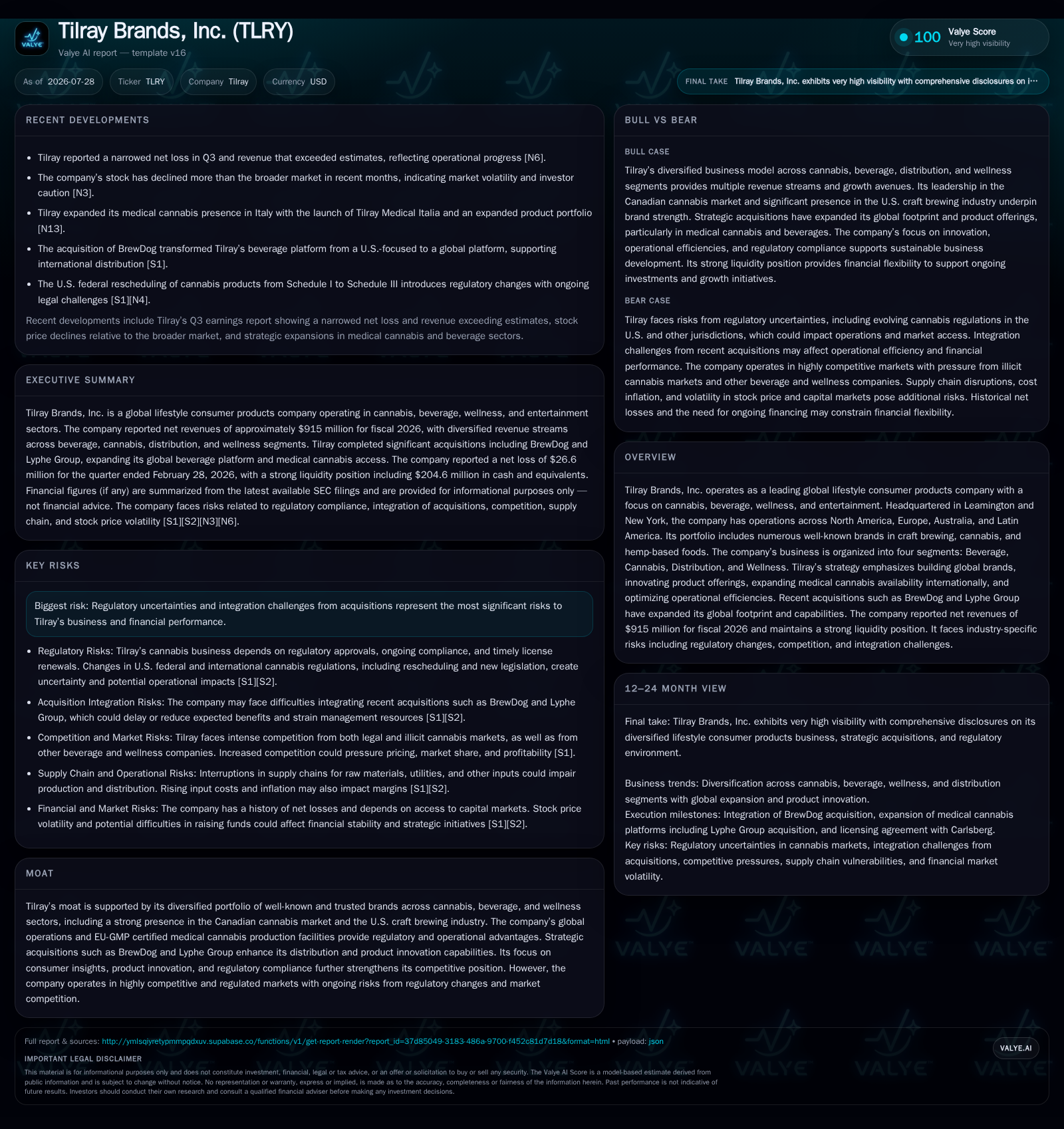
Tilray Brands, Inc. reported fiscal year 2026 results characterized by a broad multi-segment portfolio spanning cannabis, craft beverages, wellness products, and international medical cannabis distribution. Recent acquisitions such as BrewDog and Lyphe Group have transformed its beverage segment into a global platform and expanded U.S. market reach ahead of potential federal cannabis legalization. However, the company faces persistent risks including complex regulatory landscapes in multiple jurisdictions, integration costs for acquired businesses, intense competition from legal and illicit markets, and supply chain constraints. Operational focus centers on innovation in cannabis form factors, leveraging brand equity across segments, optimizing production efficiency with GMP-certified facilities, and cautiously expanding internationally. Tilray’s balance sheet remains solid with strong liquidity and manageable debt levels as evidenced in the latest quarterly filing.
Recent Operating Update
Tilray Brands, Inc. reported continued strategic advancement through fiscal year 2026, highlighted by key acquisitions and ongoing operational execution across its diversified portfolio spanning cannabis, beverages, wellness, and medical distribution [S1], [S3]. The acquisition of BrewDog in early 2026 expanded Tilray’s beverage segment from a North American craft brewing platform into a global operation, enabling broader international distribution of flagship brands such as SweetWater Brewing, now the fourth largest craft brewer in the U.S. [S1], [S13]. Concurrently, the April 2026 acquisition of the Lyphe Group, a UK-based digital medical cannabis clinic, enhances Tilray’s capabilities in telehealth and patient access, supporting its international medical cannabis expansion strategy [S13].
Operationally, Tilray manages a complex regulatory environment across more than 20 countries for its medical cannabis exports, leveraging EU-GMP certified cultivation and processing facilities in Portugal and Germany to meet stringent European standards and maintain competitive differentiation [S7], [S21]. In Canada, Tilray sustains leadership in the adult-use cannabis market through a broad product portfolio and continuous innovation in form factors including edibles, vapes, topicals, and infused beverages [S7]. Recent U.S. federal rescheduling of certain cannabis products to Schedule III under DEA oversight offers a potential pathway for federally compliant medical cannabis sales, though legal challenges and regulatory uncertainties temper near-term visibility [S21], [S16]. Additionally, the U.S. federal ban effective November 12, 2026, on hemp-derived Delta-9 THC products introduces risk to select product lines and necessitates strategic adjustments [S2].
Business Model
Tilray operates through four integrated segments: Beverage, Cannabis, Distribution, and Wellness [S25]. Revenue generation derives from direct sales to consumers via regulated retail dispensaries and wholesale distribution networks domestically and internationally [S19], [S20].
The Cannabis segment encompasses cultivation, processing, and sale of adult-use and medical cannabis products in Canada and internationally. Tilray’s product portfolio includes whole flower, pre-rolls (including infused variants), vapes, topicals, edibles (gummies and chocolates), and cannabis-infused beverages. The company leverages consumer insights and data analytics to prioritize innovation in high-demand form factors, supporting premium pricing while ensuring compliance with evolving regulatory frameworks [S7], [S19]. Internationally, Tilray’s EU-GMP certified facilities underpin its medical cannabis export business, supplying markets such as Germany, Portugal, the United Kingdom, and Australia. This certification acts as a regulatory barrier to entry and supports consistent product quality, although increasing competition in these markets exerts pricing pressure [S17], [S21].
The Beverage segment is anchored by leading U.S. craft beer brands including SweetWater Brewing and has expanded its global footprint through the BrewDog acquisition. This expansion facilitates broader distribution across mainstream beverage channels beyond traditional craft niches, enhancing brand reach and operational scale [S1], [S25].
The Wellness segment focuses on hemp-based consumables, primarily through Manitoba Harvest, capitalizing on consumer trends favoring natural and wellness-oriented products in the U.S. [S1].
Cross-segment diversification provides revenue stability by mitigating cyclical demand fluctuations inherent in individual categories. However, integration complexities arising from recent acquisitions and the need to comply with diverse regulatory regimes across regions present ongoing operational challenges.
Industry Structure & Competitive Position
Tilray operates within a fragmented yet rapidly professionalizing industry characterized by stringent regulatory compliance requirements, brand development, expansive distribution networks, and continuous product innovation aligned with evolving consumer preferences toward convenience and wellness.
Key peers include licensed cannabis producers such as Canopy Growth Corporation and Hexo Corp, which compete primarily in Canadian adult-use and medical markets. Constellation Brands serves as a beverage and cannabis investment peer, particularly in cannabis-infused beverages. BrewDog, now under Tilray ownership, is a significant craft brewing peer with a global presence. Molson Coors Beverage Company represents a mainstream beverage competitor with scale advantages.
Competitive differentiation for Tilray hinges on regulatory license renewal success across multiple jurisdictions, stringent quality control supported by GMP certification, brand equity fostering consumer loyalty, extensive distribution reach spanning retail dispensaries and pharmacy chains, and scalable production assets that optimize cost efficiency [S21]. The EU-GMP certification of Tilray’s European facilities provides a notable barrier to entry for competitors lacking similar regulatory credentials, particularly in medical cannabis export markets
Tilray’s diversified brand portfolio across cannabis, beverage, and wellness sectors enhances resilience against regulatory and market volatility compared with single-sector operators facing concentrated risks.
Growth Drivers
Tilray’s growth strategy capitalizes on the global expansion of medical and recreational cannabis legalization, with expectations of additional countries adopting regulatory frameworks that facilitate export opportunities for EU-GMP certified medical products [S7], [S21].
Product innovation remains a critical growth vector, with emphasis on expanding beyond traditional cannabis flower to edibles, cannabinoid-infused beverages, and wellness-oriented hemp derivatives. These formats align with consumer trends favoring convenience and health-conscious consumption [S7].
The Lyphe Group acquisition supports digital transformation by enhancing telehealth capabilities and patient access pathways, particularly in European markets where online pharmacy regulations are evolving [S13].
In beverages, international scaling of BrewDog combined with integration of U.S. craft brands consolidates category expertise and enables cross-border distribution synergies.
Data analytics and consumer insights underpin category management leadership, enabling targeted product development and SKU optimization focused on higher-margin form factors.
However, Tilray faces several material risks:
- Regulatory Uncertainty: The impending U.S. ban on hemp-derived Delta-9 THC products effective November 12, 2026, may disrupt established product lines, requiring reformulation or market withdrawal [S2]. Legal challenges to federal cannabis rescheduling introduce timing and implementation uncertainties affecting U.S. medical market strategies.
- Integration Risks: Execution complexities from recent acquisitions, including BrewDog and Lyphe Group, pose challenges in cultural alignment, cost synergy realization, and near-term profitability [S2].
- Competitive Pressures: Intensifying competition in legal cannabis markets, especially in Europe and Australia, drives price compression and margin pressure. The illicit cannabis market continues to exert downward pricing influence in adult-use segments [S17].
- Supply Chain and Production Risks: Agricultural operations face environmental risks such as crop failure despite controlled cultivation methods. Production capacity utilization is critical for margin leverage but remains vulnerable to plant health issues, input shortages, and utility disruptions [S16], [S26].
- Trade Barriers: New U.S. tariffs on imports from Canada and Mexico increase input costs, potentially compressing margins unless price increases are absorbed by customers, which could reduce demand [S11].
- Brand and Consumer Perception: Negative publicity or litigation related to product safety can materially affect brand reputation and demand, necessitating stringent quality control and risk management.
- Cybersecurity Threats: Increasing reliance on IT systems, especially within digital health platforms like Lyphe Group, exposes Tilray to cyber risks requiring ongoing governance and mitigation efforts [S1].
What To Watch Next
Key operational and strategic milestones to monitor include:
- Progress on compliance and product portfolio adjustments ahead of the November 2026 U.S. hemp-derived Delta-9 THC ban.
- Quarterly gross margin trends within the beverage segment reflecting BrewDog integration synergies.
- Regulatory developments and legal outcomes clarifying DEA scheduling impacts on U.S. medical cannabis market access.
- Expansion of medical cannabis export markets leveraging EU-GMP certifications, including announcements of new country entries.
- Production capacity utilization rates at Canadian and European cultivation and processing facilities, indicating operational efficiency and cost management.
- Brand health indicators such as consumer loyalty metrics, share-of-wallet gains, and expanded retail shelf presence relative to competitors.
Financial Profile Discussion
As of February 28, 2026, Tilray reported cash and equivalents of approximately $205 million, with current assets totaling $719 million against current liabilities of $258 million, resulting in a strong current ratio of approximately 2.79, indicative of solid short-term liquidity management [F1], [S2]. Total debt was last reported at approximately $130 million as of May 2024, yielding a net debt position that is negative due to excess cash holdings, providing a financial cushion against near-term maturities and capital needs [F1].
Despite ongoing operating losses, management emphasizes disciplined cost control and margin expansion initiatives supported by scale advantages from recent acquisitions [S6], [S25]. The diversified revenue streams across cannabis, beverage, distribution, and wellness segments provide partial insulation against volatility inherent in any single category. Capital expenditures focus on cultivation and production capacity optimization, while research and development investments support innovation pipelines.
This financial posture positions Tilray to navigate the capital-intensive nature of the cannabis and beverage industries, balancing compliance-driven expenditures with growth-oriented investments.
This analysis synthesizes Tilray’s mid-2026 operating environment and financial condition based on the latest SEC filings and industry context. It highlights the company’s multi-segment diversification, regulatory challenges, acquisition integration efforts, and growth prospects without projecting forward-looking outcomes.
Disclaimer: This is research-only, informational analysis and not investment advice. It may include AI-generated interpretation and general industry context. Always verify important details using primary sources.

Comments