
PharmaCyte Biotech Advances Amid FDA Clinical Hold and Capital Challenges
PharmaCyte Biotech continues its development efforts despite regulatory delays and capital constraints affecting its pancreatic cancer program.
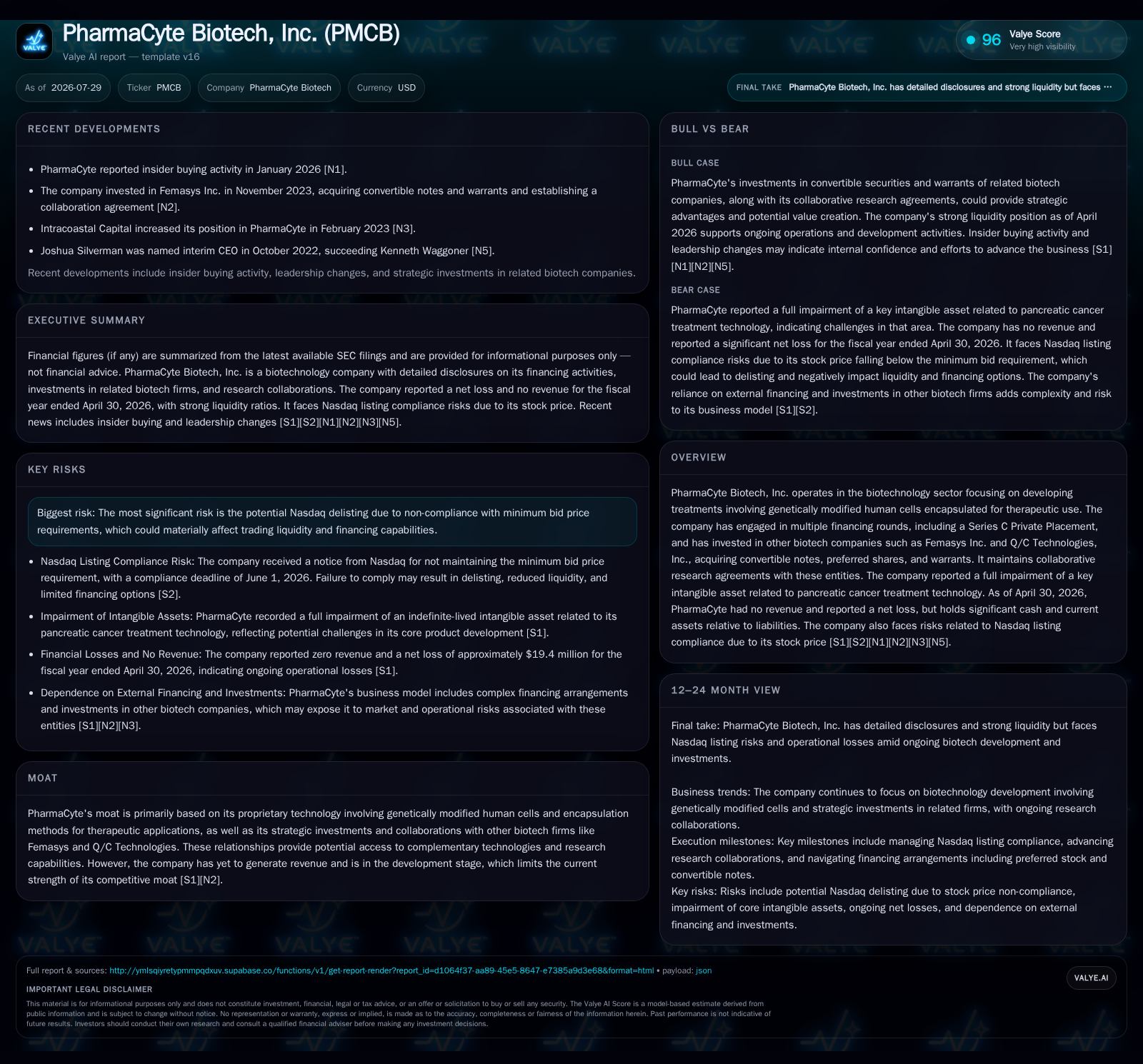
PharmaCyte Biotech remains focused on advancing its proprietary cell encapsulation therapy involving genetically modified cells, primarily targeting pancreatic cancer, although the program faces an ongoing FDA clinical hold. The company’s recent impairment of a key intangible asset and significant net losses reflect current development challenges amid capital needs. Strategic investments in complementary biotech firms diversify its portfolio but also complicate financial dynamics. Nasdaq listing compliance risks further pressure the company’s financing options and liquidity profile.
Recent Operating Update
PharmaCyte Biotech’s most immediate operational focus remains its investigational pancreatic cancer therapy, which uses genetically modified human cells encapsulated in a proprietary matrix for targeted treatment [S1][S2]. A significant challenge materialized with an FDA-imposed clinical hold on its Investigational New Drug (IND) application. The company acknowledges this hold has caused—and likely will continue to cause—considerable delays and additional expenditures without guaranteed resolution [S1]. This holds true for the latest quarterly filing ending April 30, 2026 [S2]. Until this hold is lifted, the clinical trial cannot progress to patient enrollment or data readout stages, critically limiting near-term development milestones.
In addition to delayed clinical progress, PharmaCyte fully impaired an indefinite-lived intangible asset valued at approximately $1.55 million related to their cytochrome P450 cell technology for pancreatic cancer as of fiscal year-end April 2026 [S1]. This impairment signals management’s view that prospective buyers would ascribe negligible value to this asset currently—reflecting both technical/regulatory setbacks and diminished commercial viability in the short term.
Capital-wise, PharmaCyte completed a Series C Private Placement raising gross proceeds of $7 million in August 2025 via convertible preferred stock with attached warrants exercisable into common shares [S1]. While this financing extended operational runway into mid-2026 and beyond, it notably increases potential equity dilution given conversion features tied to future share issuance at $1.00 per share. Additional placement agent fees incurred further reduce net proceeds. Cash reserves totaled about $18.6 million at April-end with current assets significantly exceeding liabilities on a nearly 45-to-1 ratio basis, reflecting conservative balance sheet management albeit devoid of revenue inflows [F1].
Business Model
PharmaCyte operates as a clinical-stage biotechnology firm centered on developing innovative therapeutic applications using genetically modified human cells combined with proprietary encapsulation technology [S1][S2]. This business model is typical of early-stage biotechs that have no commercial products yet and rely exclusively on R&D financing rounds alongside strategic partnerships.
Revenue mechanics depend heavily on successful advancement through regulated clinical trial phases culminating in marketing approvals. Until then, the company generates no product sales revenue; instead it depends on capital raises (such as private placements), milestone payments from collaborations if any are executed, and potentially licensing deals should third parties show interest [S1]. The model entails high R&D expenses related to preclinical studies, manufacturing outsourcing (notably with Austrianova for product candidate production), regulatory filings, and corporate overhead.
Strategically, PharmaCyte's moat rests on patented cell encapsulation processes that protect genetically modified cells from immune rejection while enabling localized drug activation—a potential differentiator in solid tumor therapies such as pancreatic cancer [S1]. The firm also holds stakes in other biotechnology companies—Femasys Inc. and Q/C Technologies—that broaden research synergies but also introduce cross-company risk exposure [S1].
Monetization would only materialize after achieving regulatory approvals paired with scalable manufacturing capacity allowing commercialization through direct sales or partner licensing. Timing is highly contingent on FDA clearance to resume trials following the clinical hold.
Industry Structure and Competitive Position
PharmaCyte occupies the R&D-heavy upstream segment of the biotech value chain focused on novel cell-based therapies—a high-risk area typified by long clinical cycles and regulatory uncertainty. The company resembles peers like Fate Therapeutics or bluebird bio in mechanistic approach (cell engineering) but differs due to its encapsulation technique rather than gene editing or CAR-T modalities commonly pursued by others.
Competitively, this niche is crowded with several advanced cell/gene therapy developers progressing through various solid tumor indications. Key differentiation factors include robust intellectual property protection around encapsulation methods and ability to out-license or partner manufacturing early stages with Contract Manufacturing Organizations (CMOs) like Austrianova [S1]. However, reliance on a single manufacturer creates vulnerability to supply disruptions or cost escalations.
Regulatory interactions are pivotal; clinical holds are not uncommon across this sector but often result in substantial delays impacting valuation and financing terms [S1][S2]. Nasdaq listing compliance risk adds external pressure not typically faced by larger peers with stable stock prices.
Growth Drivers
The primary growth catalyst for PharmaCyte hinges on FDA lifting the existing IND clinical hold. Successful engagement leading to trial reactivation would enable patient enrollment—a critical industry KPI—and pave the way for subsequent efficacy/safety data generation required for market authorization [S1]. Positive clinical outcomes could attract partnership/licensing deals delivering milestone payments enhancing financial flexibility.
Additional growth inflection points include diversifying product candidate pipeline beyond pancreatic cancer indications leveraging core encapsulation IP or expanding collaborations with companies like Femasys or Q/C Technologies for complementary technologies [S1]. Improving manufacturing scalability via Austrianova or alternate CMOs could reduce per-unit costs—vital for later-stage commercialization economics.
Increased investor confidence following favorable regulatory feedback or successful private financings post-clinical hold could lengthen cash runway—another key operating KPI—reducing dilution pressure while enabling expanded R&D investment.
Risks and Constraints
Foremost among risks is prolonged clinical hold status which can stall development indefinitely while escalating cash burn without commensurate value creation [S1][S2]. Failure to resolve such FDA issues quickly amplifies funding requirements given zero revenues over multiple quarters.
Liquidity constraints create another headwind; while recent Series C fundraising bolstered finances temporarily, additional capital is clearly necessary given recurring net losses totaling over $19 million recently [F1][S1]. Further equity raises risk harsh dilution amid depressed share prices exacerbated by Nasdaq warning over minimum bid compliance threatening potential delisting by June 2026 without corrective measures [S2].
Operationally, exclusive manufacturing dependence on Austrianova increases supply chain risks especially amid global disruptions impacting biotech CMOs broadly [S1]. Any breakdown here could materially delay development timelines or inflate costs.
Finally, intellectual property impairments hint at possible competitiveness gaps or weakening technological moat elements demanding close attention from investors assessing intrinsic asset value dynamics [S1].
What to Watch Next
Key monitoring points include FDA communications signaling potential clinical hold removal or requirements adjustments triggering protocol amendments—the earliest signposts that trials might resume [S1][S2]. Subsequent initiation of patient recruitment would validate operational progress.
Financially, watch for announcements regarding new funding rounds or partnership agreements that enhance cash runway beyond mid-2026 pressures. Tracking stock price movements relative to Nasdaq’s minimum bid threshold will indicate whether delisting risks are mitigated through market actions or corporate restructuring steps.
Also observe any updates on manufacturing arrangements that address current capacity or cost concerns potentially affecting scale-up feasibility post-trial approval.
Financial Profile Discussion
At April 30, 2026—with no recorded revenue—PharmaCyte reported a net loss nearing $19.4 million over the prior twelve months underscoring its development-phase status reliant on cash consumption rather than income generation [F1]. Operating losses exceeding $6.8 million reinforce ongoing high R&D expenditure demands essential for advancing pipelines yet unprofitable in current form.
Liquidity remains adequate with roughly $18.6 million held as cash equivalents complemented by total current assets surpassing liabilities by more than forty-five times due principally to low short-term obligations ($826 thousand) suggesting favorable working capital positioning despite operational losses [F1]. Total debt is negligible by comparison at under $250 thousand dating back years earlier implying minimal leverage burden entering clinical scaling phases.
However, such cash levels imply limited operating runway ahead unless further equity raises occur considering ongoing expenses inherent in resolving regulatory holds and preparing trials for restart [S1]. Dilution impact linked to convertible preferred instruments from Series C financing highlights management’s trade-off between immediate funding needs versus shareholder value erosion
Overall financial health indicates cautious optimism pending resolution of regulatory bottlenecks paired with strategic financing execution aligned to development milestones crucial for sustaining biotech venture viability in this sector.
Disclaimer: This is research-only, informational analysis and not investment advice. It may include AI-generated interpretation and general industry context. Always verify important details using primary sources.

Comments