
MMEX Resources Advances Modular Ultra-Clean Fuel and Blue Hydrogen Projects Amid Financing and Permitting Challenges
MMEX Resources is progressing development of modular ultra-clean refining and blue hydrogen projects in Texas, focusing on emissions reduction and rapid deployment despite capital and regulatory hurdles.
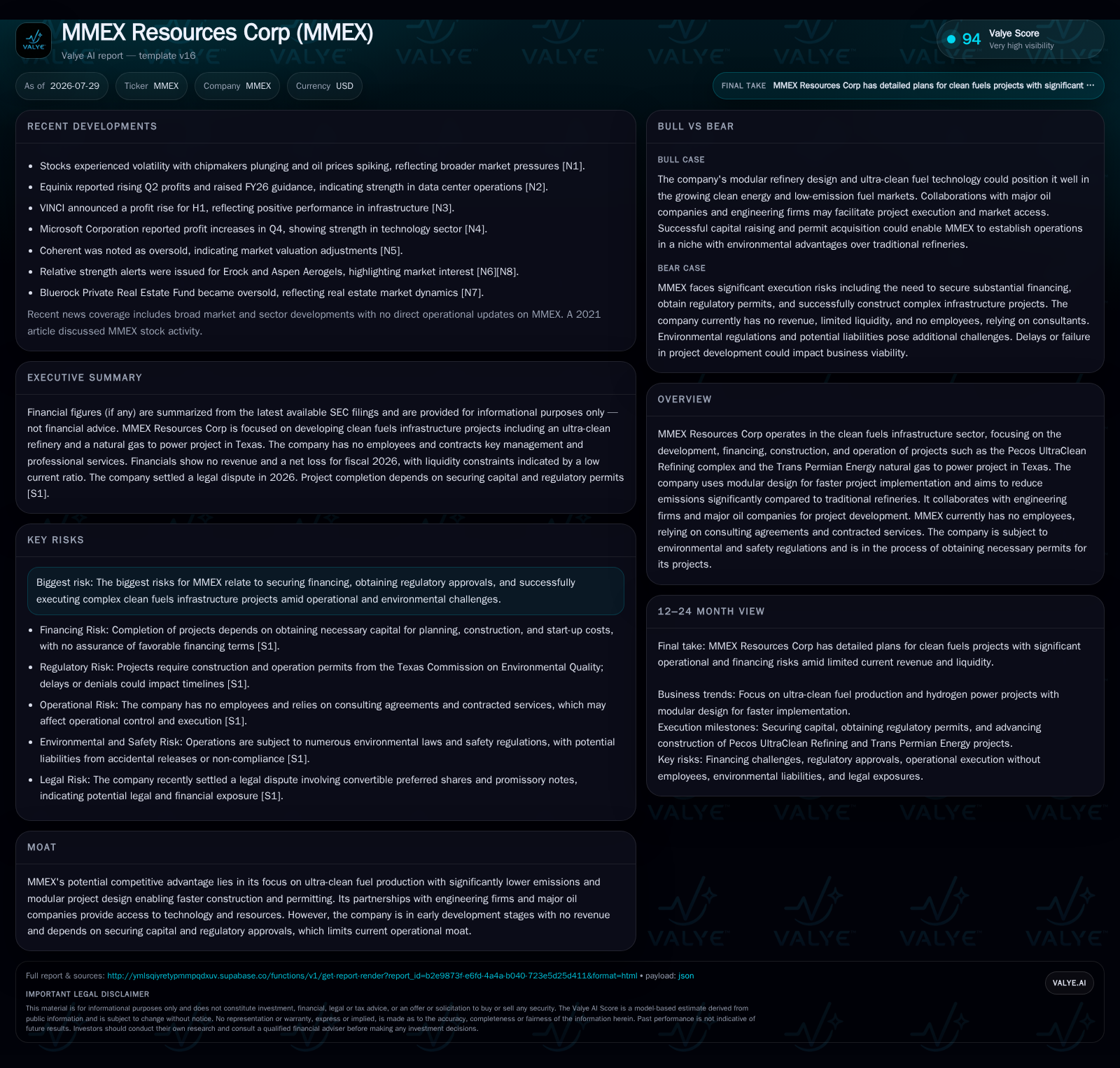
In its latest quarterly filing, MMEX Resources outlined ongoing development efforts for its Pecos UltraClean Refining complex and Trans Permian Energy natural gas to power project, leveraging modular design to accelerate deployment in the Permian Basin. The company aims to produce ultra-low sulfur diesel with emissions roughly 95% lower than traditional Gulf Coast refineries, complemented by a blue hydrogen initiative targeting CO2 elimination through hydrogen fuel integration. These projects remain pre-revenue, dependent on securing sufficient financing and regulatory approvals. MMEX’s business model centers on project development in clean fuels infrastructure with partnerships spanning engineering firms and major oil companies. While modular construction offers faster timelines and environmental permitting advantages, execution risks alongside funding constraints pose substantial challenges ahead.
Recent Operating Update: Early Development Stage Focused on Modular Clean Fuels Infrastructure
MMEX Resources Corp’s most recent quarterly filing in March 2026 reiterates the company’s concentrated efforts to develop two interlinked clean energy projects at their Pecos County, Texas site: the Pecos UltraClean Refining complex with a target capacity up to 60,000 barrels per day (bpd) of transportation grade ultra-low sulfur diesel (ULSD), and the Trans Permian Energy natural gas to power project that incorporates blue hydrogen production [S2][S1]. These initiatives remain under active planning with critical dependencies on financing acquisition and regulatory permitting before material construction activities can commence.
Central to MMEX's approach is the utilization of modular refinery design, fabricated offsite but assembled onsite to compress the overall project timeline to approximately 18 months—significantly shorter than conventional build-outs [S1]. This modular strategy not only expedites schedule but reduces onsite footprint requirements as well as emissions during construction. The company anticipates securing environmental permits from the Texas Commission on Environmental Quality more swiftly due to this smaller footprint and cleaner operational profile.
The Ultra Fuel® refinery configuration stands out technologically by aiming to reduce criteria pollutant emissions by about 95% relative to typical refineries operating in the US Gulf Coast region. This massive emissions reduction target would place MMEX's facility among the cleanest refining assets if realized [S1]. Complementing this is the Blue Hydrogen production plant that uses an international partner's reformer technology converting natural gas into hydrogen [S1]. In its initial phase, hydrogen will constitute approximately 75% of fuel input into combined cycle gas turbines used for power generation onsite; these turbines are capable of flexible hydrogen-natural gas blending. Produced hydrogen will also supply fuel gas to the refinery itself, eliminating CO2 emissions from fuel combustion within that process—a key differentiation versus traditional refineries [S1].
Critically, MMEX is engaged in negotiations with one or more super major oil companies operating in the Permian Basin—a prolific oil and natural gas producing region—to source feedstock natural gas for its energy projects and potentially market captured CO2 from carbon capture facilities planned within the Trans Permian Energy project scope [S1]. This collaboration leverages access to upstream production infrastructure, a vital competitive strength given feedstock logistics are often a limiting factor for greenfield clean fuels projects.
Business Model: Clean Fuels Infrastructure Developer Relying on Partnerships and Modular Execution
MMEX operates primarily as a developer focused on the front end of value chain activities including feasibility studies, engineering designs (including completion of front-end loading phases FEL-1/2), regulatory applications, joint ventures formation (special purpose limited liability companies), and eventually project construction oversight [S1]. It does not currently have employees but instead leverages consulting agreements with external engineering firms such as Polaris Engineering plus contractual relationships with major oil producers acting as strategic partners or feedstock suppliers.
Revenue generation will occur post-construction via sales of refined ultra-low sulfur diesel product streams downstream as transportation fuels along with electricity sales from combined cycle turbines feeding regional grid nodes like ERCOT Far West or large industrial consumers such as data centers potentially contracted directly [S1]. The modular build approach enables cost containment by fabricating refinery units off-site where capital expenditure can be optimized; this also enables phased commissioning which may improve early cash flow visibility once operations begin.
Operating expenses before revenue commencement consist primarily of corporate overheads tied to project development activities including engineering services procurement, environmental studies, permitting compliance efforts, legal administration around SPE formations, and contractual negotiations with third parties including super majors [S1][F1]. Absence of current operational cash flow stresses dependency on continual financing rounds or capital influxes.
Industry Context: Capital-Intensive Clean Fuels Infrastructure With High Regulatory Barriers
MMEX participates within an industry sector undergoing transition driven by tightening global regulations on transportation fuel emissions alongside growing emphasis on low-carbon energy sources such as blue hydrogen (hydrogen produced from fossil fuels coupled with carbon capture). The deployment of ultra-low sulfur diesel refineries offering ~95% emissions reductions is aligned with EPA and state-level air quality targets aiming at drastic reductions in NOx, SOx, particulate matter, and greenhouse gases.
Companies like Phillips 66 and Valero exemplify incumbents gradually transitioning their refinery portfolios towards ultra-clean configurations integrating hydrogen fuels. Meanwhile, natural gas-fired power generators like NextEra Energy increasingly adopt combined cycle units capable of high efficiency fuel switching including hydrogen blends.
Key industry KPIs relevant include barrels per day refining capacity—which at 60k bpd positions MMEX’s planned facility as moderate scale but suitable for rapid deployment—and hydrogen production capacities necessary for both fuel blend substitution and power generation needs. Project completion timelines anchored around modular design contrast conventional multi-year build schedules upwards of three years or more.
Environmental permitting remains one of the largest execution risks. State-level agencies such as TCEQ must balance stringent air quality standards against economic development interests. MMEX’s claim that its modular compact footprint will facilitate swifter approvals remains plausible though unconfirmed until actual permits are issued [S1].
Feedstock supply contracts are another cornerstone KPI affecting economic viability given volatile natural gas pricing dynamics characteristic of energy infrastructure sectors amid global geopolitical tensions impacting crude margins [N6][N9]
Growth Drivers: Regulatory Pressures Coupled With Technology-Led Project Acceleration
Increasing regulatory stringency on transportation fuel pollution forms a structural growth driver underpinning demand for ultra-low sulfur diesel refining capacity. Simultaneously rising commitments from corporations seeking carbon neutrality bolster interest in complementary technologies such as blue hydrogen—both as direct decarbonization enablers in refining processes and power generation fuel source alternatives.
Moreover, advances in modular fabrication techniques have improved scalability while reducing lead times—translating into more attractive economics by lowering labor costs during construction and mitigating regulatory permitting duration [S1].
Geographically advantageous positioning within the Permian Basin allows proximity access to abundant natural gas reserves essential both as feedstock input into reformers producing blue hydrogen and direct turbine firing. This location also answers growing market needs within ERCOT zones where data center expansions amplify demand for reliable low-carbon energy solutions [N4][S1].
Government incentives supporting clean infrastructure investments including tax credits related to carbon capture utilization/storage (CCUS) further enhance project's feasibility though realization depends strongly on political environments beyond firm’s control.
Risks And Watchpoints: Capital Access And Execution Complexity Are Key Hurdles
Despite promising technical design principles emphasizing significant emissions reductions through Ultra Fuel® configurations coupled with fully integrated blue hydrogen usage plans featuring zero CO2 refinery fuel gas combustion inherent benefits come paired with serious risks:
- Capital Constraints: MMEX’s current balance sheet evidences severe liquidity challenges; a current ratio near 0.05 driven by very low cash ($250) compared against significant current liabilities exceeding $6 million indicates acute short-term financial stress absent new funding sources [F1]. Successful capital raising is thus paramount before even breaking ground.
- Permitting Risks: Although modular designs aim to expedite environmental clearances under TCEQ jurisdictions by significantly shrinking physical footprints versus traditional refineries, delays or permit denials would stall or derail projects entirely given emission-sensitive nature.
- Execution Complexity: Integration of cutting-edge hydrogen reformer technology into combined cycle turbines requires proven operation reliability; transition periods may encounter technical hurdles impacting commissioning schedules and operating expenditures.
- Feedstock Price Volatility: Regional commodity market swings could raise operational cost bases significantly should long-term fixed contracts or hedges not be secured.
- Partnership Dependencies: Reliance on super major oil companies both for feedstock supply arrangements and CO2 marketing exposes MMEX to counterparty risk linked to upstream producer investment appetites.
- Market Demand Uncertainty: Emerging competition from renewable alternative fuels mandates continued validation that transportation customers will embrace ultra-low sulfur diesel blends derived from these projects at commercial scale.
Key upstream milestones include reaching final investment decisions contingent upon both financial closing events alongside final receipt of environmental permits enabling construction start commands. Successful front-end engineering completion phases provide interim decision gateways signalling viability progression [S1].
What To Watch Next
Future developments critical to monitoring include:
- Confirmation of sizeable equity/debt financings or joint ventures underpinning capital-intensive build-out phases.
- Status updates on Texas Commission on Environmental Quality permit applications indicating timeline adherence or setbacks.
- Progress reports from working partnerships with super major oil companies detailing feedstock procurement terms or CO2 sales agreements realization.
- Engineering milestones validating transition from FEED packages into procurement/contract awarding stages supporting on-site construction launch imminence.
- Any contractual announcements securing commercial customer pipelines or electricity off-takers serving burgeoning industrial loads like data centers under ERCOT tariffs.
- Management commentary regarding technology adoption results optimizing hydrogen-natural gas turbine blends towards operational targets.
Financial Profile Discussion
As of April 30, 2026 balance sheet data conveys a distressed liquidity profile: cash and equivalents stand at a nominal $250 against current liabilities surpassing $6.17 million resulting in an extremely low current ratio near 0.05 evidencing inability to meet short-term obligations without immediate capital inflows [F1]. Total debt figures provided lack currency consistency but prior best estimates placed net debt over $24 thousand—though this is immaterial compared with working capital gaps meaningfully impacting ongoing operations.
Operating results remain negative reflecting continued pre-revenue status; recent quarter posted operating losses exceeding $1.3 million confirming developmental stage expenses dominate without offsetting earnings streams yet realized [F1]. The company’s dependence on external financing to fund critical next steps remains undisputed given absence of internal cash generation capacity or asset monetization pathways presently available.
This fragile financial footing sharply limits managerial flexibility amidst growing commitments across multiple project fronts highlighting importance of successful investor engagement or strategic partnership expansions providing liquidity buffers required for sustained advancement towards commercial operations.
Disclaimer: This analysis is based exclusively on publicly available SEC filings through July 29, 2026 ([S1], [S2]) supplemented by validated numeric data ([F1]). It does not constitute investment advice or opinion regarding valuation or purchasing decisions. Projection-related statements reflect ongoing developments subject to change from future operations or external factors beyond currently disclosed parameters.
Disclaimer: This is research-only, informational analysis and not investment advice. It may include AI-generated interpretation and general industry context. Always verify important details using primary sources.

Comments