
Ionis Pharmaceuticals Advances Independent Commercialization Amid RNA Therapeutics Expansion
Ionis pushes forward with self-commercialization efforts for key RNA-based therapies while sustaining R&D and strategic partnerships.
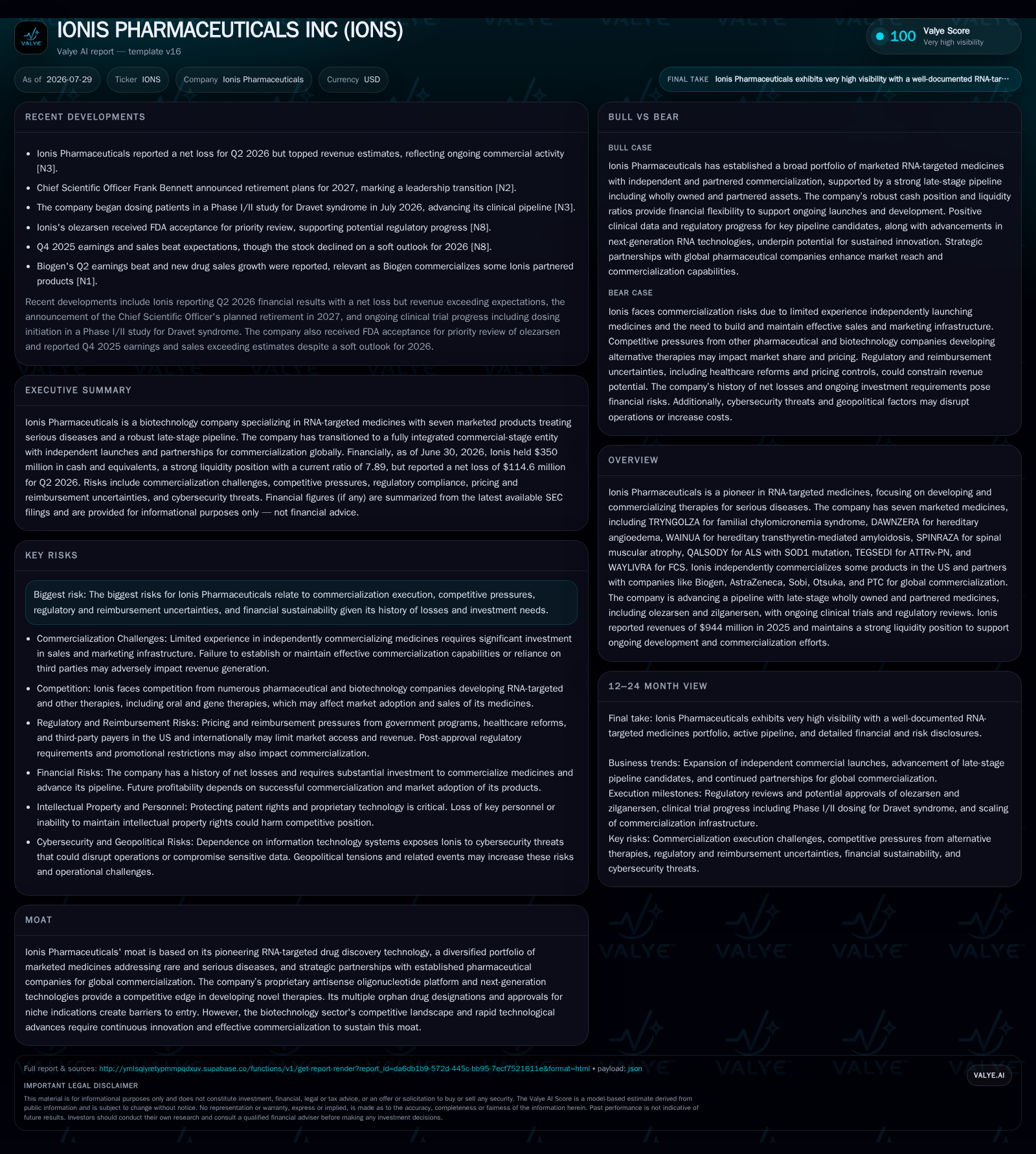
Ionis Pharmaceuticals is transitioning into a fully integrated commercial-stage biotech company, independently launching multiple RNA-targeted medicines in rare disease categories. The latest quarterly report highlights ongoing investments in commercialization infrastructure alongside continued clinical development of pipeline assets. Strategic collaborations with global pharma partners complement Ionis's direct-to-market efforts, but execution risks around manufacturing, reimbursement, and intellectual property remain critical. Financially, Ionis maintains healthy liquidity to support its growth trajectory despite recent operating losses.
Recent Operating Update
Ionis Pharmaceuticals' most recent quarterly filing dated July 29, 2026 ([S2]) underscores the company's evolution into an integrated commercial-stage biotechnology enterprise. The quarter's highlights reaffirm Ionis’s progress in independently commercializing two of its medicines in the U.S.: TRYNGOLZA (olezarsen) for familial chylomicronemia syndrome (FCS) and DAWNZERA (donidalorsen) for hereditary angioedema (HAE). This independent commercialization marks a strategic pivot from past reliance on partners toward building internal capabilities anchored by investments in sales force expansion, marketing infrastructure, patient education, and market access. The move positions Ionis for enhanced revenue capture but imposes increased operational complexity.
Financial results announced concurrently ([N2],[S3]) revealed revenues that surpassed consensus estimates for Q2 2026 while reporting net losses attributable to ongoing commercialization investments coupled with robust R&D spending. The balance between achieving market penetration with newly launched products while sustaining a costly clinical development engine presents execution risk that investors must monitor closely.
Business Model Analysis
Ionis operates primarily through developing antisense oligonucleotide (ASO)-based RNA-targeted therapies for serious and often rare diseases characterized by high unmet medical need. Its revenue streams are a hybrid of direct product sales from independently commercialized medicines like TRYNGOLZA and DAWNZERA within the U.S., alongside milestone payments, royalties, and co-commercialization income from strategic partnerships with established pharmaceutical companies globally.
The business model is inherently capital-intensive due to the specialized nature of ASO therapeutics which require sophisticated drug discovery platforms coupled with lengthy clinical trial programs given regulatory rigor around safety and efficacy validation. Tryngolza targets adult patients with genetically confirmed FCS with a clear clinical goal of reducing triglycerides and acute pancreatitis events; this niche focus benefits from orphan drug designation advantages including market exclusivity incentives but also limits population size.
Commercialization mechanics rely heavily on Ionis’s ability to establish a credible sales team that can engage specialists such as geneticists, hematologists, and neurologists who treat these rare conditions. Market access negotiations with payers determine reimbursement coverage which can be challenging given high therapy costs typical for orphan indications. Complementing this, Ionis leverages partnerships with Biogen for SPINRAZA’s global marketing in spinal muscular atrophy (SMA), AstraZeneca’s ex-U.S. rights to WAINUA for hereditary transthyretin-mediated amyloidosis polyneuropathy (ATTRv-PN), Sobi for specialty rare disease sales expertise, Otsuka Pharmaceutical for broader commercialization alliances, and PTC Therapeutics which expands pipeline development synergies.
Successfully scaling internal commercialization involves increasing SG&A expenses disproportionately relative to early-stage revenues until market penetration accelerates. Ionis must efficiently train field teams on highly technical RNA therapeutics’ clinical profiles while ensuring coordination with payer relations professionals to optimize coverage outcomes. Manufacturing also plays a pivotal role — ASOs require tight quality controls under cGMP standards; failures or delays could hamper supply continuity adversely affecting patient adherence and revenues.
Industry Structure and Competitive Position
Ionis operates within the biotechnology segment focused exclusively on RNA-targeted therapeutics—specifically using antisense oligonucleotides technology as its proprietary platform. This positions Ionis among peers such as PTC Therapeutics that also champion RNA-based approaches targeting rare diseases. Large pharmaceutical companies like Biogen offer validation of Ionis’s platform through longstanding partnership agreements but also represent competition when they develop their own RNA portfolios.
The competitive landscape is shaped by rapid technological innovation where platform agility dictates pipeline breadth and speed to regulatory milestones. Ionis’s moat rests on its pioneering ASO platform established over decades coupled with multiple marketed products addressing niche indications that benefit from orphan drug exclusivities creating entry barriers. However, patent litigations such as ongoing disputes involving SPINRAZA patents pose threats to exclusivity duration which could impact royalty income ([S10],[S17]). Additionally, reimbursement pressures globally challenge pricing power often required to justify investment in such advanced therapies.
Market acceptance hinges not only on demonstrated clinical benefit but also on ease of administration—for example,WAINUA’s auto-injector confers convenience advantage over competitors in ATTRv-PN treatment ([S1]). Physician adoption trails regulatory approval but requires extensive pharmacovigilance programs post-launch to monitor long-term safety.
Growth Drivers
Key pipeline assets including olezarsen (already marketed as TRYNGOLZA) continue regulatory reviews for expanded indications while candidates like zilganersen advance through Phase I/II studies aiming at neurodegenerative disorders such as Dravet Syndrome ([N9],[S1]). Each successful milestone achieved acts as a catalyst enhancing the company’s value proposition.
Strategic partnerships are instrumental leverage points allowing Ionis to extend geographic reach without wholly bearing commercialization risks outside the U.S., accelerating revenue growth opportunities through licensing fees and royalties.[S1] Orphan drug designation continues as an industry-tailwind providing market exclusivity benefits alongside accelerated regulatory pathways reducing time-to-market hurdles.
Manufacturing efficiencies gained via expanded capacity or superior process controls can improve gross margins incrementally—this is crucial given heavy upfront R&D investments [S1]. Incremental reimbursement gains via successful payer negotiations or expanded formulary placements directly impact revenue per patient served.
Risks and Watchpoints
Commercialization execution risk looms large given Ionis’s limited historical experience running independent launches.[S1,S2] Scaling a geographically dispersed sales force demands effective human capital management including retention incentives amid competitive biotech labor markets.[S1] Underperformance in launching new products or delays in achieving sufficient payor coverage can materially impair near-term revenue prospects.
Manufacturing scale-up risks include maintaining compliance with current good manufacturing practices (cGMP) amid growing output volumes; any lapses could trigger regulatory actions affecting product availability.[S13]
Intellectual property risk is pronounced as ongoing litigation could curtail exclusivity periods or inflate legal costs undermining profitability.[S10,S17] Heightened competition from emerging RNA modalities or gene-editing platforms may erode future market share if Ionis fails to innovate rapidly enough.
Financial sustainability remains contingent on balancing cash burn from R&D/SG&A against incoming revenues; prolonged operating losses necessitate careful cash management despite presently ample liquidity [F1]
What to Watch Next
Investors should track upcoming clinical readouts on pipeline candidates such as zilganersen's Phase II/III data releases which will materially affect development outlooks.[N9]
Progression of ongoing patent disputes especially regarding SPINRAZA’s exclusivity will influence royalty streams.[S17]
Evolution of reimbursement landscapes particularly price negotiations with large payers or public programs may significantly impact net realized pricing.
Commercial metrics including TRYNGOLZA's market uptake rates in the U.S., usage trends for DAWNZERA post launch expansion campaigns, and any announcements related to additional independent launches will reveal scalability success.
Management commentary on further enhancements of commercial infrastructure or strategic shifts towards more partner reliance versus self-commercialization would indicate risk appetite adjustment.
Financial Profile Discussion
As of June 30, 2026, Ionis held $350 million in cash and equivalents against current liabilities approximating $316 million, resulting in a strong current ratio near 7.9x—signaling robust liquidity cushioning ongoing operational expenditures [F1]. Total debt data is only available from 2011 and shows relatively low levels compared to cash reserves; no recent debt updates were disclosed, indicating a conservative leverage policy [F1]. Cash flow management remains critical given elevated SG&A ratios necessary for building an internal sales organization plus concurrent financing of pipeline progression requiring high R&D intensity [S2].
In summary, Ionis maintains financial flexibility adequate for its present strategy execution but must demonstrate improving top-line contributions from self-commercialized products to achieve sustainable profitability over the medium term.
This analysis incorporates publicly available regulatory filings up to July 29, 2026 ([S1]-[S3]), supported by market commentary () and underlying financial data [F1]. No forward-looking statements or investment advice are expressed herein.
Disclaimer: This is research-only, informational analysis and not investment advice. It may include AI-generated interpretation and general industry context. Always verify important details using primary sources.

Comments