
Boot Barn Expands Store Footprint and Enhances Credit Facility to Support Omnichannel Growth
Boot Barn’s Q2 2026 results and credit agreement amendment underscore growth execution through store expansion and financial flexibility in a specialty retail niche.
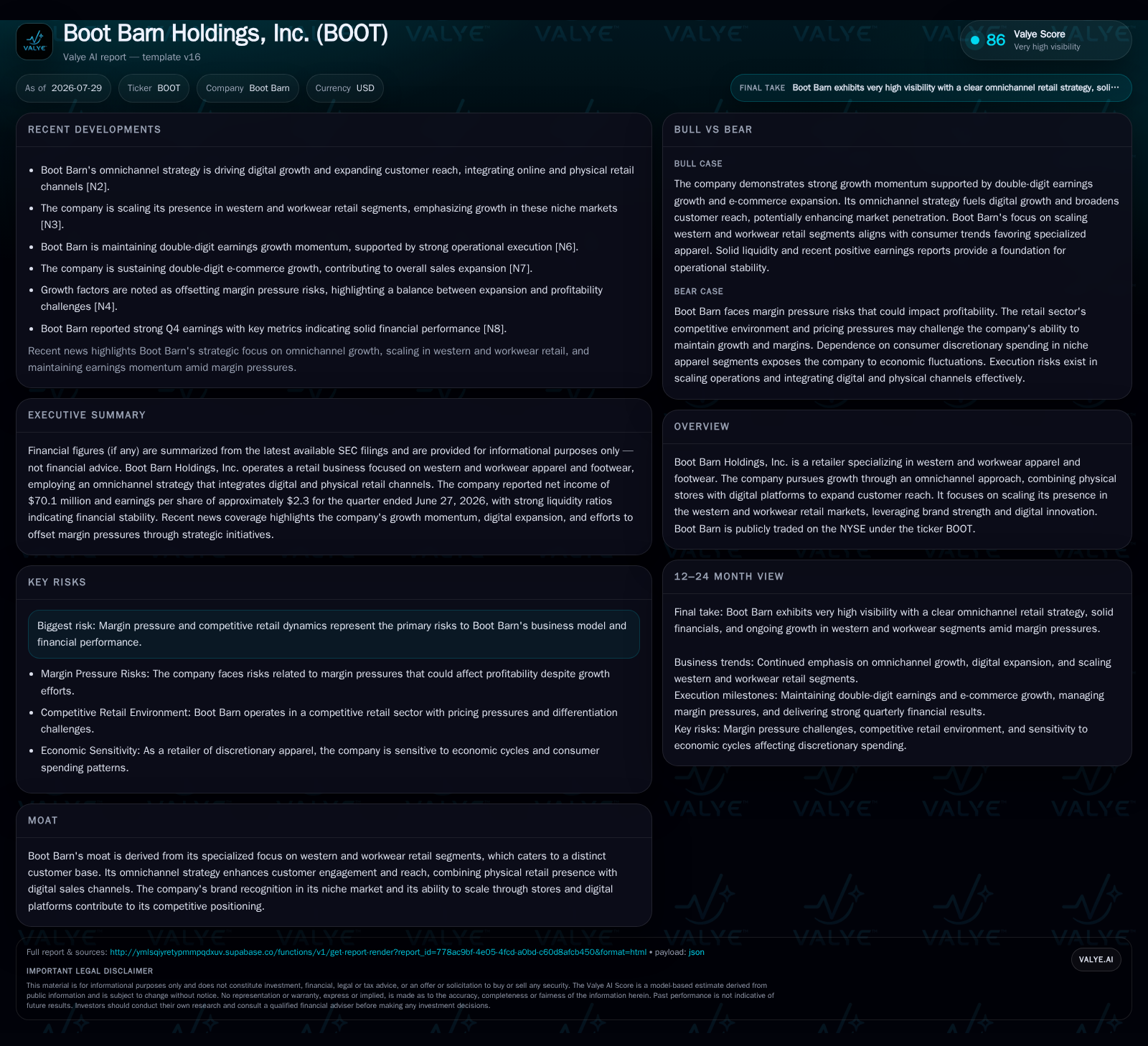
Boot Barn Holdings, Inc. reported continued same-store sales growth and an increasing e-commerce contribution in its latest quarter, reflecting momentum in its omnichannel strategy tailored to western and workwear customers. The company also amended its credit agreement to bolster financial flexibility, supporting planned store rollouts and digital investments. Boot Barn’s focused niche positioning offers differentiation but faces margin pressures from retail competition and geographic concentration risks. Inventory management and marketing effectiveness remain critical for sustaining profitability amid industry-wide supply chain challenges.
Recent Quarter Signals Store-Led Growth Momentum Amid Digital Advances
Boot Barn’s Q2 fiscal 2026 filing reveals tangible progress in its core metrics that substantiate its dual-channel growth strategy. The company reported positive same-store sales growth complemented by an increasing share of e-commerce sales within total revenue [S2]. This development signals successful engagement of western and workwear consumers across both physical stores and digital platforms. The synergy between rising foot traffic and elevated digital spending underscores an effective omnichannel model implementation that supports top-line trajectory without overreliance on any single channel [N5]. Such comparable sales gains are particularly meaningful given the specialty nature of Boot Barn’s product assortment, where customer loyalty hinges on curated lifestyle apparel choices.
Omnichannel Model Deepening Customer Reach while Managing Margin Pressure
Boot Barn’s business model centers around offering specialized western boots, workwear apparel, and accessories through an integrated network of physical locations and e-commerce sites. This omnichannel retail approach leverages brand exclusivity—particularly through private-label products—and a differentiated merchandise mix catering to occupational and lifestyle preferences within its niche segment [S1]. However, despite its focused market position providing some pricing power, the company still encounters considerable margin pressure driven by competitive discounting prevalent in retail apparel sectors. Gross margin compression relates in part to markdown cadence needed to clear seasonal inventory ahead of fashion shifts inherent even within western/workwear categories [F1][S1]. Channel diversification helps offset this by mixing higher-margin private-label sales online with volume-driven brick-and-mortar transactions.
Competitive Stakes: Specialty Niche Positioning Against Regional Peers
Within the specialty apparel retail landscape, Boot Barn occupies a defensible niche by concentrating on western boots and functional workwear—a segment less commoditized than mass-market apparel chains. Peer retailers such as Tractor Supply Company or Duluth Trading Company also show emphasis on lifestyle-specific assortments with omnichannel reach; however, Boot Barn's denser store footprint in the southwestern U.S. markets offers both an advantage in customer familiarity and risk related to market saturation [S1]. While this geographic focus fortifies brand presence among core customers, it requires careful balancing against expansion challenges faced by peers who increasingly diversify geographically or shift more aggressively toward digital platforms.
Expansion Strategy Risks from Geographic Concentration and Store Saturation
As described in Risk Factors disclosures, Boot Barn's 539-store base is heavily concentrated with nearly 200 locations across Arizona, California, and Texas alone [S1]. Such concentration exposes the company to economic cyclicality tied to regional industries—most notably oil & gas—and vulnerability to natural disasters like California wildfires or earthquakes that could disrupt distribution hubs based there. Moreover, expanding store count remains a strategic priority yet introduces risks including market cannibalization, lease cost inflation, hiring and training new personnel consistent with brand culture, plus potential supplier resistance limiting product availability in saturated markets [S1]. These dynamics complicate achieving profitability targets for newly opened stores with expected ramp-up timelines.
Supply Chain Dynamics and Inventory Management Driving Operating Efficiency
Effective inventory management constitutes a critical operational lever for Boot Barn given the specialized nature of its western/workwear offerings. Industry-wide supply chain disruptions add complexity by elevating procurement costs and elongating lead times; thus, maintaining an optimal inventory turnover ratio is essential to minimize markdown risk without sacrificing product availability necessary for customer retention [S1]. The markdown cadence must be calibrated carefully: overly aggressive discounting erodes gross margins while insufficient clearance leads to obsolete stock given seasonal fashion relevance even within niche apparel categories. Thus far, Boot Barn’s operating profile suggests ongoing efforts to optimize inventory velocity while controlling capital tied up in stock.
Digital Channel Penetration: E-Commerce as Growth Catalyst
The increasing share of e-commerce sales represents a strategic milestone for Boot Barn. By augmenting brick-and-mortar purchasing patterns with robust online engagement channels—supported by targeted marketing campaigns—the company mitigates exposure to fluctuating foot traffic patterns caused by broader shifts in consumer behavior or regional economic headwinds [S2][N5]. E-commerce penetration also potentially enhances marketing efficiency by lowering customer acquisition costs relative to traditional channels while providing data insights that inform assortment decisions aligned with core demographics.
Growth Drivers Anchored by Store Rollouts, Brand Exclusives, and Marketing
Boot Barn has pursued an assertive expansion strategy with 80 new stores opened during fiscal year 2026 reflective of confidence in both market demand and capital availability [S1]. Private-label product development further entrenches brand exclusivity—a recognized moat within specialty retail—while seasonal launches tied to western lifestyle events stimulate periodic customer traffic increases aligned with competitors’ promotional calendars [N7][N8]. Enhanced loyalty programs incorporating personalized engagement aim at boosting repeat purchase frequency essential for maximizing lifetime value within this distinct consumer segment.
Watchpoints: Margin Compression Risks, Traffic Trends, and Customer Retention
Despite encouraging top-line indicators, caution remains warranted around persistent margin pressure stemming from wholesale pricing dynamics and aggressive retail discounting necessary in competitive apparel categories [S1][N1]. Physical store foot traffic trends require close monitoring as macroeconomic factors or shifting preferences could diminish conversion rates or reduce average transaction values if not offset by digital channel gains. Furthermore, sustaining high customer retention amid rapid store expansions demands successful assimilation of new outlets into corporate culture alongside consistent merchandising quality.
Financial Profile Discussion: Strengthened Liquidity Supports Expansion
Boot Barn’s liquidity position as of June 27, 2026 reflects $139 million in cash and equivalents with current assets of approximately $1.09 billion against current liabilities near $432 million, implying a current ratio of about 2.53 [F1]. The Amendment No. 6 entered into July 28, 2026 revised the existing credit agreement, enhancing borrowing terms or capacity tailored for expansion funding requirements [S3]. This improved financial footing underpins Boot Barn’s ongoing store rollout plans alongside investments required for technology infrastructure strengthening its digital commerce capabilities. The alignment of financial resources with strategic growth initiatives positions the company well notwithstanding sectoral headwinds impacting margin stability.
This analysis is based solely on publicly available filings and industry observations as of July 29, 2026. It aims to provide an informed perspective on Boot Barn Holdings' operating dynamics without constituting investment advice or research views.
Disclaimer: This is research-only, informational analysis and not investment advice. It may include AI-generated interpretation and general industry context. Always verify important details using primary sources.

Comments