
VICI Properties' Lease Stability and Capital Strategy Under the 2026 Q2 Lens
VICI Properties maintains a robust, fully leased portfolio with long-term CPI-linked triple net leases supporting stable income amid significant near-term debt maturities.
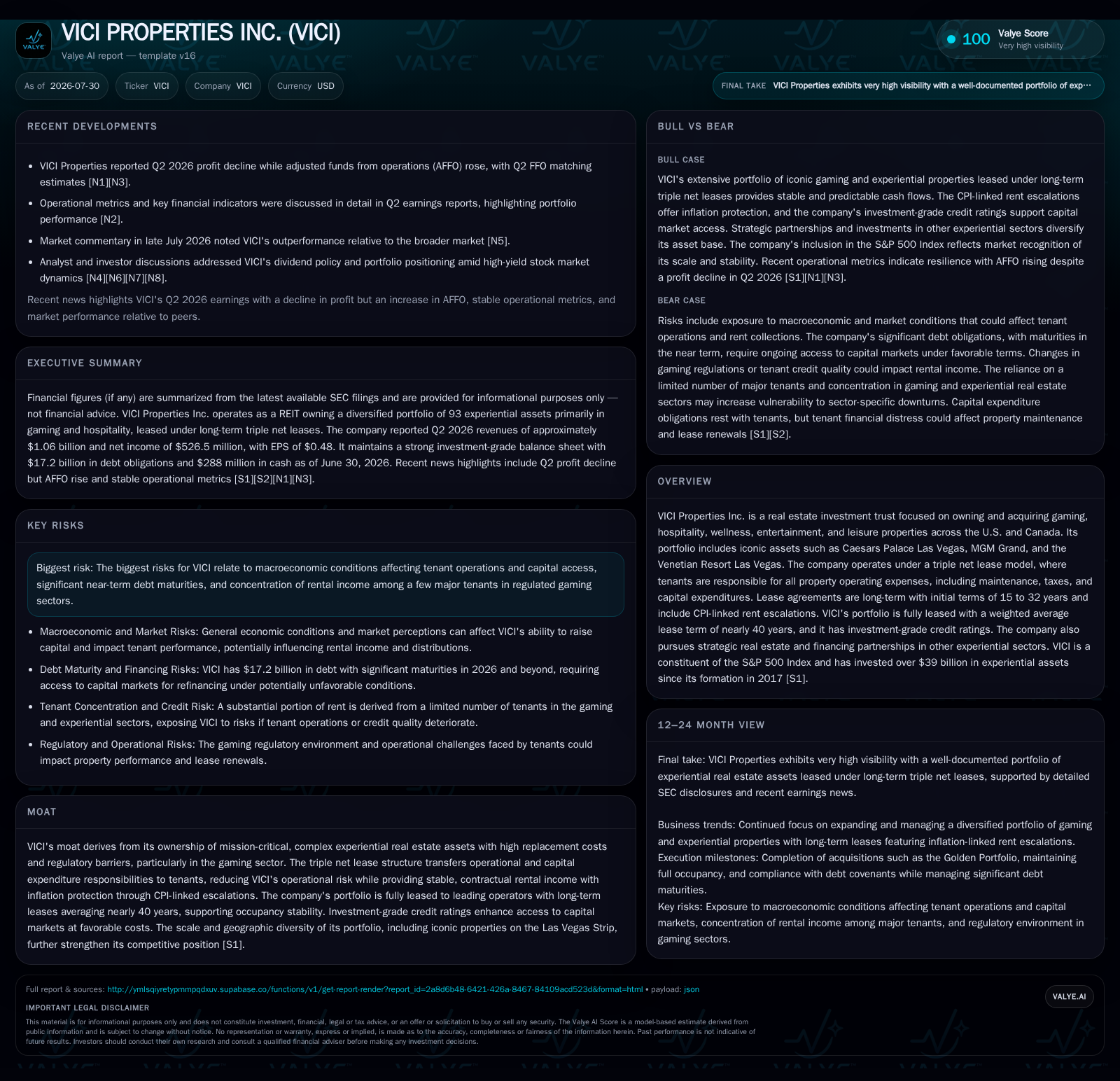
VICI Properties reported maintaining 100% occupancy with a weighted average lease term approaching 40 years as of Q2 2026, underscoring stable contractual rental income under triple net leases that transfer capital expenditure burdens to tenants [S2]. The company faces material refinancing needs totaling $1.75 billion in senior unsecured notes due in the second half of 2026, representing a key execution risk point for liquidity management [S2][S3][F1]. VICI's investment-grade credit rating and portfolio diversification across premier gaming and experiential real estate assets provide competitive advantages relative to peers such as Gaming and Leisure Properties Inc. [S1]. Growth opportunities stem from strategic experiential asset investments beyond gaming, while concentrated tenant exposure and macroeconomic uncertainties warrant ongoing monitoring [S1][S2].
Q2 Results Spotlight: Lease Portfolio Quality Amid Debt Maturities
In its Q2 2026 report filed July 29, VICI Properties reaffirmed its fully leased position across its gaming and experiential real estate portfolio with a consistent weighted average lease term (WALT) of about 39.6 years, establishing one of the longest-duration lease portfolios among REIT peers in this subsector [S2][S1]. This exceptionally long WALT provides significant visibility into rental income streams and shields the company from sudden revenue discontinuities typically associated with shorter leases.
Importantly, the triple net lease structure places responsibility for property operating expenses—including maintenance, property taxes, insurance, and capital expenditures—squarely on tenants. This arrangement materially reduces VICI’s operational risk while sustaining high-quality net operating income (NOI) margins given minimal landlord-managed expenses [S1][S2]. Additionally, leases feature rent escalations linked to the Consumer Price Index (CPI), providing an embedded hedge against inflation that bolsters rental income growth prospects.
However, this operational stability contrasts with material financial obligations posed by upcoming debt maturities. As of June 30, 2026, VICI reported approximately $17.2 billion in total debt outstanding with significant near-term principal repayments: $500 million due September 1, 2026, followed by $1.25 billion maturing December 1, 2026 [S2][F1]. These maturities amount to roughly $1.75 billion within just six months and represent a key balance sheet pressure point where refinancing execution will be critical for maintaining liquidity and credit flexibility.
Earnings Model Anchored on Triple Net Leases With Inflation Protection
VICI's revenue largely derives from contractual rental payments anchored by triple net leases whereby tenants absorb essentially all property-level operational costs including CapEx [S1]. This structural feature transfers asset-level volatility away from VICI toward established operators within the regulated gaming sector known for holding strategic control over their properties
The CPI-linked rent escalation clauses are invaluable in preserving real rental income purchasing power amid inflationary periods—a notable advantage given the capital-intensive nature of owning specialized experiential properties such as casinos and resorts with elevated replacement costs. The exceptionally long WALT—nearly four decades—underscores the durable visibility into contractual cash flows absent immediate re-leasing risk or renegotiation exposure common in shorter leases.
This revenue model aligns with peer gaming REITs like Gaming and Leisure Properties Inc., which also employ triple net structures with inflation tie-ins but where VICI differentiates through slightly longer lease tenor and geographic spread including Canadian assets. Tenant quality is paramount here since operational performance by lessees directly affects their ability to meet rental obligations under leases with minimal recovery options due to landlord operational passivity.
Competitive Footprint: Position Among Gaming-Focused Experiential REITs
Within its experiential real estate niche focused on gaming properties primarily across the U.S. and Canada, VICI’s portfolio includes marquee assets such as Caesars Palace Las Vegas, MGM Grand, and the Venetian Resort—all high-profile destinations driving consistent consumer engagement [S1]. These assets' scale and brand strength contribute defensively to occupancy and tenant retention dynamics compared to smaller or less diversified competitors.
From a credit perspective, VICI maintains investment-grade ratings affording access to capital markets at relatively favorable interest costs—an essential enabler for managing the substantial debt maturities looming through late 2026 into early 2027 [S1]. Its portfolio diversity across urban destination markets also mitigates geographic concentration risks that some peers experience more acutely.
Tenant concentration remains a structural characteristic inherent to gaming REITs given regulatory licensing barriers limiting lessee alternatives; however, large-scale operators leasing from VICI demonstrate strong credit profiles stemming from diversified casino operations that reduce single-property risk exposures [S1]. Compared with peers like Gaming & Leisure Properties Inc., which share similar leasing structures but operate fewer non-gaming experiential assets, VICI’s broader partnerships in wellness and leisure furnish incremental diversification benefits.
Growth Opportunities Via Strategic Acquisitions and Partnerships
Beyond traditional gaming real estate ownership, VICI pursues growth through selective investments in other experiential sectors such as wellness resorts (e.g., Canyon Ranch), entertainment venues (e.g., Lucky Strike Entertainment), and golf facilities adjacent to high-value urban assets—all underpinned by strategic real estate or financing partnerships [S1]
These ventures allow extension into attractive leisure segments outside regulatory-intensive casino domains while leveraging VICI's expertise in long-duration leasing with operational risk transfer. Additionally, real estate debt investments facilitate optionality to convert loans into underlying properties aligning growth with capital preservation.
Such diversification into complementary experiential asset classes is somewhat uncommon among pure-play gaming REIT peers who predominantly focus on casino-centric portfolios—offering VICI a differentiated growth runway pending favorable market conditions.
Risk Factors: Tenant Concentration, Refinancing Horizon, and Macroeconomic Sensitivities
Notwithstanding structural strengths in its leased portfolio quality and lease mechanics, VICI faces notable risks centered on tenant concentration—with major tenants comprising a significant portion of rental income—and overall exposure to regulated gaming sectors vulnerable to economic cycles affecting consumer discretionary spending patterns [S1][S2]
More imminent is refinancing risk tied to approximately $1.75 billion senior unsecured note maturities during H2 2026 at prevailing interest rates that may require increased coupon costs or alternative funding sources if market liquidity tightens [S2][F1]. The company’s ability to sustain investment-grade ratings will be pivotal in accessing cost-effective capital amid interest rate volatility.
Further macroeconomic considerations include potential declines in tenant operating cash flows during downturns that could pressure rent collections despite triple net safeguards since tenant credit quality ultimately influences contract fulfillment capability. Regulatory shifts impacting gaming operations could indirectly affect tenants’ financial health though direct impact on landlords is muted due to lease pass-through structures.
What To Monitor Next: Execution on Debt Rollovers & Lease Renewal Momentum
Critical upcoming milestones include successful refinancing or repayment strategies for the senior notes due in September and December 2026—the sequencing and pricing of which will materially impact liquidity profiles going into fiscal year-end [S2][N1]. Investors should monitor commentary on capital market access conditions reflecting broader REIT market sentiment as well as updated guidance on interest expense expectations linked to new borrowings.
Equally important are indicators around tenant lease renewal rates or any renegotiations that might reveal changes in market perceptions about balance sheet viability or asset desirability after nearly four decades of initial lease terms have elapsed for parts of the portfolio. While renewals historically have been stable given asset quality and tenant incentives aligned through capital expenditure commitments under leases, any deviations would bear close watching given their direct influence on future cash flow certainty.
Economic demand signals pertaining to leisure consumer spending trends can also serve as early markers for tenant performance outlooks influencing contract adherence over time.
Financial Profile Discussion: Balance Sheet Strength Versus Capital Market Dependence
As of June 30, 2026, VICI reported approximately $288 million in cash reserves against roughly $17.2 billion of gross debt outstanding resulting in net debt near $16.9 billion—a common leverage configuration within large-scale gaming-oriented REITs operating heavy asset bases requiring substantial external financing [F1]. These figures underscore dependence on timely refinancing actions given concentrated principal repayments totaling $500 million due September 2026 followed by $1.25 billion December 2026 noted earlier [S2][F1].
The company’s strategy prudently balances long-term contractual revenue visibility against capital market reliance inherent in REIT structures requiring periodic public financings or credit facility draws. Maintaining adequate liquidity buffers coupled with staggered maturity schedules beyond immediate horizons remains key mitigants going forward.
This analysis integrates recent quarterly disclosures via Form 10-Q alongside supplementary event filings outlining both the firm’s stable operational footing via triple net lease portfolios anchored by leading tenants with inflation protection clauses as well as meaningful near-term liabilities intrinsic to its capital structure necessitating active refinancing management amidst evolving macroeconomic realities. VICI's wide geographic footprint encompassing marquee U.S. casinos combined with strategic diversification into experiential sectors beyond gaming highlight its competitive positioning relative to established gaming REIT peers while underlining areas warranting close scrutiny related primarily to concentrated tenant exposure and balance sheet leverage dynamics.
Disclaimer: This is research-only, informational analysis and not investment advice. It may include AI-generated interpretation and general industry context. Always verify important details using primary sources.

Comments