
Cintas Expands Market Leadership with UniFirst Acquisition Amid Margin Improvement
Cintas leverages organic growth, operational efficiencies, and a strategic $5.5 billion merger to strengthen its dominant position in specialty business services.
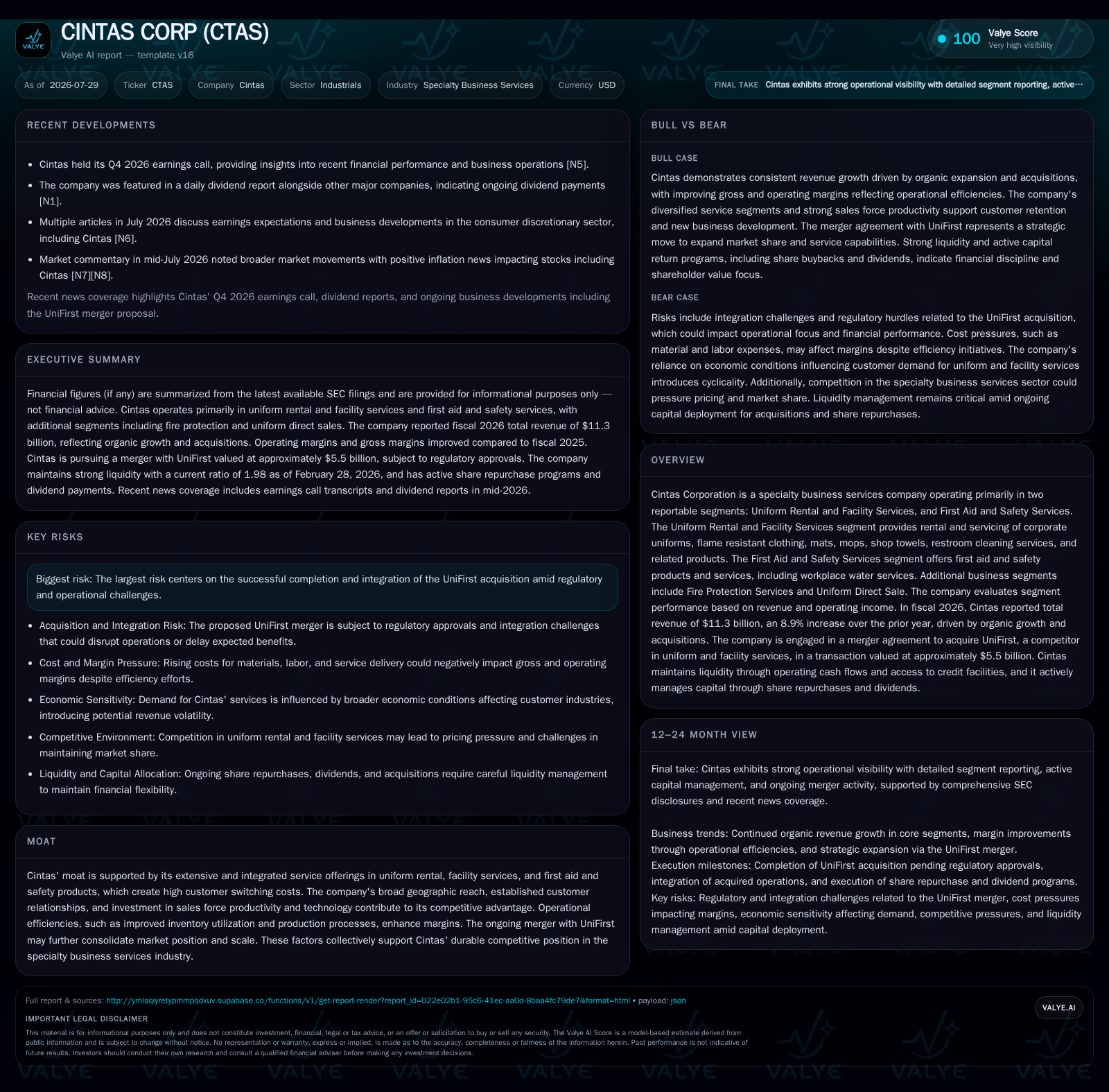
Cintas Corporation reported solid fiscal 2026 results highlighted by an 8.9% revenue increase driven by organic expansion and acquisitions, alongside modest margin improvement across its core segments. The company’s integrated service model—spanning uniform rental, facility services, and first aid and safety—supports high switching costs and customer retention amid competitive pressures. The announced $5.5 billion acquisition of UniFirst, pending regulatory approval, represents a significant consolidation move with potential to enhance scale economies. Execution risk remains on integration and regulatory hurdles, but operational metrics suggest effective leverage of Cintas’ broad service footprint and technology investments.
Recent Operating Update: Fiscal Q3 2026 Highlights
Cintas' latest quarterly filings through February 28, 2026 reveal continued momentum in top-line expansion driven by steady organic revenue growth augmented by several small-scale acquisitions across its segments [S2]. Notably, the company has been actively managing its portfolio of internally developed software assets under recently updated accounting standards (ASU 2025-06) which modernize capitalization practices but do not materially affect core cash flow dynamics [S2]. This subtle shift allows more judgment-based capitalization for internal-use software costs.
A major development disclosed in the latest annual form is the March 10, 2026 merger agreement to acquire UniFirst in a transaction valued at about $5.5 billion [S1]. UniFirst operates in overlapping markets—uniform rental, facility products servicing, as well as first aid and safety supplies—directly complementing Cintas’ established lines of business. The deal offers the prospect of significant market share gains and scale synergies once key regulatory hurdles such as HSR approvals are cleared.
Business Model: Recurring Contractual Revenue Anchored by Integrated Services
Cintas operates primarily through two reportable segments: Uniform Rental and Facility Services (about three-quarters of total revenue) coupled with First Aid and Safety Services [S1]. These segments generate revenue mainly via recurring service contracts featuring rental agreements (uniforms, mats, towels) combined with value-added facility cleaning supplies and safety product sales typically delivered through frequent scheduled route-based visits to business customers.
The Uniform Rental segment’s recurring nature stems from long-term contracts that bundle garment leasing with maintenance services including laundering and repairs—a combination that establishes high customer switching costs due to physical asset dependencies and service reliability requirements [S1][S2]. This route-based delivery system also enables upselling ancillary products like flame resistant clothing or restroom supplies.
The First Aid segment focuses on direct sale of safety kits along with workplace water services; these offerings benefit from growing regulatory mandates on workplace safety compliance which drive steady demand increases [S1]. Combined service integration enhances Cintas’ value proposition relative to peers who may only compete in narrower categories.
Revenue is driven by contract volume (number of units rented or sold), average pricing per unit or service bundle, contract renewal rates reflecting customer retention efficacy, and cross-selling success on expanded product sets within existing accounts.
Margins benefit from efficient inventory management (maximizing utilization rates of rental stock), optimized delivery route productivity reducing logistics costs per unit serviced, scale economies in laundering operations, plus continuing technology investments that streamline service scheduling and asset tracking [S1][S2]
Industry Context and Competitive Position
Cintas competes within the specialty business services sector where companies supply outsourced uniforms, facility maintenance services, safety products, and related solutions on a B2B basis. Peers include UniFirst (soon-to-be merged), Aramark (larger diversified player), G&K Services (uniform-centered provider), ServiceMaster (facility cleaning focus), and Rentokil Initial (integrated services) among others.
The sector is marked by moderately high fragmentation but significant concentration among top players who leverage scale to offer integrated bundled solutions that smaller regional firms struggle to match consistently. Cintas’ breadth across multiple service categories helps establish durable competitive moats by locking in customers who find switching providers disruptive due to bundled contracts involving multiple physical assets and ongoing servicing schedules.
Its geographic reach covers a vast North American footprint enabling local presence combined with centralized processing facilities for garment cleaning—an operational advantage versus smaller players limited to niche regions or single-service lines.
Growth Drivers
Several factors underpin Cintas’ ongoing growth trajectory:
- Contract Expansion: Winning new customers adds incremental recurring revenue streams while extending average contract length stabilizes future cash flows.
- Cross-Selling: Deepening penetration within existing customers by introducing additional facility services or first aid offerings improves wallet share per account.
- Geographic Expansion: Scaling penetration into under-served U.S., Canadian, or Mexican markets widens addressable opportunity.
- Regulatory Tailwinds: Heightened workplace safety rules fuel demand for compliant first aid kits and related consulting services.
- Mergers & Acquisitions: Acquiring smaller local providers or major competitors like UniFirst accelerates market consolidation producing scale economies.
- Technological Innovation: Investment in systems for inventory tracking, route planning automation, digital customer engagement elevate both margins and client satisfaction.
- Economic Growth Correlation: Rising industrial activities generally boost demand for outsourced uniforms/facility support used heavily in manufacturing, food processing, healthcare, hospitality sectors.
Risks and Constraints
While the fundamentals appear robust, several risks warrant attention:
- Merger Integration Risk: Combining operations with UniFirst requires alignment of IT systems, salesforces, route logistics, corporate cultures without disrupting customer experience or incurring excessive transitional costs [S1].
- Regulatory Approvals Uncertainty: The proposed deal must clear antitrust waiting periods; outcomes could delay or impair completion [S1].
- Cost Inflation Pressures: Trending wage inflation in labor-intensive routes plus rising utilities/chemical supplies could compress margins if not offset by productivity gains or price adjustments.
- Competitive Pricing Pressure: Regional firms may undercut pricing selectively; however, limited breadth restrains full-service replication.
- Inventory Management Complexity: Maintaining optimal rental inventory turnover while avoiding excess stock aging imposes operational discipline challenges.
- Route-Based Service Dependency: Transportation cost spikes or logistical disruptions materially impact cost structure given distributed delivery model.
- Safety Product Liability Risks: Defects or noncompliance claims could trigger reputational damage or legal exposure especially in First Aid segment.
What to Watch Next
Key milestones signaling progress include:
- Regulatory clearance status updates relating to UniFirst acquisition completion timeline will be critical for near-term strategic direction [S1].
- Post-merger integration benchmark disclosures regarding synergies realized in operating margins or cost savings would confirm deal rationale execution quality.
- Quarterly updates on customer retention rates within existing segments provide insight into competitive positioning sustainability.
- Segment-specific gross margin trends indicate operational leverage trajectory especially under labor cost pressures [S1].
- Announcement of further acquisitions or geographic expansions can signal sustained consolidation strategy execution.
Financial Profile Discussion
As of February 28, 2026, Cintas maintains a solid liquidity footing reflected by a current ratio near 2.0 (current assets $3.60 billion vs current liabilities $1.82 billion), providing ample coverage for short-term obligations [F1]. Cash balances stand at roughly $183 million while total debt approximates $2.43 billion dominated by senior notes bearing fixed interest rates spanning maturities from 2027 through 2037 [F1][S2].
Interest expense trends remain stable at about 0.9% of revenue contributing to predictable financial costs supportive of incremental borrowing capacity if needed for acquisition funding [S1][S2]
Capital expenditures focus primarily on expanding laundry plant capacity and upgrading delivery fleet technologies essential for sustaining service quality amid growth pressures [S2]. Operating cash flows remain strong benefiting from stable collections on recurring contracts.
This financial profile supports flexibility for the sizeable UniFirst transaction valuation ($5.5 billion), though successful capital structure management post-close will be crucial to maintain investment-grade credit standing and safeguard free cash flow generation margins post-integration.
This analysis synthesizes recent SEC filings through April-July 2026 alongside industry context framing from specialized business service sectors without extending into speculative forecasts or undisclosed proprietary information.
Disclaimer: This is research-only, informational analysis and not investment advice. It may include AI-generated interpretation and general industry context. Always verify important details using primary sources.

Comments