
Q2 Holdings Advances SaaS Growth and Innovation Amid Increasing Regulatory and Cybersecurity Demands
Q2 Holdings deepens its cloud-based digital banking platform with expanded R&D investments to address evolving fintech demands and regulatory imperatives.
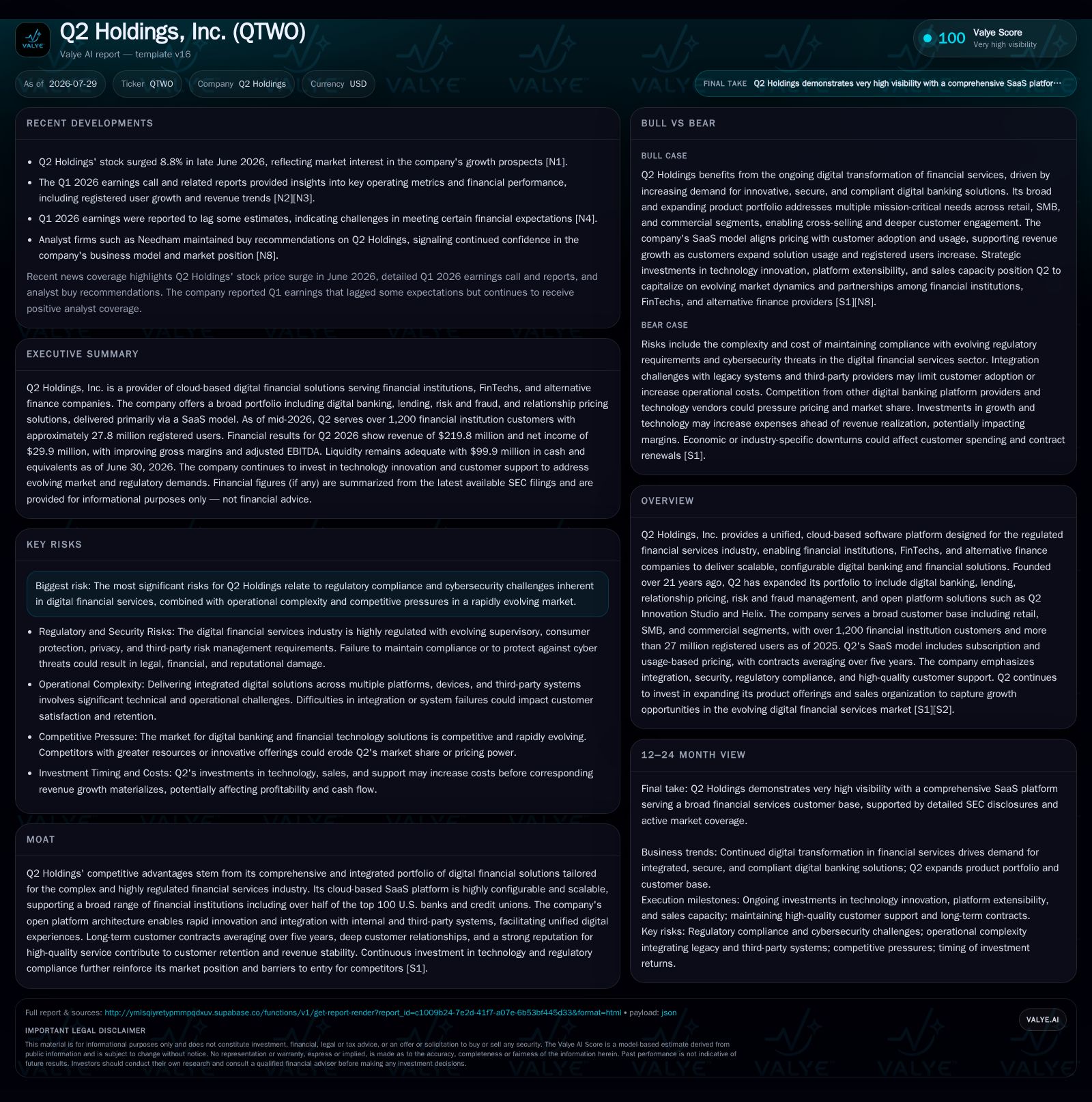
In Q2 2026, Q2 Holdings reinforced its position as a leading SaaS provider for regulated financial services through increased R&D spending focused on AI and platform enhancement, supporting scalable, compliant digital banking solutions. The company serves over 1,200 financial institutions, including more than half of the top 100 U.S. banks and credit unions, with a broad portfolio spanning digital banking, lending, and risk management. While facing sector-wide cybersecurity and regulatory compliance challenges, Q2’s open platform architecture and long-term contract model underpin resilient revenue streams. Key growth drivers include expanding FinTech adoption, regulatory-driven digitization, and continuous innovation in AI-enabled fraud prevention.
Recent Operating Update: Strategic R&D Investment during Demand for Digital Financial Innovation
Q2 Holdings’ latest quarterly filing for Q2 2026 underscores continued operational emphasis on accelerating product innovation within a complex regulatory environment. The company increased its research and development (R&D) expenses primarily due to an $8.2 million rise in personnel costs along with higher allocated overhead including AI usage expenses—reflecting ramped-up investments to enhance solution capabilities such as automation and analytics [S2]. This deliberate scaling of its engineering organization aims to sustain competitive differentiation through faster deployment of new features on its modular cloud-native platform.
Simultaneously, Q2 navigates cyclical fluctuations in revenue tied to timing variations in customer implementations driven by sales seasonality and internal capacity constraints. This pattern is common among SaaS providers with sizable enterprise deployments where onboarding new clients depends heavily on customized integration timelines [S2]. However, the increasing shift toward usage-based billing components within contracts provides some mitigation by linking revenue growth more directly to client transaction volumes.
Business Model: Configurable SaaS Platform Serving Regulated Financial Institutions
Q2 operates a subscription- and usage-based software-as-a-service (SaaS) business model focused exclusively on the regulated financial services sector—including regional banks, credit unions, FinTech firms, and alternative finance companies seeking embedded banking solutions [S1]. Revenue is generated primarily through long-term contracts (generally spanning five years or more), delivering stable recurring income augmented by 'usage fees' aligned with transaction processing volumes.
At its core is a highly configurable digital banking platform that integrates seamlessly into customers' legacy core systems while providing omnichannel engagement capabilities for retail consumers and business clients. The company’s extensive product portfolio now comprises not only digital banking but also lending solutions, relationship pricing modules designed to optimize commercial client revenue, sophisticated risk and fraud management tools enhanced by AI analytics, plus open APIs via offerings like Q2 Innovation Studio facilitating ecosystem partnerships [S1]
The broad base of over 1,200 financial institution customers includes more than half of the top U.S. banks and credit unions by asset size—a testament to the platform's scalability and regulatory robustness. Their end users number over 27 million account holders who transacted more than $4 trillion through the system in 2025 alone [S1]. These customer metrics emphasize both deep market penetration in community-level finance as well as substantial scale among larger institutions.
Industry Structure and Competitive Positioning
Within the cloud-based financial services software sector—characterized by rapid digitization trends driven by FinTech disruption—Q2 occupies a distinctive niche combining domain-specific SaaS expertise with a security-first design philosophy tailored for strict regulatory requirements. Unlike generalist cloud vendors or core banking incumbents focusing solely on back-end processing or payments infrastructure (e.g., Fiserv or Jack Henry), Q2 emphasizes unified customer engagement platforms that cover front-end digital experiences together with embedded risk controls.
The company's open architecture allows rapid integration with third-party applications—a critical advantage as institutions require flexible ecosystems rather than monolithic solutions. This contrasts somewhat with traditional vendors who may face slower innovation cycles due to legacy code bases or proprietary systems. Peers like nCino also compete in cloud banking for commercial lending but typically address different verticals or focus intensively on specific loan workflows rather than full spectrum digital banking.
Among competitive considerations are high barriers to entry given regulatory complexity and customer lock-in through long-duration contracts combined with customized implementation approaches. Coupled with a growing investment cycle into AI-powered fraud prevention capabilities—an area of acute importance given increasing cyber threats—Q2's positioning appears relatively robust against emerging fintech competitors lacking comparable scale or compliance expertise.
Growth Drivers: Digital Transformation Momentum Meets Regulatory Demand
Industry-wide growth catalysts continue to favor Q2’s accelerated innovation agenda:
- Increasing demand from banks and credit unions to modernize aging infrastructure via cloud-native SaaS platforms to support multichannel customer engagement.
- Rising fintech presence requiring embedded digital banking capabilities integrated into broader ecosystems.
- Expanding transactional volume due to digitization of payments amplifies usage-based revenue potential.
- Heightened regulatory scrutiny pushing institutions towards platforms offering comprehensive compliance management alongside agile risk controls.
- Advancements in artificial intelligence underpinning enhanced automation across onboarding, lending decisions, fraud detection, and personalized pricing strategies.
These drivers are reflected internally at Q2 through expanded R&D headcount focused on AI-related software components as well as improved deployment times for new features enabled by their modular product design [S2]. The company’s broad client base spanning retail consumers through small businesses to commercial segments further diversifies exposure across digital adoption curves.
Risks and Watchpoints: Regulatory Complexity and Cybersecurity Challenges
Notwithstanding these growth opportunities, risks persist notably from evolving supervisory requirements impacting development priorities and potential cost structures. Regulatory changes may necessitate ongoing enhancements or redesigns of functionality to maintain certification or compliance status across multiple jurisdictions [S1]. Likewise cybersecurity remains a paramount concern; Q2 maintains an enterprise-wide risk management framework led by seasoned executives including a Chief Risk Officer (CRO) overseeing identification of cyber threats [S1]. Despite this governance rigor, breaches or vulnerabilities within either Q2's own infrastructure or those of integrated third-party vendors could materially disrupt operations or damage reputation.
Additionally, significant implementation complexities inherent in integrating with diverse legacy core banking systems present operational execution risks influencing time-to-market for new clients or upgrades. Maintaining platform uptime amid increasing load while rolling out continuous innovations is another critical metric affecting customer satisfaction—factors typical for large-scale SaaS providers servicing financial institutions.
Competitive pressures from nimble fintech startups targeting specific niche functionalities or user experience innovations remain a background threat but have yet to erode Q2’s established client relationships anchored by multi-year contracts averaging over five years [S1]. Nonetheless vigilance around contract renewal rates will be essential monitoring data points moving forward.
What to Watch Next
Key near-term milestones include monitoring Q3 execution against the backdrop of elevated R&D spend—to validate that investments translate into faster feature deployment cycles without disproportionately increasing operating expense ratios. Metrics such as net retention rates within installed customers will indicate success in cross-selling broader product suites beyond the core digital banking modules.
Further updates on transaction volumes processed can signal adoption momentum particularly if usage-based revenues gain share relative to fixed subscriptions. Management commentary around evolving regulatory impacts or any shifts in cybersecurity posture will be important given sensitivity of client trust in this sector.
Finally, market activity such as strategic partnerships facilitated through the open platform ecosystem may provide forward-looking insight into growth avenues beyond direct financial institutions—including embedded finance within alternative finance companies or emerging FinTech verticals.
Financial Profile Discussion
As of June 30, 2026, Q2 Holdings held nearly $100 million in cash equivalents with no reported debt obligations highlighting a solid liquidity position that underpins its operational flexibility [F1]
In summary, Q2 Holdings operates from a position of financial strength enabling sustained investment into innovation while maintaining resilience amidst sector-specific regulatory complexities. Its embedded presence within large regulated financial institutions combined with ongoing technology enhancements centered on AI-driven analytics offers a differentiated value proposition aligning well with evolving industry demands.
Disclaimer: This analysis is based solely on publicly available information including SEC filings dated up to July 29, 2026. It does not constitute investment advice nor an endorsement of any securities mentioned herein.
Disclaimer: This is research-only, informational analysis and not investment advice. It may include AI-generated interpretation and general industry context. Always verify important details using primary sources.

Comments